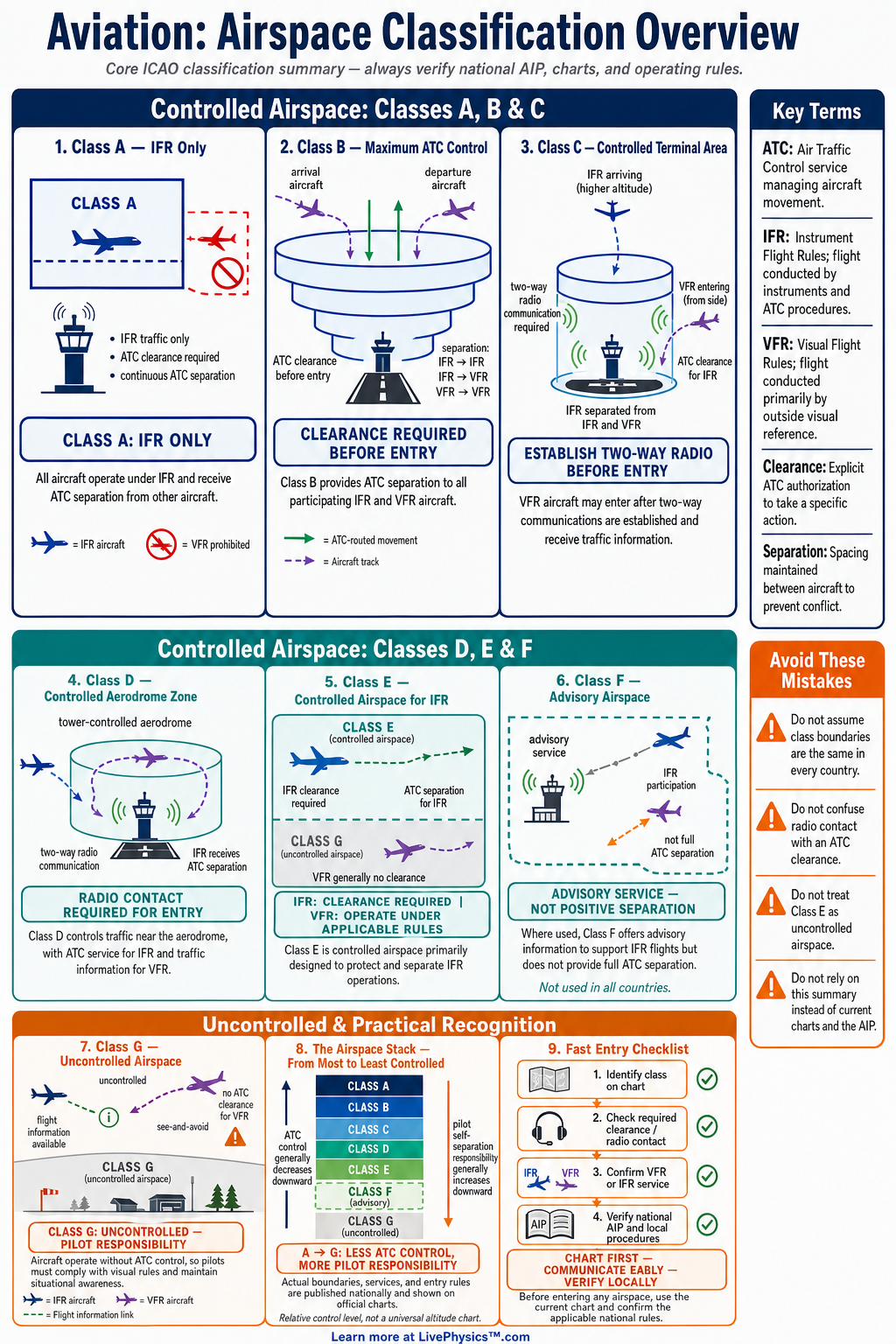
This cheat sheet explains the ICAO airspace classification system from Class A through Class G. Pilots use these classes to understand which flights may enter an area, what ATC services are available, and what responsibilities remain with the pilot. It is a practical reference for flight planning, chart reading, radio preparation, and aviation theory study.
Airspace classes range from highly controlled Class A to uncontrolled Class G. The key differences involve IFR and VFR access, ATC separation, traffic information, and clearance requirements. National aviation authorities may apply the ICAO framework differently, so pilots must always check the relevant aeronautical information publication and current charts.
Key Facts
- ICAO recognizes seven airspace classes, named Class A through Class G.
- Class A airspace permits IFR flights only and provides ATC separation between all aircraft.
- Class B airspace permits IFR and VFR flights and provides ATC separation between all aircraft.
- In Class C airspace, ATC separates IFR aircraft from IFR and VFR aircraft, while VFR aircraft are separated from IFR aircraft.
- In Class D airspace, ATC separates IFR aircraft from other IFR aircraft and provides traffic information to IFR and VFR flights.
- In Class E airspace, IFR flights receive ATC separation from other IFR flights, while VFR requirements depend on national rules.
- Class F airspace provides an advisory service where established, but it is not controlled airspace.
- Class G airspace is uncontrolled, so pilots remain responsible for collision avoidance and compliance with applicable rules.
Vocabulary
- Airspace classification
- A system that divides airspace into categories based on permitted flights and the level of air traffic service provided.
- Controlled airspace
- Airspace where air traffic control provides specified services and may require pilots to obtain an ATC clearance.
- IFR
- Instrument Flight Rules are procedures used to operate an aircraft mainly by reference to instruments and ATC clearances.
- VFR
- Visual Flight Rules are procedures used when a pilot operates with required visual references and weather conditions.
- Separation
- An ATC service that keeps aircraft apart by applying approved vertical, lateral, or longitudinal standards.
- Flight information service
- A service that provides useful information to help pilots conduct flights safely and efficiently.
Common Mistakes to Avoid
- Assuming every country uses each ICAO class in exactly the same way is wrong because States can modify implementation, entry requirements, and service details.
- Treating Class G as having no rules is wrong because pilots must still follow weather minima, right of way rules, altitude rules, and published procedures.
- Confusing traffic information with ATC separation is wrong because traffic information alerts pilots, while separation requires ATC to keep aircraft apart by approved standards.
- Reading only the airspace class letter is wrong because a charted area also has boundaries, floors, ceilings, frequencies, and time limits that affect a flight.
- Assuming VFR flights receive the same service as IFR flights is wrong because the level of separation and traffic information varies by airspace class.
Practice Questions
- 1 A controlled airspace sector extends from 2,500 feet to 10,500 feet. What is the vertical depth of the sector in feet?
- 2 A Class C shelf has a floor at 4,000 feet and a ceiling at 8,000 feet. An aircraft at 6,500 feet is how many feet above the floor and how many feet below the ceiling?
- 3 Which ICAO airspace class permits IFR flights only and provides ATC separation between all aircraft?
- 4 Explain why a pilot must review the national aeronautical information publication even after learning the general ICAO rules for Classes A through G.
Understanding Airspace Classification Overview
ICAO airspace classification gives pilots a common way to understand who may fly in an area and what service air traffic control provides. The classes run from A through G, but a class letter does not replace careful chart reading.
Each State decides where classes begin, end, and apply. Pilots must check published lateral boundaries, vertical limits, operating hours, radio frequencies, weather minima, and special procedures before flight.
Classes A through E are controlled airspace, although the services and entry conditions change from class to class. Class A permits IFR flights only. Classes B, C, D, and E can include IFR and VFR operations, subject to the rules published by the State.
ATC separation is greatest in Class A and Class B. As the classification moves toward Class E, pilots take more responsibility for seeing and avoiding other aircraft while ATC support becomes less complete.
Classes F and G are outside the normal controlled airspace structure. Class F provides an advisory service where it is established, and Class G is uncontrolled airspace. Uncontrolled does not mean unregulated or risk free.
Pilots still follow weather minima, right of way rules, altitude rules, radio requirements where published, and all applicable national regulations. Flight information services can still provide valuable weather, traffic, aerodrome, and operational details.
Separation and traffic information are different services. Separation means ATC keeps aircraft apart using approved standards. Traffic information tells a pilot about observed or reported traffic so the pilot can look out and take action if necessary.
In Class C, IFR aircraft are separated from IFR and VFR aircraft. VFR aircraft are separated from IFR traffic and receive traffic information about other VFR traffic. These differences affect pilot workload, route planning, lookout, and radio expectations.
Study an airspace chart by locating the class letter first, then reading the floor and ceiling of the airspace. A label may show that a controlled area starts above a stated altitude, while another may show a shelf that begins at a different height.
Next, identify whether the intended flight is IFR or VFR and review the applicable entry and communication requirements. The safest study habit is to connect every airspace class with three ideas, permitted flight rules, ATC service, and pilot responsibility.