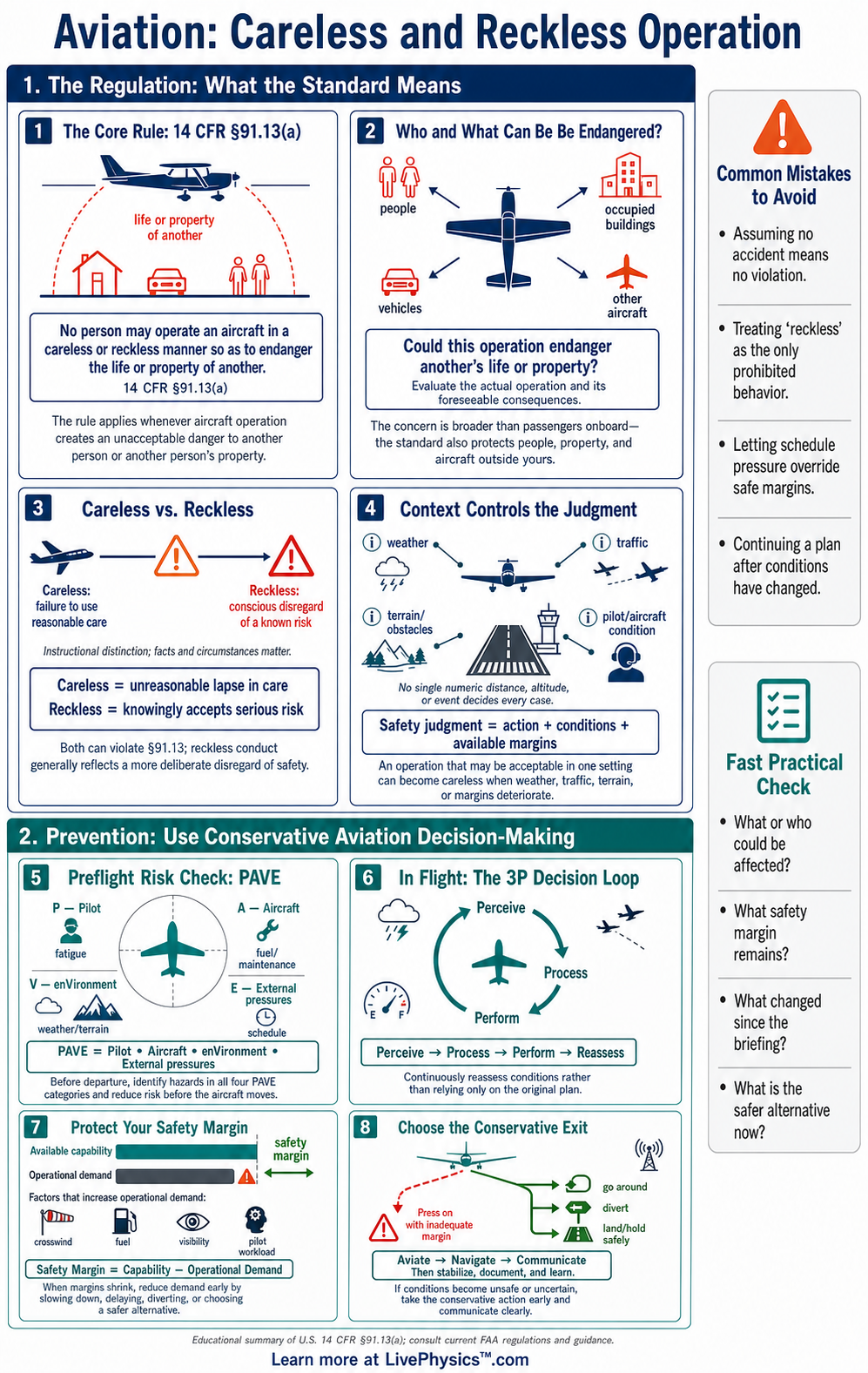
Careless and reckless operation is a central aviation safety and legal topic. Pilots must understand that a flight can violate regulations even when no accident occurs. This cheat sheet explains the rule, the difference between careless and reckless behavior, and the factors used to judge an operation.
It helps students connect sound aeronautical decision making with their legal duty as pilot in command.
The main U.S. rule is 14 CFR 91.13, which prohibits operating an aircraft carelessly or recklessly so as to endanger the life or property of another. Careless conduct usually involves poor judgment, inattention, or failure to use reasonable care. Reckless conduct involves a conscious disregard for a known and substantial risk.
The rule applies to every phase of flight, including planning, taxi, takeoff, landing, and low-altitude operations.
Key Facts
- Under 14 CFR 91.13, no person may operate an aircraft in a careless or reckless manner so as to endanger the life or property of another.
- Careless operation means failing to use the reasonable care expected from a prudent pilot in similar circumstances.
- Reckless operation means consciously disregarding a known and substantial safety risk.
- A violation of 14 CFR 91.13 can occur even when no accident, injury, or property damage occurs.
- The pilot in command is directly responsible for and is the final authority as to the operation of the aircraft under 14 CFR 91.3.
- Legal minimums are not always safe minimums, because weather, traffic, terrain, aircraft condition, and pilot experience can require greater margins.
- Careless or reckless operation can occur during preflight planning, taxi, takeoff, cruise, approach, landing, or ground handling.
- FAA enforcement may rely on evidence such as air traffic records, witness statements, video, aircraft data, and the pilot's own actions.
Vocabulary
- Careless operation
- Operating an aircraft without the reasonable care that a prudent pilot would use in the same situation.
- Reckless operation
- Operating an aircraft while knowingly disregarding a substantial and unjustifiable risk to people or property.
- Endanger
- To expose a person or property to a meaningful risk of harm or damage.
- Pilot in command
- The pilot who has final authority and direct responsibility for the operation and safety of the aircraft.
- Aeronautical decision making
- A systematic process pilots use to assess risks and make safe operational choices.
- Enforcement action
- An FAA response to an alleged regulatory violation that may include investigation, counseling, or certificate action.
Common Mistakes to Avoid
- Assuming no accident means no violation is a mistake because 14 CFR 91.13 can apply when an operation creates danger without causing damage.
- Treating legal minimums as automatic proof of safety is a mistake because changing conditions may require larger safety margins than the regulation states.
- Calling every error reckless is a mistake because recklessness involves knowingly disregarding a substantial risk, while carelessness can result from poor attention or judgment.
- Blaming passengers, weather, or schedule pressure is a mistake because the pilot in command remains responsible for the safety of the operation.
- Focusing only on airborne actions is a mistake because unsafe taxiing, ramp behavior, and ground operations can also endanger people or property.
Practice Questions
- 1 A pilot taxis at 35 knots through a crowded ramp area despite limited visibility from parked aircraft. Identify the regulation that may apply and explain why the operation could be careless.
- 2 A pilot sees that the fuel quantity is 12 gallons, and the aircraft burns 10 gallons per hour. The planned flight time is 1 hour 20 minutes. Calculate the planned fuel use and explain why the fuel plan creates a safety concern.
- 3 A pilot intentionally performs a very low pass over a group of friends at a private field after being told that people are near the runway. Explain why this behavior may be considered reckless rather than merely careless.
- 4 Explain why a pilot can comply with a published altitude or visibility minimum and still be operating carelessly in the actual conditions.
Understanding Careless and Reckless Operation
Federal aviation safety rules do not list every unsafe act a pilot might perform. Instead, 14 CFR 91.13 provides a broad standard that applies whenever an operation endangers another person or property. This makes the rule important in many situations, from an unsafe taxi speed to an aggressive maneuver near homes.
The FAA can evaluate the complete situation rather than relying only on a narrow technical limit. A pilot may meet one published minimum and still operate carelessly if the conditions demand greater caution.
Careless operation generally means that a pilot did not use the level of care a prudent pilot would use in similar conditions. Examples can include failing to obtain enough fuel, taxiing too fast in a congested ramp area, or continuing toward deteriorating weather without a safe plan. The pilot may not intend harm.
Even so, poor preparation or weak judgment can create an unreasonable risk. Training, experience, weather, aircraft condition, airport activity, and available information all affect what reasonable care looks like.
Reckless operation is more serious because it involves knowingly accepting a substantial and unjustifiable risk. A pilot who understands that an action is dangerous but performs it anyway may be acting recklessly. Examples can include intentional low passes over people, unsafe aerobatic maneuvers, or flying after ignoring clear evidence that the aircraft is unairworthy.
Recklessness often shows a deliberate choice, not merely an oversight. The distinction matters because intentional disregard for safety can lead to stronger enforcement action.
This rule protects people both inside and outside the aircraft. It covers passengers, other pilots, airport workers, people on the ground, buildings, vehicles, and other property. A flight does not need to result in damage for the FAA to investigate a possible violation.
Near misses, credible witness reports, video evidence, air traffic records, and pilot statements can all show that an operation created danger. Local noise concerns or public complaints can also bring attention to unsafe low-level flight.
Students should focus on decision making before and during every flight. Complete a realistic risk assessment, use current weather and airport information, and set personal limits that are more conservative than legal minimums when needed. Follow operating limitations and avoid pressure to impress passengers or complete a flight despite warning signs.
When conditions change, slow down, reassess, divert, delay, or discontinue the operation. Good judgment is not simply avoiding enforcement. It is the daily practice of protecting life and property through disciplined, professional choices.