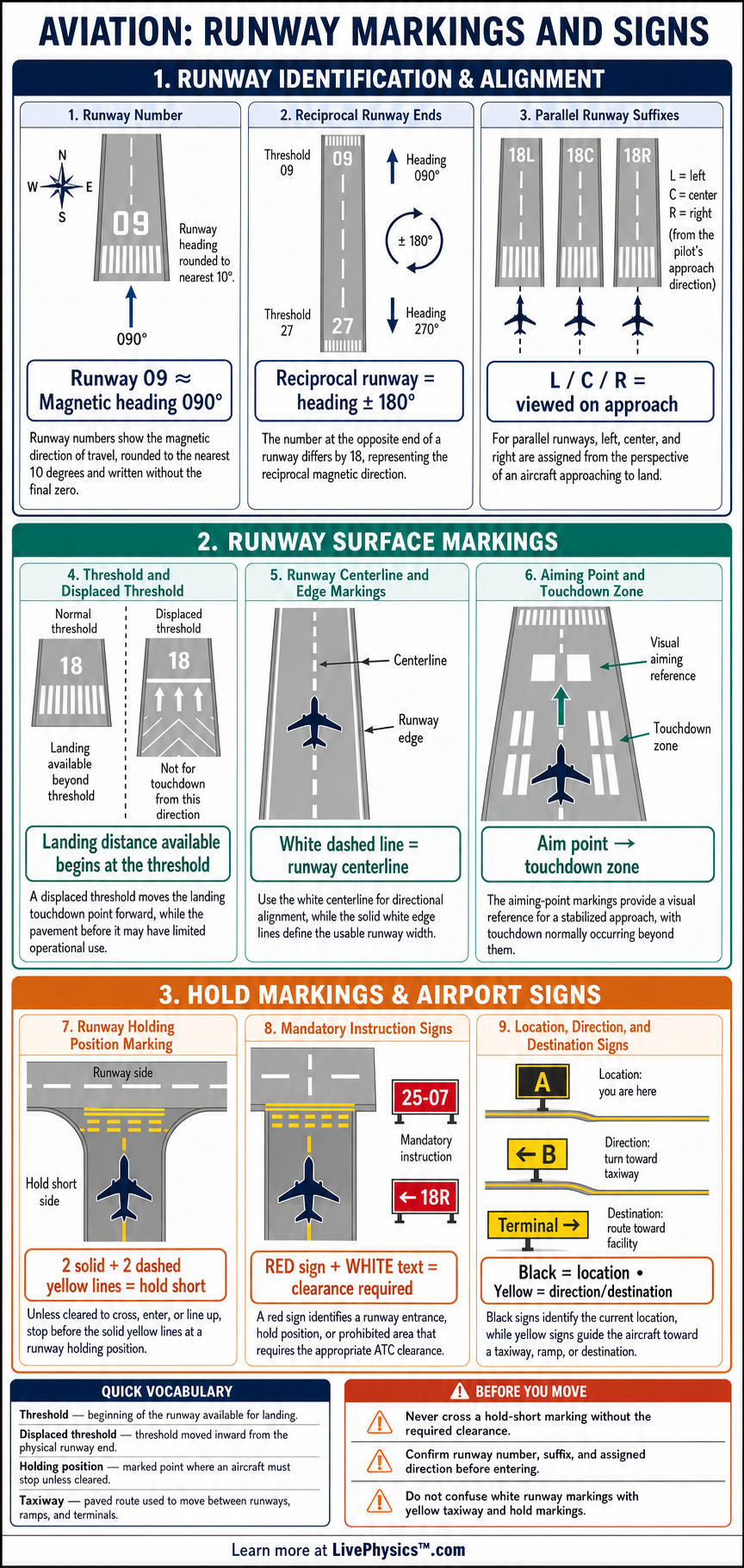
Runway markings and signs give pilots a shared visual language for moving safely on an airport. They identify runways, show where aircraft may taxi, and mark places where clearance is required. This cheat sheet organizes the most important visual cues into three color-coded study sections.
It supports pilot training, airport familiarization, and quick review before flight operations.
The first section focuses on runway identification and runway surface markings. The second section explains taxiway guidance, holding position markings, and mandatory signs. The third section covers approach, landing, and safety-area markings.
Students should learn both the appearance of each marking and the operational action it requires.
Key Facts
- A runway number equals the magnetic runway direction rounded to the nearest ten degrees and written without the final zero.
- Opposite runway numbers differ by 18 because opposite directions are 180 degrees apart.
- A broken white runway centerline marks the lateral center of the runway.
- Solid white runway edge lines define the usable lateral edges of a runway.
- A holding position marking uses two solid yellow lines and two dashed yellow lines, and aircraft stop before the solid lines unless cleared to cross.
- A red sign with white runway numbers is a mandatory instruction sign that requires clearance before entering or crossing the runway.
- A black sign with yellow lettering identifies the current taxiway or other location.
- Yellow signs with black letters and arrows provide direction information toward taxiways, runways, or airport destinations.
Vocabulary
- Runway designation
- A two-digit runway identifier based on the magnetic direction of the runway rounded to the nearest ten degrees.
- Threshold
- The marked beginning of the portion of a runway available for landing.
- Displaced threshold
- A threshold located farther along the runway because pavement before it has restricted use for landing operations.
- Holding position
- A marked point where an aircraft must stop and wait for clearance before entering a runway or protected area.
- Runway incursion
- An incorrect presence of an aircraft, vehicle, or person in a protected area of an airport surface.
- Aiming point
- Large white rectangular runway markings that provide a visual target for the intended touchdown area.
Common Mistakes to Avoid
- Stopping on the dashed side of a holding position marking is wrong because aircraft approaching the marking must stop before the two solid yellow lines.
- Treating a red runway holding position sign as simple navigation information is wrong because red signs show mandatory instructions and runway entry needs clearance.
- Using the pavement start as the landing point at a displaced threshold is wrong because the marked threshold identifies where normal landing is permitted.
- Confusing white runway markings with yellow taxiway markings is wrong because color is a primary cue for distinguishing runway surfaces from taxi guidance areas.
- Relying only on a taxiway sign is wrong because safe airport movement requires cross-checking signs, painted markings, the airport diagram, and air traffic control instructions.
Practice Questions
- 1 A runway has a magnetic direction of 184 degrees. What runway designation should be painted at that end?
- 2 An aircraft is taxiing toward a holding position marking with two solid yellow lines nearest the aircraft. What must the pilot do if no clearance has been received?
- 3 Runway 04 has an opposite runway end. What number is displayed at the opposite end?
- 4 Explain why a pilot must use both pavement markings and mandatory instruction signs before entering a runway.
Understanding Runway Markings and Signs
A runway is identified by its magnetic direction rounded to the nearest ten degrees and shown as a two-digit number. A runway aligned near 090 degrees is marked Runway 09. The opposite end is 180 degrees away, so it is marked Runway 27.
Parallel runways add a letter such as L, C, or R for left, center, or right. Pilots must compare the runway number with the assigned runway and their aircraft heading. This simple check helps prevent a runway incursion or departure from the wrong runway.
White markings are generally used on runways, while yellow markings guide aircraft on taxiways and apron areas. A runway centerline is a broken white line that helps the pilot keep the aircraft aligned. Runway edge markings are solid white lines that define the usable width of the runway.
Threshold markings identify the beginning of the runway available for landing. Displaced threshold arrows show pavement before the threshold, but the pavement may have limits on its use for landing, takeoff, or taxiing.
Holding position markings are among the most important airport markings to recognize. They use two solid yellow lines and two dashed yellow lines across a taxiway. An aircraft must stop before the solid lines when approaching them, unless air traffic control has issued clearance to cross.
A runway holding position sign has a red background with white runway numbers. It tells the pilot that entry to the runway environment requires clearance. This rule protects aircraft that may be landing, departing, or crossing nearby.
Guidance signs use color to communicate their purpose quickly. Black signs with yellow letters provide location information, such as the taxiway currently occupied. Yellow signs with black letters or arrows give direction information toward taxiways, runways, or other destinations.
Red signs with white letters show mandatory instructions and require compliance. Pilots should use signs together with pavement markings, the airport diagram, and radio instructions. No single cue should replace a complete visual check.
Approach and landing markings help pilots judge alignment and distance during the final phase of flight. Aiming point markings are broad white rectangles placed before the touchdown zone. Touchdown zone markings appear in pairs and help pilots estimate remaining runway distance.
A runway with a displaced threshold requires special attention because the marked threshold, not the pavement beginning, is the normal landing reference point. Study each marking as an action cue. Identify its color, shape, location, and the clearance or control decision it requires.