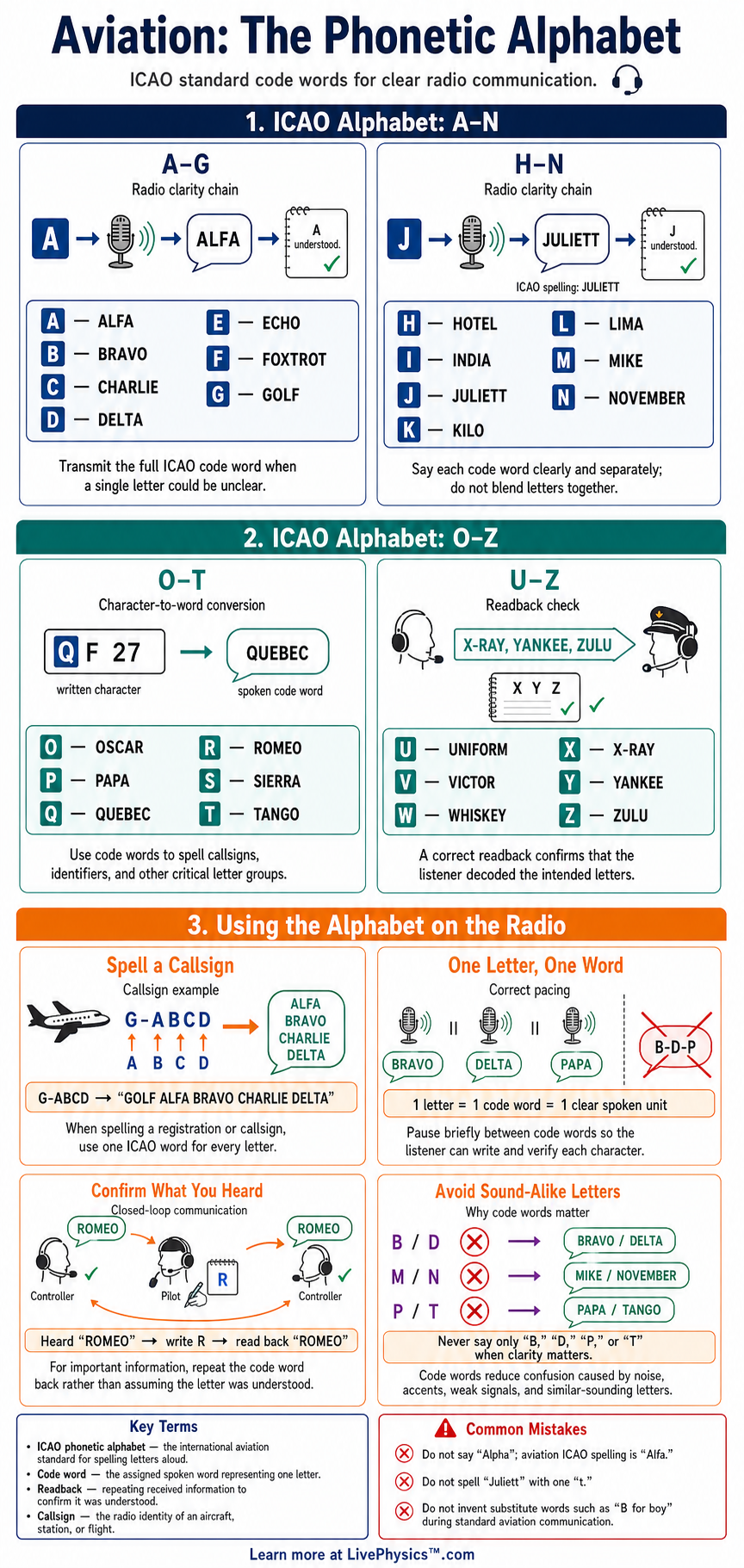
The aviation phonetic alphabet gives pilots, air traffic controllers, and ground crews a standard way to say letters clearly over radio. It reduces errors caused by static, accents, fast speech, and similar-sounding letters. Students use this cheat sheet to spell call signs, airport codes, taxiways, routes, and aircraft registrations accurately.
Clear radio communication supports safe and efficient flight operations.
The International Civil Aviation Organization, or ICAO, phonetic alphabet assigns one distinct code word to every letter. For example, Alpha represents A and Bravo represents B. Aviation also uses standard pronunciations for several numbers because some ordinary number words can be misunderstood over a radio.
Pilots should speak at a steady pace, use the exact code words, and listen carefully for correct readbacks.
Key Facts
- The ICAO phonetic alphabet assigns Alpha to A, Bravo to B, Charlie to C, and Delta to D.
- The next sequence is Echo for E, Foxtrot for F, Golf for G, Hotel for H, India for I, and Juliett for J.
- The middle sequence is Kilo for K, Lima for L, Mike for M, November for N, Oscar for O, and Papa for P.
- The later sequence is Quebec for Q, Romeo for R, Sierra for S, Tango for T, Uniform for U, and Victor for V.
- The final sequence is Whiskey for W, X-ray for X, Yankee for Y, and Zulu for Z.
- Standard aviation number pronunciation uses tree for 3, fife for 5, niner for 9, and decimal for a decimal point.
- A frequency written as 118.7 is spoken as one one eight decimal seven.
- Use the exact ICAO code word when spelling a call sign, registration, taxiway letter, or other identifier over radio.
Vocabulary
- ICAO phonetic alphabet
- An international set of code words used to represent letters clearly in aviation communication.
- Call sign
- A unique radio identifier used to address and identify an aircraft, controller, or ground station.
- Readback
- A repetition of received instructions by a pilot so the controller can confirm they were understood correctly.
- Transmission
- A spoken message sent over an aviation radio frequency.
- Frequency
- A specific radio channel used for communication, usually expressed in megahertz.
- Registration
- The official letters and numbers assigned to identify a particular aircraft.
Common Mistakes to Avoid
- Using informal words such as Apple or Boy instead of Alpha or Bravo is wrong because ICAO code words are standardized for international clarity.
- Saying three, five, and nine in ordinary speech can be unclear over radio, so use tree, fife, and niner when standard aviation pronunciation applies.
- Speaking letters alone in a noisy transmission is risky because similar letters such as B, D, P, and T can be mistaken for one another.
- Rushing through a call sign or registration is wrong because speed reduces intelligibility and makes an accurate readback harder.
- Changing the order of letters or digits during a readback is dangerous because the controller may believe an incorrect identifier or instruction has been confirmed.
Practice Questions
- 1 Spell the aircraft registration N482QX using the ICAO phonetic alphabet.
- 2 Write the standard spoken form of the frequency 123.95.
- 3 Convert the spoken call sign Golf Sierra Tree Fife Niner into letters and numbers.
- 4 Explain why a pilot should use the phonetic alphabet when confirming a taxiway identifier after hearing a weak radio transmission.
Understanding The Phonetic Alphabet
Radio communication in aviation must remain understandable even when conditions are poor. Aircraft radios can include noise from engines, distance, weather, weak signals, and overlapping transmissions. A single unclear letter can create a serious mistake when it appears in an aircraft call sign, flight level, runway, or navigation fix.
The phonetic alphabet replaces easily confused letters with longer, distinct words. Saying Delta is clearer than saying D, especially when another speaker may hear B, P, or T.
The ICAO alphabet is used internationally, so it gives aviation professionals a shared communication system. The sequence runs from Alpha for A through Zulu for Z. These are official code words, not casual alternatives.
For example, pilots say Juliett rather than Juliet, and they say X-ray rather than Xray. Learning the exact words matters because controllers and pilots expect to recognize them immediately. Consistent vocabulary also helps speakers with different first languages communicate safely.
Pilots commonly use the alphabet to spell aircraft registrations and unusual call signs. A controller might identify an aircraft as November One Two Three Alpha Bravo. The alphabet is also useful for confirming taxiway letters, gate locations, maintenance references, and weather report details.
It is often safer to spell an unfamiliar name or identifier than to assume the listener heard it correctly. When a message contains critical information, a readback lets the sender verify that the receiver understood the words and numbers.
Number pronunciation follows standard aviation practice too. Three is spoken as tree, five as fife, and nine as niner. These forms make the words more distinct from similar sounds and from background noise.
Decimal is used for the point in a frequency. A frequency of 121.5 is spoken as one two one decimal five. Whole numbers are normally spoken digit by digit unless a specific procedure permits another form.
Study the alphabet in small groups and practice saying every word aloud. Focus extra attention on letters that are easy to confuse, including Bravo and Delta, Mike and November, and Papa and Quebec. Practice with realistic examples such as call signs, runway identifiers, and frequencies.
Good communication is not about speaking quickly. It is about being calm, accurate, and easy to understand on the first transmission.