
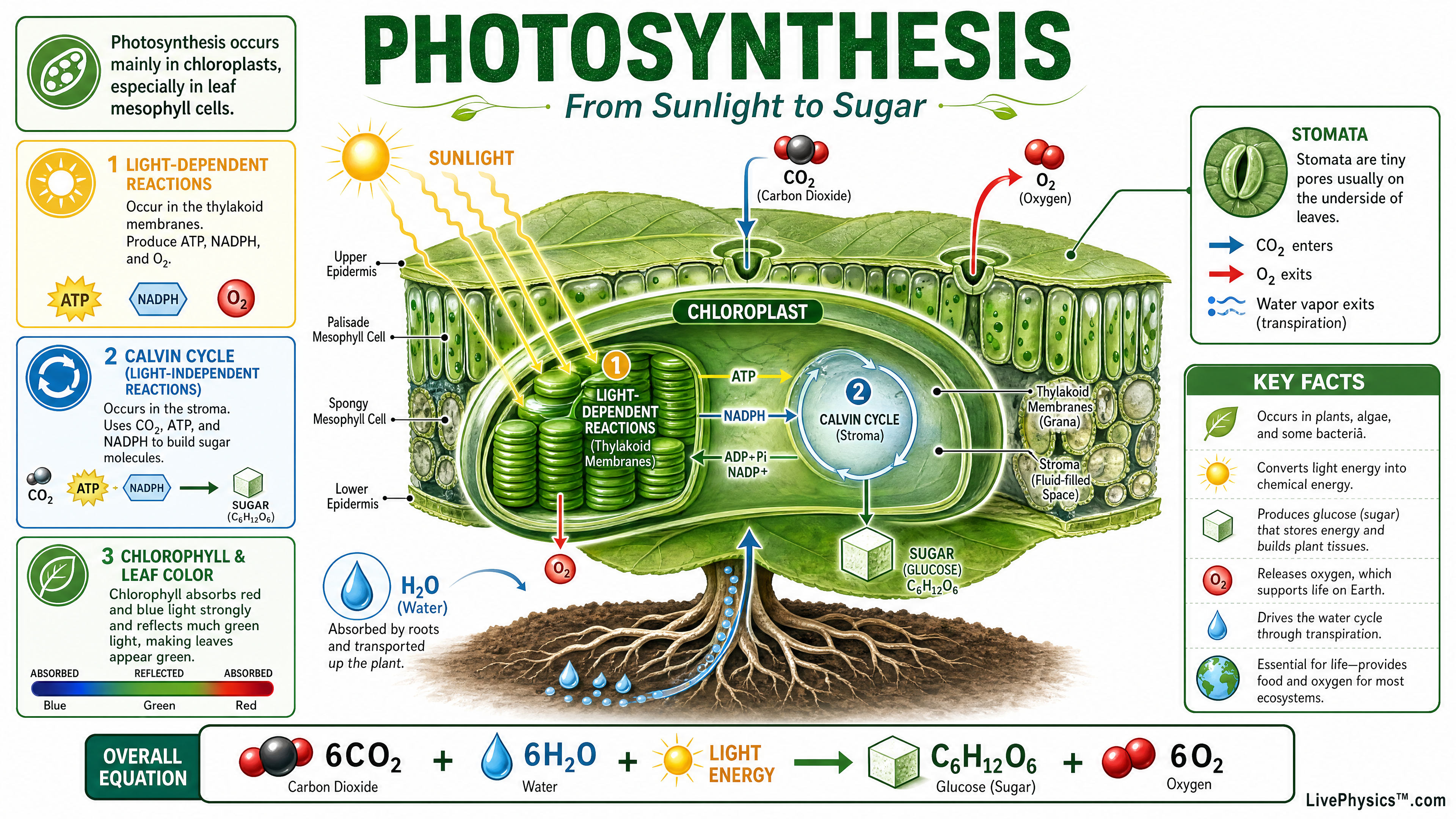
Photosynthesis is the process plants, algae, and some bacteria use to convert light energy into chemical energy stored in sugar. It matters because it supplies most of the food energy in ecosystems and releases the oxygen that many organisms need for cellular respiration. In plants, photosynthesis mainly occurs in chloroplasts inside leaf cells, where pigments capture sunlight.
A leaf is shaped and structured to collect light, exchange gases, and move water and sugars efficiently.
Photosynthesis has two major stages, the light-dependent reactions and the Calvin cycle. In the light-dependent reactions, chlorophyll absorbs light energy, water is split, oxygen is released, and energy-carrying molecules are made. In the Calvin cycle, carbon dioxide is fixed into organic molecules and eventually used to build glucose and other carbohydrates.
The overall process links sunlight, water, and carbon dioxide to the chemical bonds in sugar.
Understanding Photosynthesis
Light capture depends on more than a leaf being in the sun. Chlorophyll sits in clusters with helper pigments that pass energy toward reaction centers. There, an excited electron begins a controlled chain of transfers.
Each transfer releases a small amount of usable energy rather than losing it all as heat. This energy moves hydrogen ions across a membrane. The ions then flow back through a protein channel, much like water turning a tiny turbine.
The cell uses that flow to make ATP. Another electron carrier becomes NADPH. Both molecules act as short-term energy supplies for carbon dioxide processing.
Replacing the lost electrons is an important part of the process. Water molecules provide electrons, but splitting water requires a great deal of energy from light. The hydrogen from water helps build the ion difference across the membrane.
Oxygen atoms left behind join in pairs and leave the plant. This explains why the oxygen released by a plant comes from water rather than from carbon dioxide.
Students often remember that water is an input but miss its specific role. Tracing atoms through a process is a useful biology skill because it shows where products actually come from.
The carbon-building stage does not make a finished glucose molecule each time it runs. It first attaches carbon dioxide to a five-carbon compound with help from an enzyme called rubisco. The resulting molecules are rearranged using ATP and NADPH.
Some become a small three-carbon sugar. Most are used to rebuild the five-carbon starting compound so the cycle can continue. Only after many turns can the plant combine small sugars into glucose, sucrose, starch, cellulose, fats, or other materials.
Plants use sugars for respiration, growth, roots, fruits, seeds, and storage. A plant is not simply making food for later. It is constantly balancing production, transport, and use.
Stomata show why photosynthesis involves tradeoffs. When these pores open, carbon dioxide can enter, but water vapor escapes. On hot or dry days, a plant may partly close its stomata to avoid dehydration.
Less carbon dioxide then reaches the leaf cells, so sugar production can slow. Some plants have adaptations for difficult conditions. Cacti often open stomata at night and store carbon dioxide until daylight.
Corn and sugarcane use a pathway that concentrates carbon dioxide near rubisco. In class experiments, light intensity, carbon dioxide level, temperature, and water supply are common variables. Each can limit the rate, but only until another factor becomes the main limit.
Temperature matters because photosynthesis uses enzymes, which work best within a certain range. Too much heat, too little water, or damaged chlorophyll can reduce the process even in bright sunlight.
Key Facts
- Overall photosynthesis equation: 6CO2 + 6H2O + light energy -> C6H12O6 + 6O2
- Photosynthesis occurs mainly in chloroplasts, especially in leaf mesophyll cells.
- Light-dependent reactions occur in the thylakoid membranes and produce ATP, NADPH, and O2.
- The Calvin cycle occurs in the stroma and uses CO2, ATP, and NADPH to build sugar molecules.
- Chlorophyll absorbs red and blue light strongly and reflects much green light, making leaves appear green.
- Stomata allow CO2 to enter and O2 to leave, but they can also cause water loss by transpiration.
Vocabulary
- Photosynthesis
- Photosynthesis is the process that uses light energy to convert carbon dioxide and water into sugars and oxygen.
- Chloroplast
- A chloroplast is a plant cell organelle where photosynthesis takes place.
- Chlorophyll
- Chlorophyll is a green pigment that absorbs light energy for photosynthesis.
- Thylakoid
- A thylakoid is a flattened membrane sac inside a chloroplast where the light-dependent reactions occur.
- Calvin Cycle
- The Calvin cycle is the set of reactions that uses carbon dioxide to help build sugar in the chloroplast stroma.
Common Mistakes to Avoid
- Saying plants get their food from soil is wrong because most of the mass of plant sugars comes from carbon dioxide in the air, not minerals in the soil.
- Forgetting to balance the photosynthesis equation is wrong because atoms must be conserved, so the standard balanced equation uses 6 CO2 and 6 H2O to make 1 glucose and 6 O2.
- Thinking oxygen comes from carbon dioxide is wrong because the oxygen gas released during photosynthesis comes mainly from the splitting of water in the light-dependent reactions.
- Mixing up the two stages is wrong because the light-dependent reactions make ATP and NADPH in thylakoids, while the Calvin cycle uses those molecules to fix carbon in the stroma.
Practice Questions
- 1 Using the balanced equation 6CO2 + 6H2O + light energy -> C6H12O6 + 6O2, how many molecules of CO2 are needed to produce 4 molecules of glucose?
- 2 If a plant produces 18 molecules of O2 during photosynthesis, how many molecules of glucose are produced according to the balanced equation?
- 3 A plant is kept in bright light but its stomata close during a hot, dry day. Explain how this would affect carbon dioxide intake, water loss, and the rate of sugar production.