Constellations & Seasonal Sky Explorer
The night sky changes with the seasons. Explore which star patterns appear in winter, spring, summer, and fall - and discover the myths behind the constellations.
winter sky3 constellations visible
Choose a Month to Observe
Tap a constellation to highlight it
Tap a constellation on the sky to explore it.
Constellations Reference
Why Do Constellations Change?
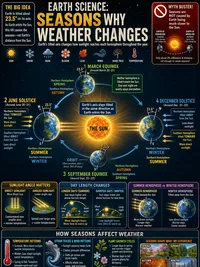
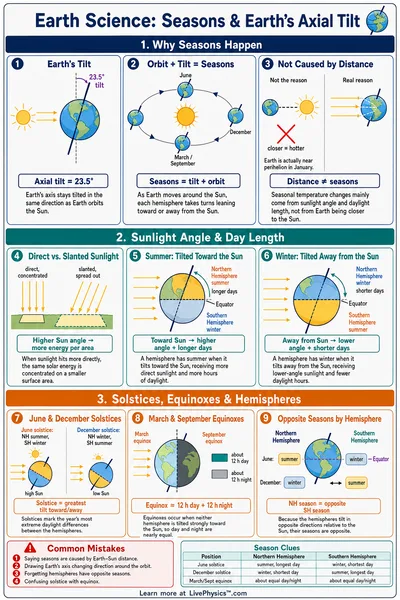
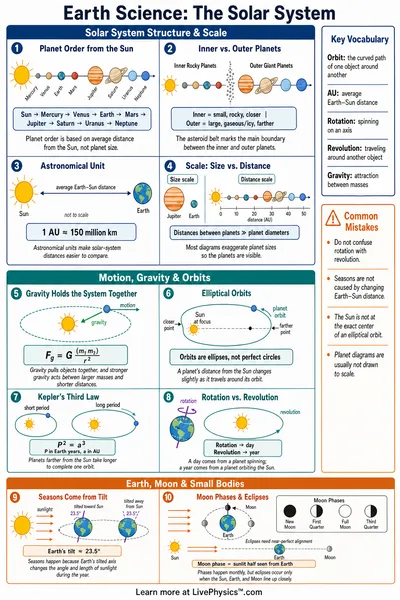
Earth orbits the sun over one year. Different parts of the sky face away from the sun at different times, making different constellations visible each season.
- Winter, Orion is high in the sky
- Spring, Leo rises in the east
- Summer, Cygnus and Scorpius shine
- Fall, Pegasus and Cassiopeia are prominent
Year-Round Constellations
Some constellations near the North Pole are visible all year from the Northern Hemisphere because they never set below the horizon.
- Big Dipper (Ursa Major)
- Cassiopeia
- Polaris (North Star) marks true north
Related Content
Visual Explainers
Related Tools
Earthquake Magnitude Calculator
Four modes, magnitude scales (Richter Mₗ, moment magnitude M𝑤, energy), energy comparison (each step = 31.6× more energy, logarithmic bar chart), Modified Mercalli Intensity I-XII with descriptions, and Richter magnitude from seismograph amplitude. Presets include Minor M3 through Great M8, 1906 San Francisco M7.9, and 2011 Japan M9.1.
Carbon Footprint Calculator
Estimate annual CO₂ emissions from transportation (car miles, fuel type, flights), home energy (electricity, heating, AC), diet (meat consumption, food waste), and lifestyle (shopping, recycling). Pie chart breakdown, country comparison bar chart, trees-to-offset and equivalent-driving metrics. Five presets, Average American, Eco-Conscious, Heavy Commuter, Frequent Flyer, Work from Home.
Star Lifecycle Visualizer
Three modes: interactive HR diagram with 23 real stars (click to see properties), stellar evolution pathway from nebula to end state (white dwarf, neutron star, or black hole based on initial mass), and star properties calculator (luminosity L∝M^3.5, radius, lifetime t∝M^-2.5, apparent magnitude). Six presets: Sun, Red Dwarf (0.3 M☉), Sirius A (2 M☉), Blue Giant (20 M☉), Betelgeuse (15 M☉), Supergiant (50 M☉). Includes spectral class colour strip and SVG star visualization.
H-R Diagram Explorer
Three modes, plot a single star on the Hertzsprung-Russell diagram from temperature, radius, and mass (Stefan-Boltzmann luminosity, spectral class O-M, absolute magnitude, HR region); compare multiple stars side by side; and browse the spectral atlas with typical properties for each class. 23 reference stars plotted, 6 presets from Proxima Centauri to Rigel.
Related Labs
Constellations & Seasonal Sky Lab
Identify constellations in the night sky, explore which stars appear in each season, and trace star connection patterns. NGSS 5-ESS1-2. Grades 3–5.
Sun, Moon & Daylight Patterns Lab
Investigate predictable sky patterns. Record sunrise, sunset, daylight hours, and moon phases across seasons to find the patterns that repeat. Grades K-1.
Sun, Shadows & Daylight Lab
Observe how shadow length and direction change across the day and between seasons as the sun moves across the sky. Grades 1-3.
Moon Phases, Eclipses & Seasons Lab
Explore moon phases through the synodic month, eclipse geometry with node alignment, and Earth's seasons driven by axial tilt and solar declination