Choose a skill All skills SC.5.N.1.1: Evaluate investigations and evidence SC.3.N.1.1: Investigate questions about nature (also assessed) SC.4.N.1.1: Use references and investigations to explain nature (also assessed) SC.4.N.1.6: Keep records and separate observation from inference (also assessed) SC.5.N.1.2: Distinguish experiments from other investigations (also assessed) SC.5.N.1.4: Explain the purpose of a control group (also assessed) SC.5.N.2.1: Link testable scientific explanations to evidence SC.3.N.1.7: Use observations and measurements as evidence (also assessed) SC.4.N.1.3: Science uses evidence without one rigid sequence (also assessed) SC.4.N.1.7: Scientists explain using evidence (also assessed) SC.5.N.1.5: Investigations need not follow one prescribed method (also assessed) SC.5.N.1.6: Distinguish opinion from checked observation (also assessed) SC.5.N.2.2: Other investigators should be able to replicate evidence SC.3.N.1.2: Compare groups using the same tools (also assessed) SC.3.N.1.5: Scientists question and check one another’s evidence (also assessed) SC.4.N.1.2: Compare groups using different tools (also assessed) SC.4.N.1.5: Compare classmates’ procedures and results (also assessed) SC.5.N.1.3: Explain repeated experimental trials (also assessed) SC.5.E.5.1: Galaxies contain stars, dust and gas; our galaxy is Milky Way SC.3.E.5.1: Stars differ in size and apparent brightness (also assessed) SC.3.E.5.2: The Sun is a star emitting light energy (also assessed) SC.3.E.5.3: The Sun looks large and bright because it is closest (also assessed) SC.5.E.5.3: Distinguish Solar-System objects and Earth’s position SC.5.E.5.2: Compare planets and inner/outer planet groups (also assessed) SC.4.E.5.4: Earth’s rotation connects to apparent sky motion SC.4.E.5.1: Star patterns appear to shift nightly and differ seasonally (also assessed) SC.4.E.5.2: The Moon’s visible shape changes across roughly a month (also assessed) SC.4.E.5.3: Earth rotates daily and revolves yearly (also assessed) SC.4.E.6.2: Mineral properties and minerals making rocks SC.4.E.6.1: Rock groups are defined by formation (also assessed) SC.4.E.6.3: Earth resources can be renewable or nonrenewable SC.4.E.6.6: Recognize Florida’s natural resources (also assessed) SC.4.E.6.4: Weathering breaks rock; erosion moves it SC.5.E.7.1: Explain water-cycle processes and water states SC.5.E.7.2: Oceans connect to the water cycle (also assessed) SC.5.E.7.3: Weather involves temperature, pressure, humidity, wind and precipitation SC.5.E.7.4: Relate precipitation forms to conditions (also assessed) SC.5.E.7.5: Different environments have different weather conditions (also assessed) SC.5.E.7.6: Climate-zone temperature and precipitation relate to location (also assessed) SC.5.P.8.1: Compare properties of solids, liquids and gases SC.3.P.8.1: Measure and compare temperatures of solids/liquids (also assessed) SC.3.P.8.2: Measure and compare solid/liquid mass and volume (also assessed) SC.3.P.8.3: Compare materials by observable properties (also assessed) SC.4.P.8.1: Compare objects by physical properties (also assessed) SC.5.P.8.3: Separate solid mixtures using component properties SC.5.P.8.2: Dissolving in water and factors affecting rate (also assessed) SC.5.P.9.1: Temperature affects physical and chemical changes SC.3.P.9.1: Water changes state when heated or cooled (also assessed) SC.4.P.9.1: Some material changes produce different materials (also assessed) SC.5.P.10.1: Recognize light, heat, sound, electrical, chemical and mechanical energy SC.3.P.10.1: Identify basic energy forms (also assessed) SC.3.P.10.3: Light travels straight until interacting with an object/material (also assessed) SC.3.P.10.4: Light reflects, bends or is absorbed (also assessed) SC.3.P.11.1: Light sources often also produce heat (also assessed) SC.3.P.11.2: Rubbing objects can produce heat (also assessed) SC.4.P.10.1: Describe basic energy forms including motion (also assessed) SC.4.P.10.3: Sound comes from vibration; faster vibration means higher pitch (also assessed) SC.5.P.10.2: Energy can cause motion or change SC.3.P.10.2: Recognize energy causing movement/change (also assessed) SC.4.P.10.2: Describe energy producing motion/change (also assessed) SC.4.P.10.4: Moving air and water can move things (also assessed) SC.5.P.10.4: Electrical energy can become heat, light, sound or motion SC.3.E.6.1: Sunlight warms objects; objects can cool without it (also assessed) SC.4.P.11.1: Heat moves from hotter to colder objects (also assessed) SC.4.P.11.2: Materials conduct heat differently (also assessed) SC.5.P.10.3: Static charges can attract or repel without contact (also assessed) SC.5.P.11.1: Electric current needs a complete circuit (also assessed) SC.5.P.11.2: Materials conduct or insulate electricity (also assessed) SC.5.P.13.1: Pushes, pulls, gravity and magnetism affect motion SC.3.E.5.4: Other forces can overcome gravity (also assessed) SC.4.P.8.4: Magnets attract some materials and attract/repel magnets (also assessed) SC.5.P.13.2: Greater applied force produces greater motion change SC.4.P.12.1: Moving objects change position and may change direction (also assessed) SC.4.P.12.2: Speed depends on distance and time (also assessed) SC.5.P.13.3: Same force changes heavier objects’ motion less (also assessed) SC.5.P.13.4: Opposing balanced forces can keep an object still (also assessed) SC.3.L.14.1: Plant structures support, transport, make food and reproduce SC.3.L.14.2: Plants respond to light, heat and gravity (also assessed) SC.4.L.16.1: Flowering plants reproduce through pollination, seeds and germination (also assessed) SC.5.L.14.1: Human organs have specific functions SC.5.L.14.2: Compare functions of plant/animal physical structures SC.3.L.15.1: Classify animals from physical characteristics and behavior (also assessed) SC.3.L.15.2: Classify plants by flowers, seeds and spores (also assessed) SC.4.L.16.4: Compare life cycles of Florida plants and animals SC.5.L.17.1: Adaptations help plants/animals survive different environments SC.3.L.17.1: Plants and animals respond to seasonal change (also assessed) SC.4.L.16.2: Characteristics are inherited and also affected by environment (also assessed) SC.4.L.16.3: Animal behavior can be inherited or learned (also assessed) SC.4.L.17.1: Florida seasonal changes differ from other regions (also assessed) SC.4.L.17.4: Organisms including people affect environments (also assessed) SC.5.L.15.1: Differences among individuals affect survival after change (also assessed) SC.4.L.17.3: Energy flows from Sun to producers to consumers SC.3.L.17.2: Plants use sunlight, air and water to make food (also assessed) SC.4.L.17.2: Animals obtain food energy by eating plants/animals (also assessed) Support level Learn Practice Challenge Ask for a hint when you need one. All levels use the same original questions.
0 of 191 questions reviewed in this skill selection. This is practice, with no official score.
Question 1 of 191 · SC.5.N.1.1
A seedling investigation This is an original classroom example, not a report of a published study.
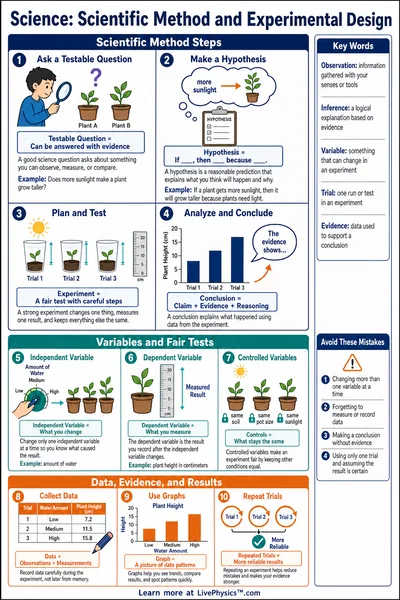
Students ask whether covering soil with mulch changes how quickly it dries. They use equal pots, the same soil and amount of water, and the same sunny shelf. One group has a thin mulch layer; the single comparison group has no mulch.
They check the soil at the same time each day and record whether its surface looks damp or dry. They do not choose which pot to record based on its appearance.
A seedling investigation records Day Mulched soil surface Unmulched soil surface 1 Damp Damp 2 Damp Dry 3 Damp Dry
Read the seedling investigation. Which part of the supplied procedure makes the mulch comparison fair? Show hint Choose one answer. Both groups use equal pots, soil, water, and shelf conditions. Only the mulched pots receive water. Each group is checked at a different time of day. Students record only pots that look dry. Check answer Retry question
Previous question Next question