Understanding Simple Pulley Calculator
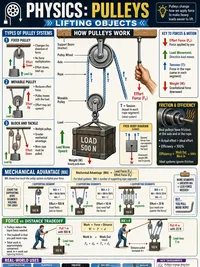
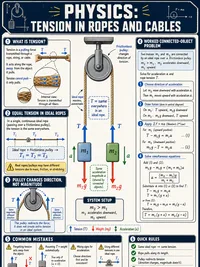
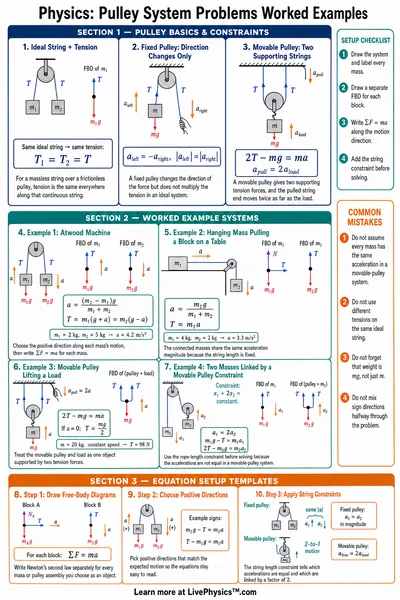
A pulley changes the way a rope carries force. In an ideal rope, the tension is nearly the same along every straight section, so each rope segment supporting a moving block shares part of the load.
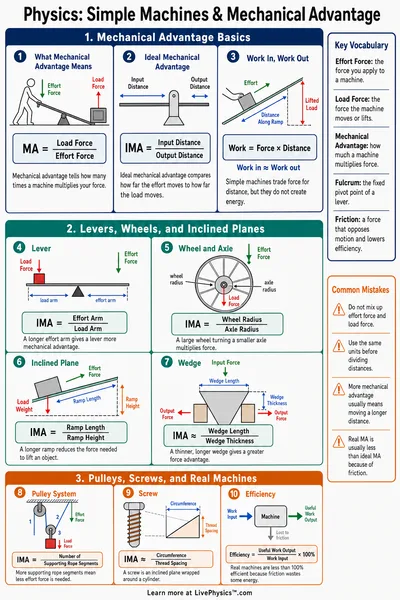
This is why counting supporting segments is useful, but only segments pulling upward on the moving load count. A rope end attached to the fixed support does not lift the moving block, even though it is visible in the diagram.
The force saving comes with a distance cost. If a system has four supporting rope segments, the free end of the rope must be pulled four metres to raise the load one metre. In the ideal case, effort force times pulling distance equals load force times lifting distance.
Energy is not created by the pulley system. It trades a smaller force for a longer pull, which is often easier for a person or a motor to manage.
Real pulleys never behave perfectly because bearings, rope bending, and rubbing surfaces resist motion. The effort force must overcome the load plus these losses, so the actual mechanical advantage is lower than the number predicted by the rope layout.
Efficiency describes how much of the input work becomes useful lifting work. A heavy rope can matter too, especially in tall lifting systems, because part of the effort goes into moving the rope itself.
Pulley direction matters in practical work. A fixed pulley can let a worker pull downward while the load rises, which allows the worker to use body weight and stand in a safer position.
A movable pulley reduces the required effort, but it moves with the load and makes the setup more complex. Cranes, theatre rigging, sailing equipment, window blinds, garage doors, and gym machines use these ideas in different forms.
When using a calculator, first identify what is moving and trace the rope from its anchored end to the effort end. Check whether each pulley is fixed to a support or attached to the load, since a diagram can look complicated even when only a few segments support the load.
Use consistent units for force and weight. If mass is given, its weight is mass times gravitational field strength, so the calculator needs to distinguish kilograms from newtons.
Students should treat high mechanical advantage carefully. More supporting segments can reduce the input force, but the rope travels farther and the load rises more slowly for the same pulling speed.
In a real system, extra pulleys add friction and make alignment more important. A rope that crosses incorrectly or runs at an angle can increase wear, reduce efficiency, and create unsafe sideways forces.
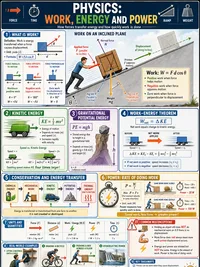
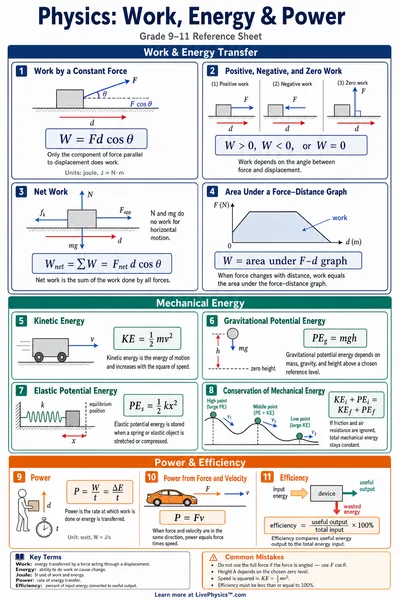
Pulley calculations connect directly to conservation of energy. A person lifting a load by hand feels the full weight over a short distance, while a pulley system spreads the same energy transfer over a longer rope movement.
This helps explain why a machine can feel easier without doing less total work. The energy supplied may even be greater in reality because friction turns some energy into heat and sound.
Safe lifting depends on more than the calculated effort. Every rope, hook, axle, and support must be rated for forces larger than the load, including sudden starts or stops.
A load can swing if it is pulled unevenly, and a moving rope can trap hands or clothing. Physics calculations give a starting estimate, while real lifting requires safety margins and careful equipment inspection.