Rock Cycle Explorer
Discover how Earth's rocks continuously transform between igneous, sedimentary, and metamorphic types. Click any rock, then choose a geological process to see how it changes.
Igneous Rock
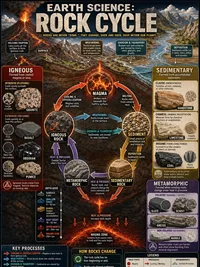
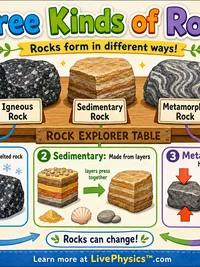
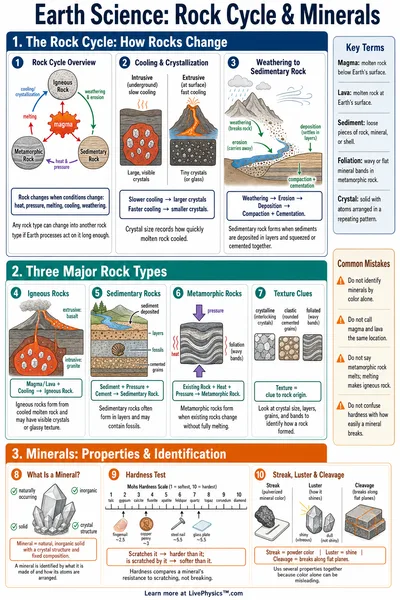
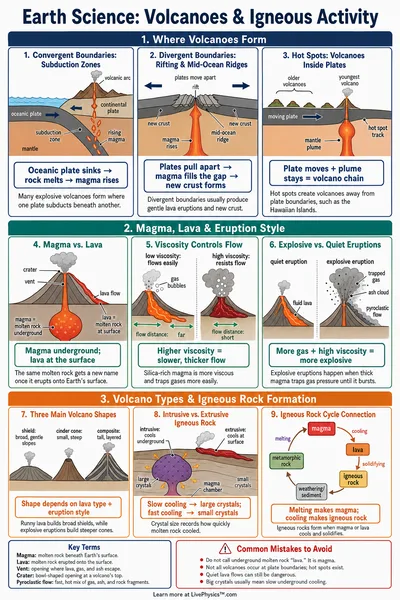
Igneous rocks form from the cooling and solidification of magma or lava. They are the most abundant rock type in Earth's crust and mantle.
Examples
Magma cools slowly underground to form intrusive igneous rocks, or lava cools rapidly at the surface to form extrusive igneous rocks.
Sedimentary Rock
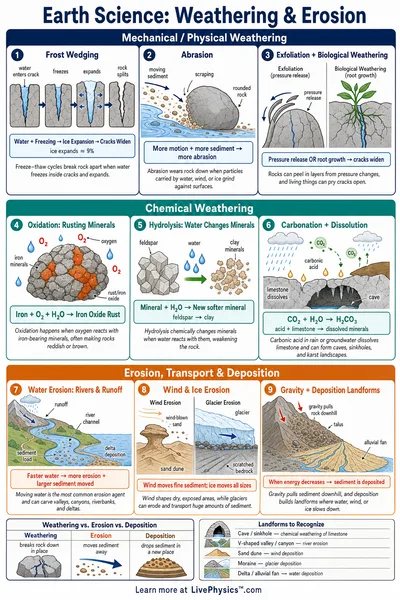
Sedimentary rocks form from the accumulation and compaction of sediment, organic material, or minerals deposited by water, wind, or ice.
Examples
Layers of sediment are compacted and cemented together over millions of years in a process called lithification.
Metamorphic Rock
Metamorphic rocks form when existing rocks are transformed by heat, pressure, or chemically active fluids deep within Earth's crust.
Examples
Pre-existing rocks are subjected to extreme conditions that alter their mineral structure and texture without fully melting them.
Transform the Rock
Apply a geological process to change Igneous Rock into another type.
Did You Know
About 90% of Earth's crust is made of igneous and metamorphic rocks. The granite beneath your feet in many mountain ranges started as underground magma chambers millions of years ago.
Reference Guide
Rock Formation
Igneous Rocks
Form when magma cools underground (intrusive) or lava solidifies at the surface (extrusive). Slow cooling produces large crystals; fast cooling produces fine-grained or glassy textures.
Sedimentary Rocks
Form from layers of sediment compacted and cemented over millions of years. Common in river deltas, ocean floors, and desert basins. Contain most known fossils.
Metamorphic Rocks
Form when existing rocks are changed by heat, pressure, or hot fluids deep in Earth's crust. Minerals recrystallize into new arrangements without the rock fully melting.
Geological Processes
Weathering and Erosion
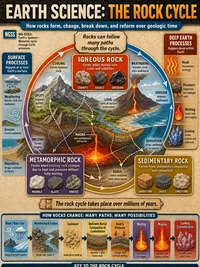
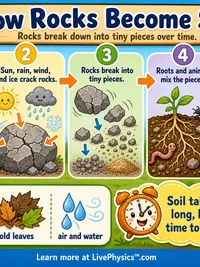
Physical and chemical breakdown of surface rocks into smaller fragments. Wind, water, and ice transport the sediment to new locations where it is deposited.
Heat and Pressure
Burial or tectonic collision can subject rocks to temperatures of 300-700 degrees C and pressures thousands of times greater than at the surface. This recrystallizes minerals without melting.
Melting
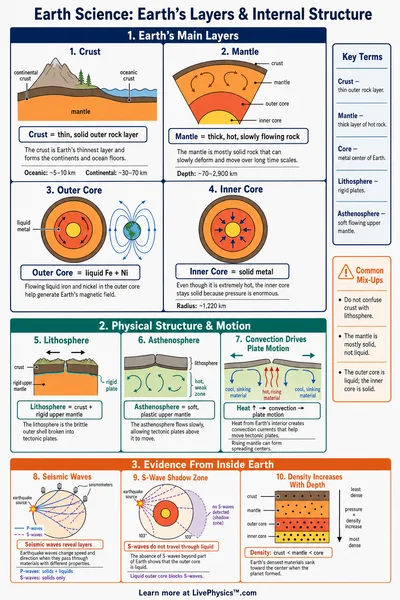
At depths of 100 km or more, temperatures exceed 700-1300 degrees C. Rock melts to form magma, which rises through the crust and eventually cools to form new igneous rock.
The Continuous Cycle
No rock type is permanent. Over geological time, every rock can be transformed into any other type through the processes of weathering, burial, melting, and solidification.
The cycle is driven by two main energy sources, heat from Earth's interior (geothermal energy) and energy from the Sun (which powers erosion and the water cycle).
Plate tectonics plays a central role, carrying rocks to different depth and temperature environments through subduction, mountain building, and rifting.
- Volcanic eruptions bring rock to the surface
- Subduction carries surface rock into the mantle
- Mountain uplift exposes deep metamorphic rock
- Rivers carry sediment to ocean basins