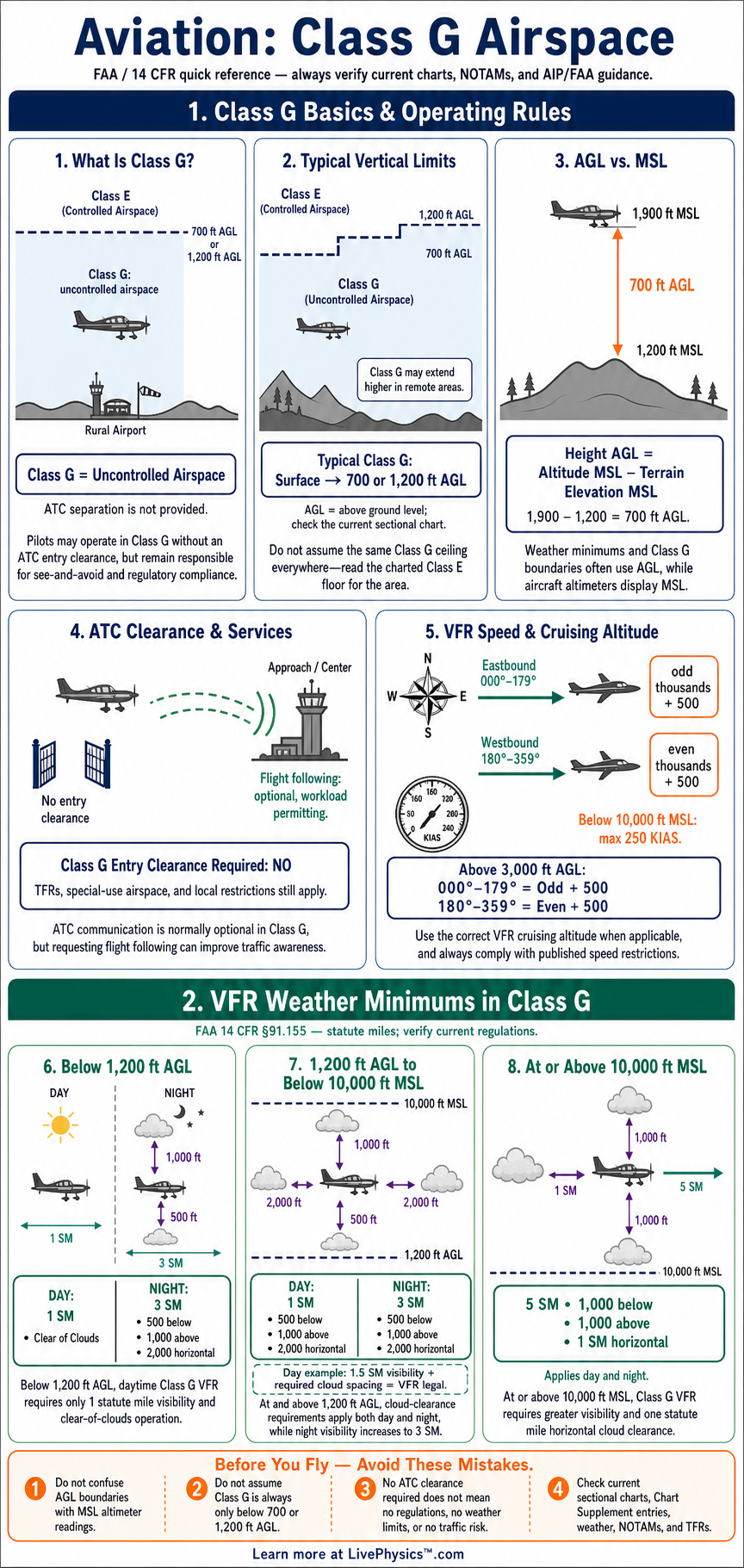
Class G airspace is the basic uncontrolled airspace in the United States. Pilots often operate in it during rural flying, low-level flight, and operations near smaller airports. This cheat sheet helps students quickly identify Class G airspace and apply the correct visual flight rules.
It also emphasizes that charts, NOTAMs, and current FAA guidance always control.
The most important Class G rules involve altitude above ground level, altitude above mean sea level, time of day, flight visibility, and cloud clearance. Daytime rules below 1,200 feet above ground level are less restrictive than most other VFR rules. Night operations and higher altitudes require greater visibility and specific distances from clouds.
Pilots must also understand that Class G does not mean aircraft operations are unregulated.
Key Facts
- Class G airspace is uncontrolled airspace where ATC separation services are not normally provided to VFR aircraft.
- Below 1,200 feet AGL in Class G during the day, VFR minimums are 1 statute mile visibility and clear of clouds.
- Below 1,200 feet AGL in Class G at night, VFR minimums are 3 statute miles visibility, 500 feet below clouds, 1,000 feet above clouds, and 2,000 feet horizontally from clouds.
- More than 1,200 feet AGL and below 10,000 feet MSL in Class G during the day, VFR minimums are 1 statute mile visibility, 500 feet below, 1,000 feet above, and 2,000 feet horizontally from clouds.
- More than 1,200 feet AGL and below 10,000 feet MSL in Class G at night, VFR minimums are 3 statute miles visibility, 500 feet below, 1,000 feet above, and 2,000 feet horizontally from clouds.
- At or above 10,000 feet MSL in Class G, VFR minimums are 5 statute miles visibility, 1,000 feet below clouds, 1,000 feet above clouds, and 1 statute mile horizontally from clouds.
- AGL means above ground level, while MSL means above mean sea level, and Class G rules use both altitude references.
- Pilots must verify current charts, NOTAMs, weather, and FAA guidance because local airspace boundaries and restrictions can change.
Vocabulary
- Class G airspace
- Uncontrolled airspace where ATC does not normally separate VFR aircraft from other aircraft.
- VFR
- Visual flight rules are regulations for flying primarily by outside visual reference and required weather minimums.
- Flight visibility
- Flight visibility is the distance a pilot can see and identify prominent unlighted objects during flight.
- Cloud clearance
- Cloud clearance is the required vertical and horizontal distance an aircraft must maintain from clouds.
- AGL
- Above ground level is an altitude measured from the surface directly below the aircraft.
- MSL
- Mean sea level is an altitude reference measured from average sea level.
Common Mistakes to Avoid
- Using the daytime below 1,200 feet AGL rule at night is wrong because nighttime Class G operations require 3 statute miles visibility and specified cloud clearance.
- Confusing AGL with MSL is wrong because the 1,200-foot boundary uses height above the surface, while the 10,000-foot boundary uses mean sea level.
- Assuming Class G means no rules apply is wrong because pilots must still follow VFR weather minimums, right-of-way rules, equipment rules, and all applicable regulations.
- Using reported ground visibility as flight visibility without checking conditions aloft is wrong because the pilot must meet the visibility requirement from the aircraft.
- Assuming airspace around every untowered airport is Class G is wrong because some untowered airports lie under Class E or other controlled airspace.
Practice Questions
- 1 A VFR aircraft flies in Class G at 900 feet AGL during the day. What minimum flight visibility and cloud clearance are required?
- 2 A VFR aircraft flies in Class G at 2,500 feet AGL and 6,500 feet MSL at night. State the required visibility and cloud clearance.
- 3 A VFR aircraft operates in Class G at 11,000 feet MSL. What minimum flight visibility and cloud clearance are required?
- 4 Explain why a pilot must identify both AGL and MSL altitude before selecting the correct Class G weather minimums.
Understanding Class G Airspace
Class G is uncontrolled airspace, meaning air traffic control does not provide separation services to VFR aircraft as a normal service. It commonly begins at the surface in rural areas and may extend upward to the base of overlying controlled airspace. Its upper limit varies by location.
A sectional chart, chart supplement, and applicable airspace information help a pilot determine where Class G begins and ends. Pilots should never assume that all airspace near an untowered airport is Class G.
The key rule is found in 14 CFR section 91.155. Below 1,200 feet above ground level during the day, a VFR aircraft needs at least one statute mile of flight visibility and must remain clear of clouds. This rule supports low-level daytime operations where a pilot can see the ground and avoid clouds.
At night in the same area, the requirement increases to three statute miles visibility. The aircraft must then remain 500 feet below clouds, 1,000 feet above clouds, and 2,000 feet horizontally from clouds.
At more than 1,200 feet above the surface and below 10,000 feet mean sea level, daytime visibility remains one statute mile. Cloud clearance becomes 500 feet below, 1,000 feet above, and 2,000 feet horizontally. At night, visibility increases to three statute miles while the same cloud distances apply.
At and above 10,000 feet mean sea level, a VFR pilot needs five statute miles visibility. The required cloud distances are 1,000 feet below, 1,000 feet above, and one statute mile horizontally.
These limits matter because pilots must see and avoid terrain, towers, other aircraft, and changing weather. Visibility can fall rapidly in haze, smoke, precipitation, or fading light. Cloud clearance gives pilots room to detect aircraft that may be operating near clouds.
It also reduces the chance of entering instrument meteorological conditions without proper training, equipment, or clearance. A pilot must use the visibility that actually exists during the flight, not a forecast that looked acceptable before departure.
When studying, separate the rules by three factors. First, identify whether the aircraft is below or above 1,200 feet above ground level. Second, determine whether the flight is during day or night.
Third, check whether the aircraft is at or above 10,000 feet mean sea level. Practice reading both AGL and MSL references carefully because they are not interchangeable. Remember that FAA / 14 CFR quick reference material supports learning, but pilots must always verify current charts, NOTAMs, and AIP or FAA guidance before flight.