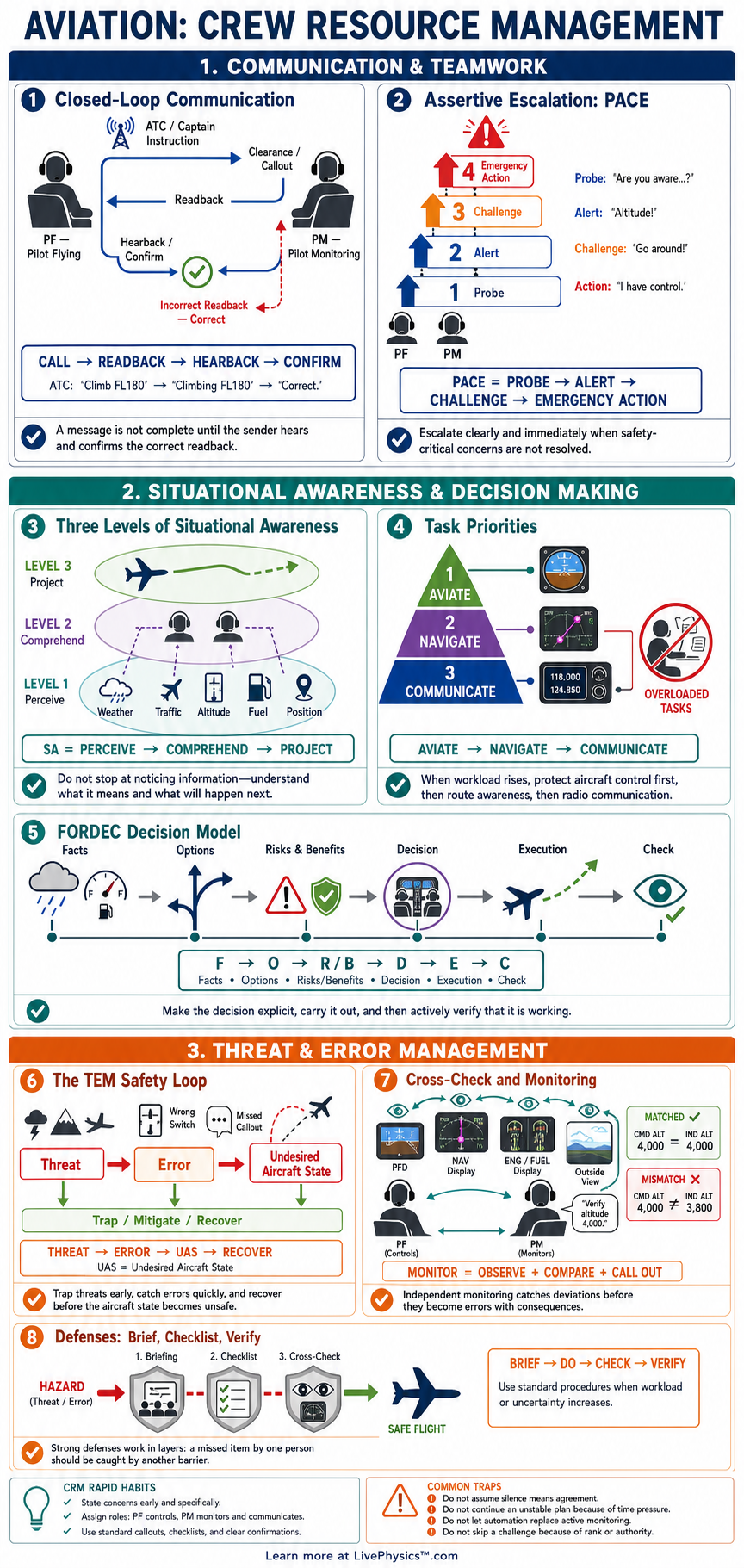
Crew Resource Management, often called CRM, is the set of teamwork skills pilots use to operate safely and effectively. It helps crew members communicate clearly, share information, make sound decisions, and manage pressure. Students need this cheat sheet because technical flying skill alone does not prevent every accident.
Many aviation events involve breakdowns in communication, monitoring, leadership, or decision-making.
CRM treats every available person, procedure, tool, and source of information as a resource. Its core skills include communication, situational awareness, workload management, decision-making, leadership, followership, and threat and error management. Effective crews state concerns clearly, verify important actions, and support each other without losing authority or discipline.
The goal is to recognize risks early and prevent small errors from becoming unsafe outcomes.
Key Facts
- Crew Resource Management uses people, procedures, equipment, and information to improve safety and decision-making.
- Closed loop communication follows the rule message given, message repeated or confirmed, and understanding verified.
- Situational awareness includes knowing the current situation, understanding its meaning, and anticipating what may happen next.
- The basic decision-making cycle is identify the problem, gather facts, consider options, act, and review the outcome.
- Threat and error management follows the rule identify threats, avoid or trap errors, and recover from unsafe aircraft states.
- Workload management prioritizes aviate, navigate, and communicate before lower-priority tasks.
- An effective safety challenge states the concern, explains the risk, proposes an action, and escalates if needed.
Vocabulary
- Crew Resource Management
- Crew Resource Management is the use of teamwork, communication, and available resources to operate an aircraft safely.
- Situational awareness
- Situational awareness is an accurate understanding of the aircraft, environment, and likely future events.
- Closed loop communication
- Closed loop communication is a process in which a message is acknowledged or repeated and then verified by the sender.
- Threat
- A threat is an external event or condition that adds risk or complexity to a flight operation.
- Error
- An error is an unintended action or decision that may reduce safety if it is not detected and managed.
- Assertiveness
- Assertiveness is the respectful and clear expression of a safety concern or needed action.
Common Mistakes to Avoid
- Using vague hints instead of a direct safety statement is wrong because the other pilot may not recognize the urgency or required action. State the concern and the needed response clearly.
- Assuming a clearance, altitude, or runway assignment was understood is wrong because assumptions can create dangerous mismatches. Use readbacks and confirmation for critical information.
- Fixating on one malfunction is wrong because it can cause the crew to lose awareness of altitude, airspeed, navigation, or fuel. Keep monitoring the overall flight path while diagnosing the problem.
- Treating the captain as the only source of decisions is wrong because other crew members may notice hazards or hold important information. Use authority appropriately while encouraging timely safety input.
- Continuing nonessential tasks during a high-workload event is wrong because it distracts from controlling the aircraft. Delay, delegate, or stop lower-priority work until the situation is stable.
Practice Questions
- 1 During an approach, the aircraft is cleared to descend to 3,000 feet. Write a closed loop communication exchange between the pilot flying and pilot monitoring.
- 2 A crew has 4,800 kilograms of fuel remaining and expects to use 3,900 kilograms to reach the destination. If the required reserve is 900 kilograms, calculate the expected fuel remaining after landing.
- 3 A flight is 25 nautical miles from the airport and is descending at 1,500 feet per minute from 7,500 feet to 3,000 feet. Calculate the time needed for the descent.
- 4 A first officer believes the aircraft is becoming unstable on approach, but the captain continues toward landing. Explain how the first officer should communicate and escalate the concern using CRM principles.
Understanding Crew Resource Management
Crew Resource Management developed after accident investigations showed that capable crews could still make serious mistakes when teamwork failed. A captain may have strong technical knowledge, but safety improves when every crew member can speak up about a concern. CRM creates a working environment where information moves freely and important warnings are heard.
It does not remove the captain's authority. It helps the captain make better decisions by using the full knowledge of the crew.
Communication is one of the most visible CRM skills. Crews use standard phraseology, briefings, callouts, readbacks, and checklists to make messages clear. Closed loop communication means one person gives a message, the other repeats or confirms it, and the sender verifies that it was understood.
This process is especially important for altitudes, headings, clearances, runway assignments, and aircraft configuration. Direct language reduces the chance that a vague hint will be ignored during a busy phase of flight.
Situational awareness means understanding what is happening now, what it means, and what may happen next. A crew builds this awareness from instruments, outside visual cues, weather, air traffic control messages, aircraft systems, and operational plans. It can fade when workload is high, when a crew becomes focused on one fault, or when assumptions replace checks.
Good crews regularly compare the aircraft's actual position, altitude, fuel state, and configuration with the plan. They also state changes aloud so both pilots maintain the same mental picture.
Decision-making in CRM is structured rather than impulsive. Crews identify the problem, gather relevant facts, consider available options, choose an action, carry it out, and review the result. Time pressure can change how much detail is possible, but it should not eliminate cross-checking.
Threat and error management supports this process. A threat is anything that increases operational complexity, such as poor weather, fatigue, traffic, or an unfamiliar airport. An error is an unintended action or decision that can be detected and managed before it leads to an undesired aircraft state.
Workload management is vital during takeoff, approach, landing, and abnormal events. Crews prioritize flying the aircraft, navigating, and communicating, then complete lower-priority tasks when time allows. They may divide duties, delay nonessential tasks, use automation carefully, or request extra time from air traffic control.
Assertive followership matters when a pilot notices a hazard. A useful escalation pattern is to state the concern, describe the risk, suggest a safe action, and continue until the issue is resolved. CRM is a habit of disciplined cooperation that protects passengers, crew, and aircraft.