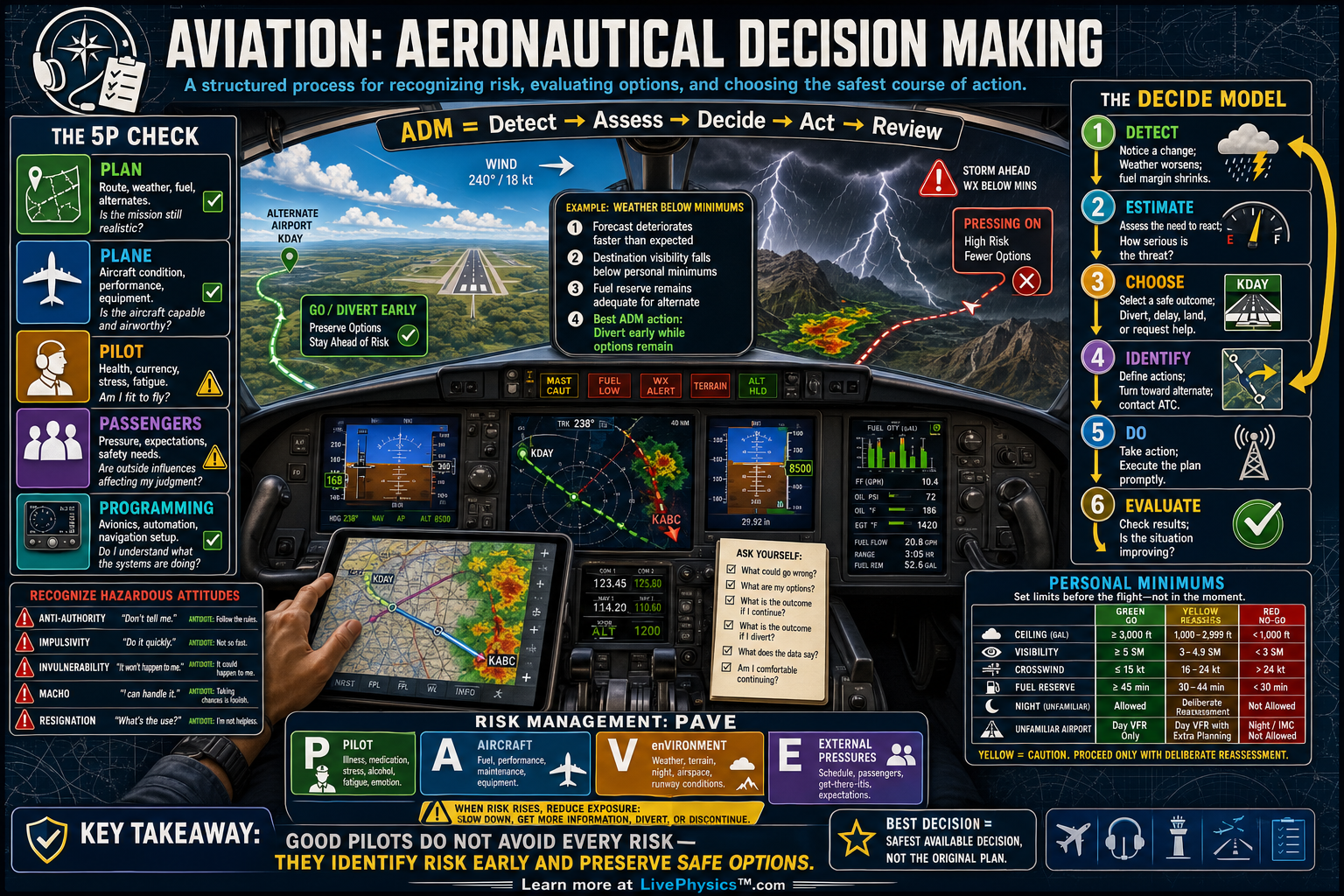
Aeronautical decision making, often called ADM, is the process pilots use to make safe choices before and during a flight. It turns a complex situation into a series of manageable checks and actions. Good ADM matters because weather, aircraft condition, fuel, fatigue, and outside pressure can change quickly.
A pilot who notices risks early has more safe options.
ADM is not a single checklist item or a talent that some pilots naturally possess. It is a repeatable habit of gathering information, identifying hazards, choosing a safe response, then checking whether that response works. Pilots use tools such as PAVE, the 3P model, and the DECIDE model to organize their thinking.
The safest decision may be delaying a flight, turning around, diverting, or saying no to a plan that no longer fits the conditions.
Understanding Aviation, Aeronautical Decision Making
Aeronautical decision making begins before the engine starts. A pilot reviews weather reports, notices, aircraft records, fuel needs, route choices, and personal readiness. The PAVE checklist organizes many of these risks into Pilot, Aircraft, enVironment, and External pressures.
Each category can create a problem on its own. Several small problems together can create a situation that exceeds a pilot's ability or the aircraft's limits.
Personal condition deserves careful attention because poor judgment often begins with a pilot who is not fully ready. The IMSAFE checklist covers Illness, Medication, Stress, Alcohol, Fatigue, and Emotion. A pilot may be legally allowed to fly while still not being in a good condition to make demanding decisions.
Fatigue can slow recognition of a weather change. Stress can make a pilot fixate on reaching a destination instead of reassessing the plan.
The 3P model gives pilots a cycle they can use throughout flight. First, perceive the facts in the current situation. Next, process what those facts mean by considering hazards, limits, and available choices.
Finally, perform the safest action, then monitor its result. This cycle is useful when clouds build along a route, a warning light appears, or a passenger becomes ill. It prevents a pilot from treating an old plan as if it must remain correct.
Risk management is not about removing every risk from aviation. Flying always involves some uncertainty, so the goal is to keep risk within acceptable limits. Pilots can lower risk by adding fuel margin, choosing a different route, departing earlier, bringing another qualified pilot, or canceling.
A diversion airport is most useful when selected before it becomes urgently needed. Good pilots protect their options while options still exist.
External pressure is one of the most common threats to sound ADM. A meeting, a reservation, a waiting passenger, or money already spent can make a pilot feel committed to completing a flight. This is called get there itis, and it can lead to continuing into worsening weather or accepting inadequate fuel reserves.
Students should practice saying that a changed condition requires a changed plan. The key learning habit is to identify the hazard, name the available options, select a conservative action, and reevaluate often.
Key Facts
- PAVE = Pilot + Aircraft + enVironment + External pressures.
- IMSAFE = Illness + Medication + Stress + Alcohol + Fatigue + Emotion.
- 3P = Perceive + Process + Perform.
- DECIDE = Detect + Estimate + Choose + Identify + Do + Evaluate.
- Fuel remaining = fuel at departure - fuel used.
- Time = distance / groundspeed.
Vocabulary
- Aeronautical decision making
- A systematic process pilots use to recognize hazards, evaluate risk, choose actions, and review the outcome.
- Risk management
- The process of identifying hazards and reducing their chance or severity to an acceptable level.
- Diversion
- A change from the planned route or destination to land at another suitable airport.
- External pressure
- Pressure from schedules, passengers, money, or personal goals that can push a pilot toward an unsafe choice.
- Get there itis
- A hazardous mindset in which a pilot continues toward the original destination despite changing conditions.
Common Mistakes to Avoid
- Treating a preflight plan as fixed is wrong because weather, fuel status, and aircraft condition can change after departure. Reassess the plan whenever new information appears.
- Ignoring fatigue because it does not violate a regulation is wrong because fatigue slows judgment and reaction time. Use IMSAFE honestly before accepting a flight.
- Waiting too long to choose a diversion is wrong because fuel, daylight, weather, and workload may reduce available choices. Identify suitable alternates early in the flight.
- Letting a passenger schedule control the decision is wrong because external pressure does not change aircraft limits or weather hazards. State the safety reason clearly and select a safer option.
Practice Questions
- 1 A pilot plans a 180 nautical mile flight at a groundspeed of 120 knots. How many hours will the flight take, assuming constant groundspeed?
- 2 An aircraft departs with 52 gallons of usable fuel and burns 8 gallons per hour. How many gallons remain after a 3.5 hour flight?
- 3 A pilot finds lowering clouds ahead, has adequate fuel for a nearby alternate airport, and feels pressure to arrive for an important meeting. Explain the safest ADM process and the action that best manages the risk.