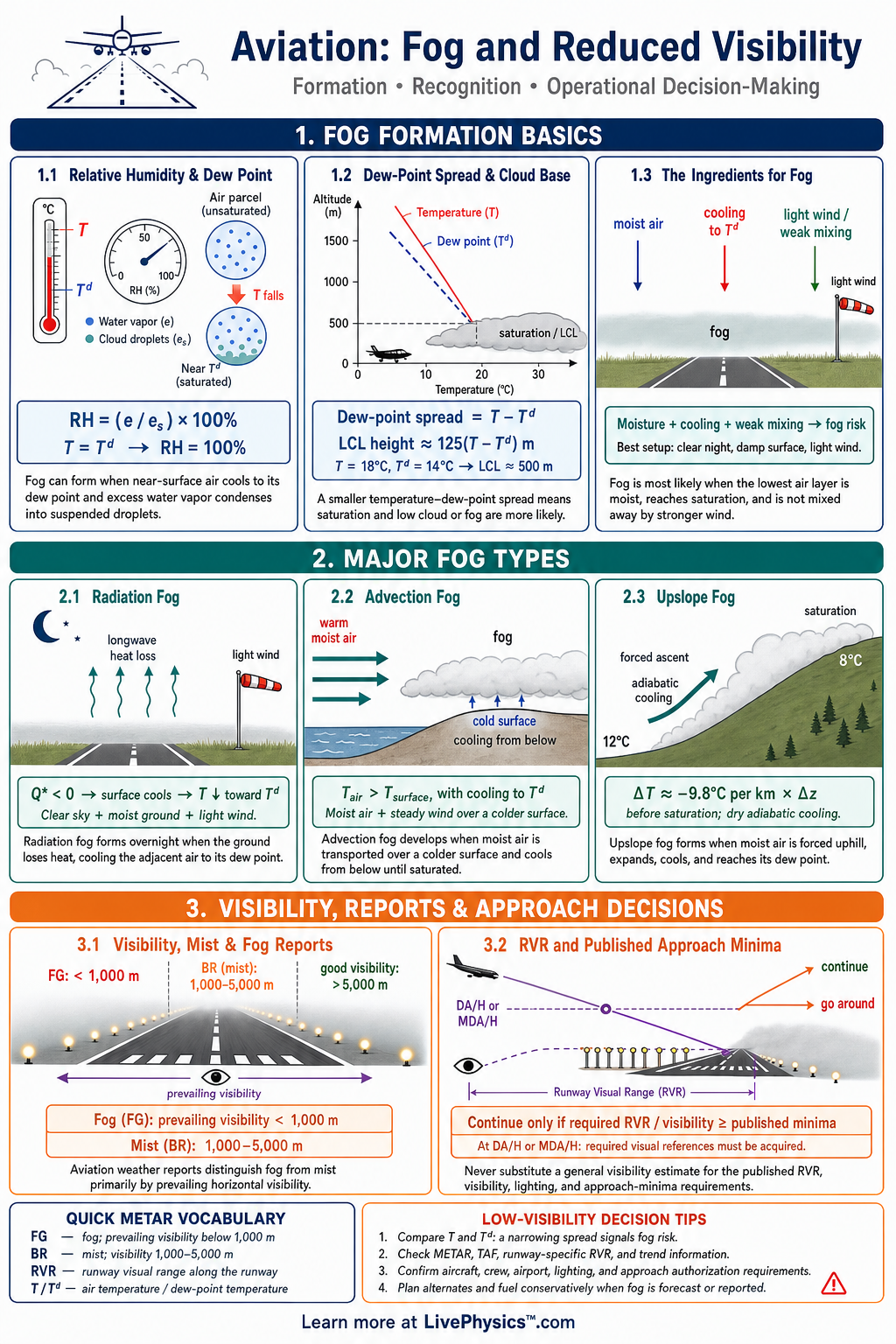
Fog and reduced visibility are major aviation hazards because pilots may lose the visual references needed for takeoff, landing, taxiing, and terrain avoidance. This cheat sheet explains how fog forms, how to recognize the weather patterns that support it, and how visibility is reported. It also connects weather knowledge to practical operational decisions.
Fog is a cloud at the ground, made of tiny water droplets that scatter light and hide objects. It forms when air near the surface becomes saturated, meaning air temperature cools to its dew point or moisture is added. Pilots use temperature and dew point, visibility reports, ceiling reports, runway visual range, forecasts, and personal limits to assess risk.
Key Facts
- Fog is a cloud at the surface that reduces prevailing visibility to less than 1 kilometer, or about 5 eighths of a statute mile.
- The dew point spread equals air temperature minus dew point temperature, and a smaller spread indicates a greater chance of saturation.
- When air temperature equals dew point, the dew point spread equals zero and condensation can occur.
- Radiation fog forms when the ground cools at night and cools nearby moist air to its dew point.
- Advection fog forms when warm, moist air moves over a colder land or water surface and is cooled to its dew point.
- Runway visual range is the distance over which a pilot can see runway surface markings or lights along a specific runway.
- A ceiling is the lowest broken or overcast cloud layer, or the vertical visibility into an obscuring phenomenon.
Vocabulary
- Fog
- Fog is a visible collection of tiny water droplets at the ground that severely reduces horizontal visibility.
- Dew point
- The dew point is the temperature at which air becomes saturated when cooled without changing its water vapor content.
- Visibility
- Visibility is the greatest distance at which prominent objects can be seen and identified.
- Ceiling
- A ceiling is the height of the lowest broken or overcast cloud layer, or vertical visibility in an obscuration.
- Runway visual range
- Runway visual range is an instrument-based measurement of the distance a pilot can see runway lights or markings.
- Advection fog
- Advection fog forms when moist air moves horizontally over a colder surface and cools to its dew point.
Common Mistakes to Avoid
- Treating a small temperature and dew point spread as proof that fog already exists is wrong because saturation also depends on local cooling, moisture, wind, and surface conditions.
- Confusing visibility with ceiling is wrong because visibility measures horizontal sight distance while ceiling measures cloud or obscuration height.
- Assuming airport visibility applies equally across every runway is wrong because fog can vary greatly by runway, threshold, terrain, and time.
- Using only a forecast before departure is wrong because fog can form or clear rapidly, so pilots must also check current observations and trends.
- Continuing to taxi when uncertain of position is wrong because low visibility raises the risk of runway incursions and collisions, so the pilot should stop and request assistance.
Practice Questions
- 1 The air temperature is 12 degrees Celsius and the dew point is 10 degrees Celsius. Calculate the dew point spread and state what it suggests about saturation risk.
- 2 An airport reports temperature 4 degrees Celsius and dew point 4 degrees Celsius after a clear, calm night over wet ground. Identify the fog type most likely to develop.
- 3 Warm, moist air moves from the sea over a much colder coastal surface. Name the likely fog type and explain the cooling process.
- 4 Explain why a pilot should use runway visual range, current observations, and personal operating limits together rather than relying only on a general airport visibility report.
Understanding Fog and Reduced Visibility
Fog is not simply low cloud. It is a surface weather condition that can reduce horizontal visibility quickly and unevenly. The key process is saturation.
Air becomes saturated when its temperature reaches the dew point, or when enough water vapor enters the air. The temperature minus dew point spread gives a useful warning sign.
A small spread means the air is close to saturation. A spread of zero means the temperature and dew point are equal, so fog, dew, or low cloud may form if suitable particles are present.
Radiation fog often develops on clear nights with light winds. The ground loses heat after sunset, then cools the air directly above it. If that air reaches its dew point, fog forms.
It is common in valleys, over damp ground, and after rain. Advection fog develops when warm, moist air moves over a colder surface. Sea fog and fog near cold coastlines are common examples.
Upslope fog forms when moist air is forced to rise along terrain and cools as it rises. Steam fog can form when cold air moves over warmer water, adding moisture to the lower air.
Aviation weather reports separate visibility from ceiling. Visibility describes how far an observer can see and identify objects. Ceiling is the height of the lowest cloud layer reported as broken or overcast, or the vertical visibility into an obscuring phenomenon.
Fog can produce both poor visibility and a very low ceiling. Mist usually allows better visibility than fog, but both can make runway lights, signs, other aircraft, and obstacles difficult to see. Haze is different because it is usually caused by dry particles rather than liquid droplets.
Runway visual range gives a runway-specific estimate of how far a pilot can see runway markings or lights. It can differ from the general airport visibility because fog may be thicker near one runway threshold or in low areas. Instrument approaches have published visibility and decision requirements.
A pilot must understand the applicable procedure, aircraft equipment, airport lighting, and operating rules. Meeting a reported minimum does not guarantee a comfortable or safe visual picture during the approach.
Reduced visibility requires conservative thinking before flight and during flight. Check current observations, trend information, terminal forecasts, satellite imagery, and nearby reports. Expect conditions to change around sunrise, sunset, frontal boundaries, and wet surfaces.
Plan alternates, fuel, approach options, and taxi routes before entering low visibility. During taxi, use charts, signs, lights, and clearances carefully.
Stop and request help when position is uncertain. The most important study focus is linking the physical cause of fog to its likely location, timing, movement, and operational effect.