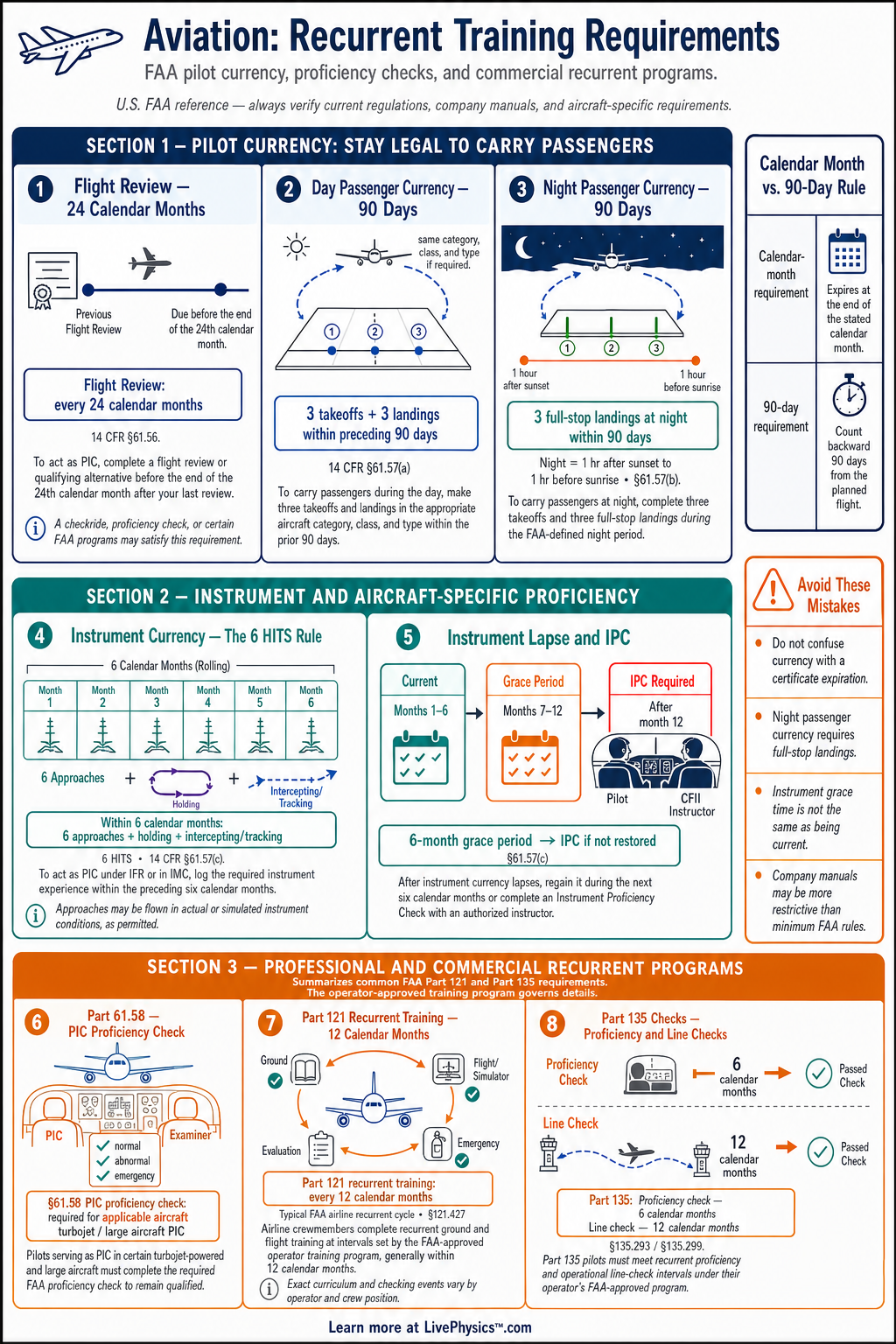
This cheat sheet explains the FAA rules that help pilots remain legally current and prepared to fly. Recurrent training requirements are not one single event, because different flying activities have different deadlines and standards. Pilots need to track flight reviews, recent flight experience, instrument currency, medical eligibility, and any training required by an employer or aircraft operator.
This reference helps students separate these rules and plan ahead.
The core FAA rules appear mainly in 14 CFR parts 61, 91, 121, and 135. A flight review normally occurs every 24 calendar months, while passenger and instrument currency use shorter rolling time periods. Medical certificate duration depends on the pilot certificate held, age, and kind of operation.
Airline, charter, and other commercial pilots also follow structured operator training programs that may be more demanding than the basic Part 61 rules.
Key Facts
- Under 14 CFR 61.56, a pilot normally needs a flight review within the preceding 24 calendar months to act as pilot in command.
- A standard flight review includes at least one hour of flight training and one hour of ground training with an authorized instructor.
- Under 14 CFR 61.57, carrying passengers generally requires three takeoffs and three landings within the preceding 90 days in the same category, class, and type when a type rating is required.
- For night passenger carrying, the required three takeoffs and landings must be full stops made from one hour after sunset until one hour before sunrise.
- Instrument currency requires six instrument approaches, holding procedures, and intercepting and tracking courses through navigation systems within the preceding six calendar months.
- After missing the six-month instrument currency period, a pilot has an additional six calendar months to regain currency before an instrument proficiency check is required.
- A pilot in command of an aircraft requiring a type rating must generally complete a pilot in command proficiency check within the preceding 12 calendar months under 14 CFR 61.58.
- A flight review may be substituted by certain practical tests, proficiency checks, or a completed FAA WINGS phase when completed within the preceding 24 calendar months.
Vocabulary
- Flight review
- A periodic review with an authorized instructor that confirms a pilot can safely exercise certificate privileges.
- Currency
- The recent flight experience a pilot must have before conducting a specific activity such as carrying passengers or flying by instruments.
- Instrument proficiency check
- An evaluation by an authorized instructor, examiner, or qualified person used to restore instrument currency after the allowed period has passed.
- Type rating
- An additional qualification required to act as pilot in command of certain large, turbine-powered, or otherwise specified aircraft.
- Calendar month
- A time period that ends on the last day of a named month rather than after a fixed number of days.
- Safety pilot
- A qualified pilot who watches for traffic while another pilot operates under simulated instrument conditions.
Common Mistakes to Avoid
- Confusing a flight review with passenger currency is wrong because a current flight review does not replace the 90-day takeoff and landing requirement.
- Counting 24 calendar months as exactly 730 days is wrong because FAA calendar-month deadlines normally run through the last day of the applicable month.
- Using touch-and-go landings for night passenger currency is wrong because the required night landings must be full-stop landings.
- Logging six instrument approaches but ignoring holding and tracking is wrong because all required instrument tasks must be completed for instrument currency.
- Assuming Part 61 rules are the only requirements for a commercial flight is wrong because Part 121 and Part 135 operators may impose approved recurrent training and checking requirements.
Practice Questions
- 1 A pilot completed a flight review on May 12, 2024. Through what date may that pilot normally act as pilot in command without another flight review or valid substitute?
- 2 A pilot made three daytime takeoffs and landings 75 days ago in a Cessna 172. Can the pilot carry passengers in that aircraft during daylight today under the basic 90-day rule?
- 3 A pilot last completed all required instrument currency tasks in January. By what general point must the pilot regain currency or complete an instrument proficiency check before acting as pilot in command under IFR?
- 4 Explain why a pilot can be current for carrying passengers but still not be legal or prepared to fly under IFR.
Understanding Recurrent Training Requirements
FAA recurrent requirements serve two connected goals. They help pilots keep practical skills fresh, and they reduce the chance that a pilot flies after a long break without realizing it. The rules use several different clocks.
Some deadlines use calendar months, while others use a number of days before a flight. A calendar month ends on the last day of that month, which can give a pilot more time than counting a fixed number of days. Accurate logbook entries and training records make these dates easier to verify.
The flight review is the broadest recurring requirement for most certificated pilots. It normally includes at least one hour of ground training and one hour of flight training with an authorized instructor. The instructor chooses material that fits the pilot's experience and the flying they do.
A review might cover regulations, airspace, weather decisions, emergency procedures, landings, or navigation. It is not a pass or fail checkride, but the instructor must find that the pilot can safely exercise the privileges of the certificate. Certain practical tests, proficiency checks, and completed FAA WINGS phases can substitute for a flight review.
Passenger carrying creates a separate recent experience requirement. To carry passengers, a pilot generally needs three takeoffs and three landings within the preceding 90 days in the same category and class of aircraft. A type rating is also required when applicable.
For passengers at night, the three required takeoffs and landings must be to a full stop during the period from one hour after sunset until one hour before sunrise. This rule matters because takeoff and landing skills fade quickly. It applies even when a pilot has a current flight review.
Instrument flying has its own currency system because instrument skills demand frequent practice. During the preceding six calendar months, a pilot must log six instrument approaches plus holding procedures and intercepting and tracking courses through navigation systems. The work may be completed in actual or simulated instrument conditions when FAA rules are met.
A pilot who misses this period has another six calendar months to regain currency under specified conditions. After that, an instrument proficiency check is required. Pilots should study the exact logging rules, including when a safety pilot is needed and how simulated instrument time is recorded.
Professional operations add another layer of recurrent training. Pilots flying for Part 121 airlines or Part 135 operators must meet company training, checking, and qualification programs approved under FAA rules. Aircraft that require a type rating may also require an annual pilot in command proficiency check.
Medical eligibility remains essential for operations that require a medical certificate, and its duration depends on the certificate class and the pilot's age. The safest study habit is to identify the operation first, then check every applicable rule, company manual, and aircraft requirement before flying.