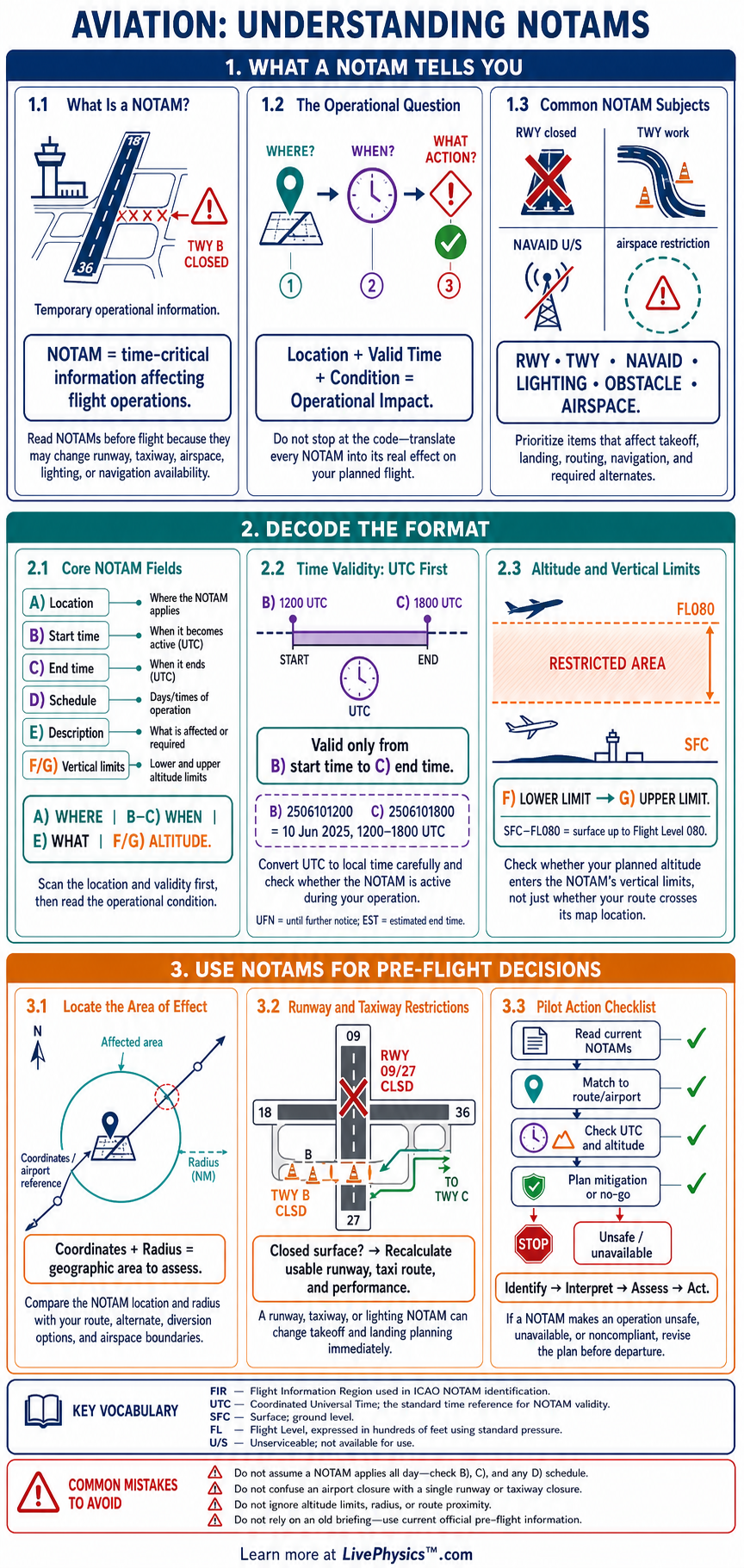
NOTAMs are time-critical aviation notices that warn pilots and flight crews about changes or hazards affecting a flight. They can describe closed runways, unavailable navigation aids, temporary airspace restrictions, obstacles, lighting failures, and many other operational conditions. This cheat sheet helps students read NOTAMs quickly and identify information that matters before departure.
It supports safe, legal, and well-planned pre-flight decision making.
A standard international NOTAM contains coded fields that identify the affected area, subject, condition, altitude range, time period, and plain-language details. The Q line provides structured ICAO information, while the B and C fields show start and end times in UTC. The E field gives the full operational message that pilots must understand.
Careful interpretation is important because a short notice can change a route, fuel plan, alternate airport, or landing procedure.
Key Facts
- A NOTAM provides temporary or time-critical information about hazards, facilities, services, procedures, or airspace that may affect a flight.
- The B field gives the NOTAM start time and the C field gives the end time, and both times are normally expressed in UTC.
- The A field identifies the affected location, such as an aerodrome or a flight information region.
- The E field contains the main operational text and should be read in full before deciding whether the notice affects a flight.
- In the Q line, the altitude limits show the vertical area affected, usually written as a lower limit followed by an upper limit.
- A NOTAM radius identifies the affected horizontal area around the stated coordinates, commonly measured in nautical miles.
- A runway closure NOTAM means the runway must not be planned for takeoff or landing during the stated effective period.
- Pilots should check NOTAMs again close to departure because a new notice can be issued after the original briefing.
Vocabulary
- NOTAM
- A NOTAM is an official aviation notice that gives time-sensitive information relevant to flight operations.
- UTC
- UTC is the worldwide time standard used in aviation so times remain consistent across time zones.
- Q line
- The Q line is the coded section of an ICAO NOTAM that summarizes its location, subject, scope, altitude, and area.
- FIR
- A flight information region is a defined area of airspace where flight information and alerting services are provided.
- Aerodrome
- An aerodrome is a defined area on land or water used for aircraft arrival, departure, and ground movement.
- Unserviceable
- Unserviceable means that a facility, light, navigation aid, or other aviation resource is unavailable or not operating correctly.
Common Mistakes to Avoid
- Reading NOTAM times as local time is wrong because B and C times are normally published in UTC. Convert the time carefully before deciding whether the notice is active.
- Ignoring the E field is wrong because the coded fields alone may not explain the full restriction or operational consequence. Read the complete plain-language notice.
- Assuming every airport NOTAM affects all runways is wrong because the notice may name one runway, taxiway, apron area, or procedure only. Match the notice to the facilities in the flight plan.
- Overlooking altitude limits is wrong because some airspace or hazard notices apply only within a stated vertical range. Check whether the planned cruise, climb, or descent altitude enters that range.
- Using an old briefing is wrong because NOTAMs can be issued, cancelled, or changed shortly before departure. Obtain current official information before flight.
Practice Questions
- 1 A NOTAM has B) 2506100800 and C) 2506101400. How many hours is the notice active?
- 2 A pilot plans to arrive at 1230 UTC. A runway closure NOTAM is active from 1100 UTC until 1300 UTC. Is the runway available for the planned arrival?
- 3 A NOTAM states that a crane is located within 2 nautical miles of an aerodrome and reaches 450 feet above ground level. What two parts of a low-level arrival or departure plan should the pilot review?
- 4 A NOTAM reports that an instrument landing system is unserviceable at the destination. Explain why this may affect the flight even when the weather forecast appears suitable.
Understanding Understanding NOTAMs
A NOTAM is an official notice about an aeronautical facility, service, procedure, or hazard that may affect flight operations. The name originally meant Notice to Airmen, but ICAO now uses Notice to Air Missions. NOTAMs are published when information is temporary, urgent, or not yet included in normal aeronautical publications.
A pilot reviews them during pre-flight planning along with weather, charts, airport information, and aircraft performance data. The goal is to find operational changes before they become a surprise in flight.
Most ICAO NOTAMs use a predictable structure. The Q line contains coded information for sorting and filtering notices. It identifies the flight information region, subject, condition, traffic affected, purpose, scope, altitude limits, coordinates, and a radius.
The A field identifies the relevant location or aerodrome. The B field shows when the NOTAM begins, and the C field shows when it ends.
These times use UTC, which prevents confusion between local time zones. The E field contains the detailed plain-language text and deserves close attention.
A pilot should first decide whether a NOTAM affects the planned flight. Notices about departure and destination airports often have the highest priority. Runway closures, reduced runway length, displaced thresholds, unserviceable approach lights, and closed taxiways can directly change takeoff and landing planning.
En route notices can affect navigation aids, airways, controlled airspace, military activity, cranes, parachute operations, or GPS reliability. A notice may also apply only below a stated altitude or within a stated distance from a location. Reading every field together prevents a pilot from treating a local warning as a route-wide restriction.
Good NOTAM study involves translating codes into a clear operational action. A runway lighting outage may require a different arrival time or an alternate airport. A navigation aid outage may affect a planned instrument procedure or backup navigation plan.
A temporary restricted area may require a reroute, additional fuel, and a revised weather review. Students should practice identifying the location, effective period, affected facility, and practical consequence of each notice.
They should also distinguish a NOTAM that is merely informative from one that makes a procedure unavailable. The safest approach is to read current official notices, verify uncertain details through approved briefing sources, and include important restrictions in the final flight plan.