Quick answer
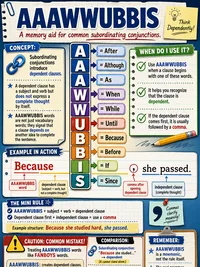
AAAWWUBBIS remembers common subordinating conjunctions: after, although, as, when, while, until, because, before, if, and since.
Study next
Quick self-quiz
Tap each word to check what it stands for.
When to use it
Use AAAWWUBBIS while drafting or revising a complex sentence. First, find the word that introduces the less complete idea: after, although, as, when, while, until, because, before, if, or since. That word turns its clause into a dependent clause, so the clause needs an independent clause to complete the thought.
Next, check the order of the clauses. When the AAAWWUBBIS clause comes first, place a comma after that opening dependent clause before the independent clause begins. When the independent clause comes first, a comma is usually unnecessary before the closing dependent clause.
Example
In "Because she studied hard, she passed," because introduces the dependent clause "Because she studied hard." The words "she passed" form the independent clause, and the comma marks the boundary after the opening dependent clause. Moving the clauses gives "She passed because she studied hard," which normally needs no comma before because.
Try the same check with a time relationship: "When the bell rang, the students packed their bags." When begins the dependent clause, while the second clause can stand alone. Labeling both clauses makes the punctuation decision easier than memorizing a comma by itself.
Common mistake
Do not treat AAAWWUBBIS words like FANBOYS words. Subordinating conjunctions make one idea depend on another, whereas coordinating conjunctions such as and, but, and so can join equal grammatical parts. A sentence that starts with "Although" is incomplete until an independent clause finishes the contrast.
Also avoid inserting a comma automatically before every AAAWWUBBIS word. Clause order controls the usual punctuation pattern, so identify which clause can stand alone before adding a comma. Finally, remember that since and while can express more than one relationship; read the whole sentence to decide whether the writer means time, cause, or contrast.