Grammar Patterns Lab
Sharpen your editing skills on real sentences. For each item, identify the kind of grammar error, then rewrite the sentence so it follows standard English rules. The lab tracks your accuracy across ten error categories and shows a category breakdown at the end of each session.
Guided Experiment Focus on Subject-Verb Agreement
Predict your accuracy if you practice only subject-verb agreement items. Will identification rate and correction rate be close, or will one be much higher than the other?
Write your hypothesis in the Lab Report panel, then click Next.
Controls
Phase Setup
Identify the grammar error, then rewrite the sentence so it follows standard English rules.
Set up your session
Difficulty
Error type filter
18 exercises available at this difficulty.
Session length
Data Table
(0 rows)| # | Trial | Difficulty | Items | Identified Correctly | Corrected Correctly | Final Score (%) |
|---|
Reference Guide
Subject-Verb Agreement Rules
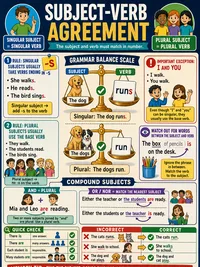
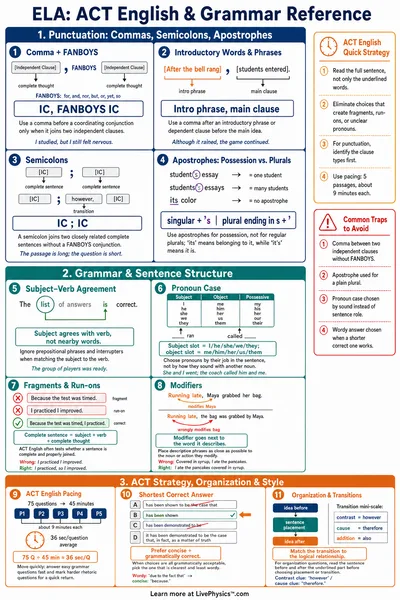
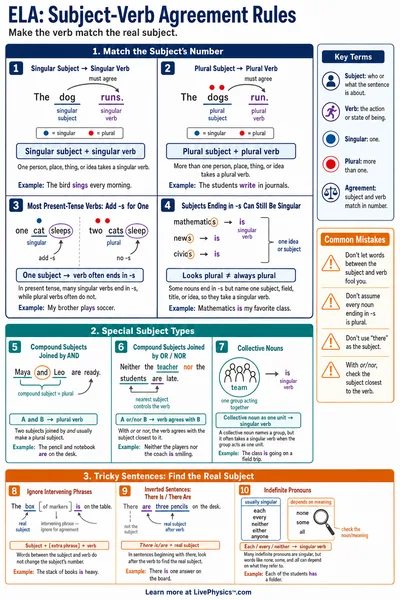
A singular subject takes a singular verb, and a plural subject takes a plural verb. The tricky part is locating the real subject.
- Ignore prepositional phrases. In "The list of books is on the table," the subject is "list," not "books."
- Indefinite pronouns are singular. Each, every, anyone, someone, neither, and either all take singular verbs.
- Compound subjects with "and" are plural. "Maya and Diego are here."
- Either/or, neither/nor agree with the closer subject. "Neither the cat nor the dogs eat the food."
- Collective nouns are singular as a unit. "The team is ready" but "The team are arguing among themselves" if members act individually.
Tip. Cross out everything between the subject and the verb to test agreement. The verb should match what is left.
Fragments and Run-Ons
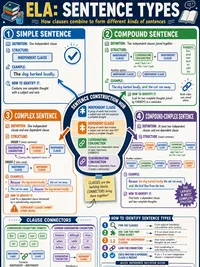
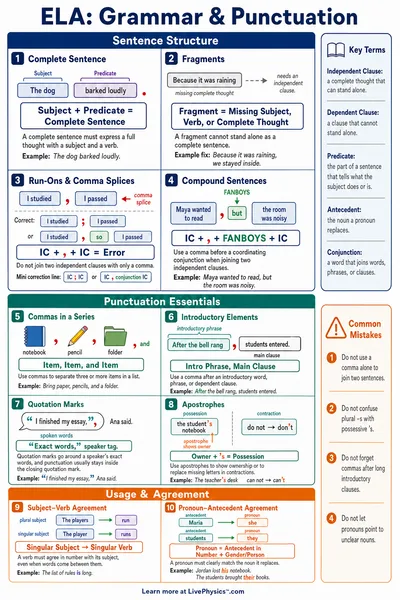
A complete sentence needs a subject, a verb, and a complete thought. Fragments are missing one of these pieces, and run-ons cram too many complete thoughts together without proper punctuation.
Common fragment patterns include dependent clauses starting with although, because, when, since, if, until, or while. These clauses must attach to an independent clause.
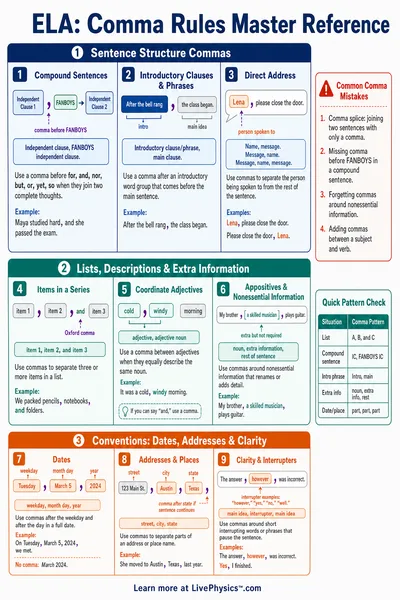
Run-ons can be fixed four ways. (1) Add a period to split into two sentences. (2) Add a semicolon between the clauses. (3) Add a comma plus a coordinating conjunction (and, but, or, so, yet, for, nor). (4) Subordinate one clause using a word like because, although, or when.
Tip. If you read your sentence aloud and need to take two breaths, it is probably a run-on. If it ends before you have a full idea, it is a fragment.
Punctuation Common Errors
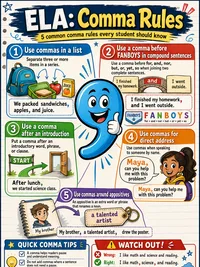
Comma splices happen when two independent clauses are joined with only a comma. Fix them the same way you fix run-ons. With a stronger punctuation mark or a conjunction.
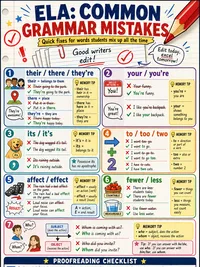
Apostrophes do three jobs. They show possession (the dog's bone), stand in for missing letters in contractions (it's, who's, they're), and they are never used to make a regular plural.
Trouble pairs to memorize. it's means it is, while its shows possession. who's means who is, while whose shows possession. they're means they are, their shows possession, and there names a place.
Tip. Read the contraction with both words expanded. If "it is raining hard" makes sense, use "it's." If not, use "its."
Pronoun Case and Agreement
Pronouns must match their antecedents in number, gender, and person. Singular antecedents take singular pronouns, and plural antecedents take plural pronouns.
Pronoun case depends on the pronoun's job in the sentence. Use I, we, he, she, they, who as subjects. Use me, us, him, her, them, whom as objects of verbs or prepositions.
Quick test for who vs whom. If you can answer the question with "he" or "she," use who. If "him" or "her" fits, use whom.
Quick test for "X and I" vs "X and me." Drop the other person. "Me built the rocket" sounds wrong, so it is "Diego and I built the rocket." "The librarian gave the books to I" sounds wrong, so it is "to Jamal and me."