Triangle Centers Explorer
Drag the three vertices of a triangle and watch the four classical centers move in real time. See how the centroid, circumcenter, and orthocenter stay collinear on the Euler line while the incenter generally does not.
Drag vertices A, B, C to reshape the triangle. a = 4.99, b = 6.22, c = 6.45
Preset triangles
Centers
Lines and circles
Centroid
G = (5.17, 4.13)
Incenter
I = (5.4, 4.31), r = 1.64
Circumcenter
O = (4.85, 3.81), R = 3.45
Orthocenter
H = (5.8, 4.77)
Euler line
The circumcenter O, centroid G, and orthocenter H always lie on a single line, with .
Status, O, G, H are collinear (verified).
The incenter I lies on the Euler line only for isosceles and equilateral triangles; in general it does not.
Reference Guide
The Four Classical Centers
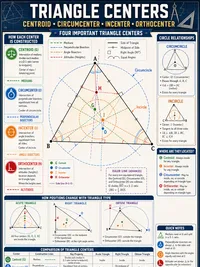
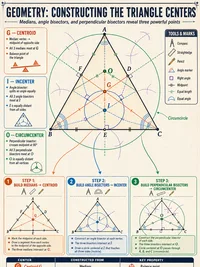
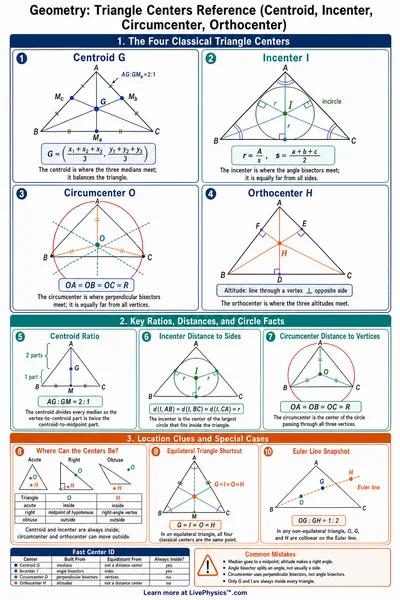
The centroid G is the average of the three vertices, the meeting point of the medians.
The incenter I is where the angle bisectors meet, weighted by the opposite side lengths a, b, c. It is the center of the inscribed circle.
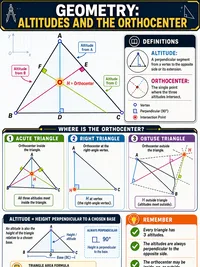
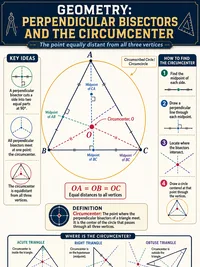
The circumcenter O is equidistant from all three vertices, where the perpendicular bisectors meet, and the center of the circumscribed circle of radius R. The orthocenter H is where the three altitudes meet.
The Euler Line
For any non-equilateral triangle the circumcenter O, centroid G, and orthocenter H lie on a single straight line called the Euler line. The centroid divides the segment in a fixed ratio.
Equivalently the orthocenter satisfies , which is how this tool computes H from the circumcenter. The incenter I does not lie on the Euler line in general.
When the Centers Coincide
In an equilateral triangle all four centers collapse onto the same point, so the Euler line shrinks to a single location and the incenter joins it too.
In an isosceles triangle the incenter lies on the axis of symmetry together with O, G, and H, so all four centers are collinear. For a right triangle the circumcenter sits at the midpoint of the hypotenuse and the orthocenter lands exactly on the right-angle vertex.
Try the preset triangles, then drag a vertex to break the symmetry and watch the centers separate.
Area, Inradius, Circumradius
The signed area follows from the shoelace formula, and the inradius relates the area to the semiperimeter s.
The circumradius is the distance from the circumcenter O to any vertex. The readout panel reports the current area, the three side lengths a, b, c, the inradius r, and the circumradius R as you reshape the triangle.