Practice recognizing dynamic programming problems, comparing memoization and tabulation, and tracing simple algorithms that store and reuse results.
Read each problem carefully. Show your reasoning, tables, or code traces in the space provided.
Solving overlapping subproblems with saved results
CS - Grade 9-12
- 1
In your own words, explain what dynamic programming is and name the two main properties a problem usually needs in order for dynamic programming to be useful.
- 2
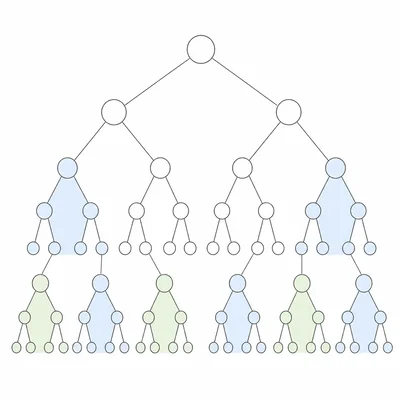
A recursive Fibonacci function calls fib(n - 1) and fib(n - 2) until it reaches fib(0) or fib(1). Explain why this plain recursive version does repeated work.
- 3
For the Fibonacci sequence where fib(0) = 0 and fib(1) = 1, fill in the tabulation values from fib(0) through fib(7).
- 4
Compare memoization and tabulation. State one similarity and one difference between the two approaches.
- 5
The following pseudocode uses memoization: function fib(n): if n is in memo: return memo[n] if n <= 1: return n memo[n] = fib(n - 1) + fib(n - 2) return memo[n] If fib(6) is called with an empty memo, what final key-value pairs should be stored in memo for n from 2 through 6?
- 6
A student says, "Memoization always uses less memory than tabulation because it only computes what it needs." Explain why this statement is not always true.
- 7
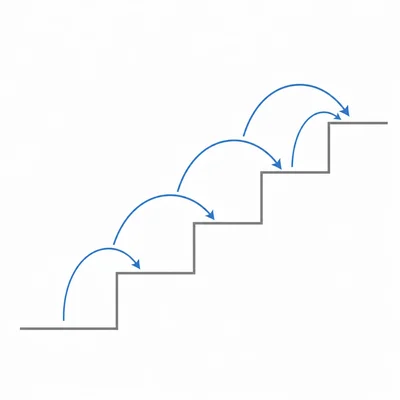
You can climb a staircase by taking either 1 step or 2 steps at a time. Let ways(n) be the number of ways to climb n steps. Write the recurrence relation and base cases for this problem.
- 8
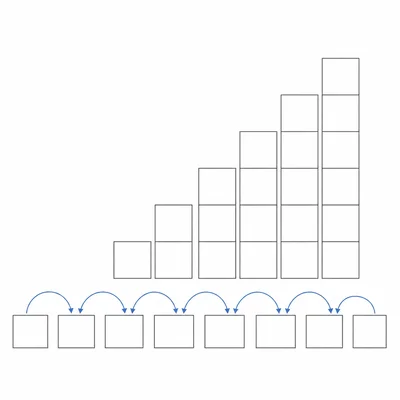
Using the staircase recurrence ways(n) = ways(n - 1) + ways(n - 2), ways(0) = 1, and ways(1) = 1, compute ways(2) through ways(5) using tabulation.
- 9
A coin change problem asks for the minimum number of coins needed to make a target amount using coin values 1, 3, and 4. Let dp[x] be the minimum number of coins needed for amount x. Write a recurrence for dp[x].
- 10
Using coins 1, 3, and 4 with dp[0] = 0, find the minimum number of coins needed to make amount 6. Show the best combination.
- 11
A longest common subsequence problem compares strings A = "ABC" and B = "AC". What is the length of the longest common subsequence, and what is one such subsequence?
- 12
For Fibonacci, explain how a tabulation solution can be changed from using an array of size n + 1 to using only constant extra space.