Practice identifying and solving first-order linear differential equations using standard form, integrating factors, and initial conditions.
Put each differential equation in standard linear form when needed. Find the integrating factor, solve for the general or particular solution, and show your work.
Solving linear differential equations with integrating factors
Math - Grade 9-12
- 1
Identify whether the differential equation y' + 3y = 6 is first-order linear. If it is, write P(x) and Q(x) from the standard form y' + P(x)y = Q(x).
- 2
Solve the differential equation y' + 2y = 0.
- 3
Solve the differential equation y' + 4y = 8.
- 4
Solve the initial value problem y' + y = e^x, with y(0) = 3.
- 5
Put the equation 2y' + 6y = 10x into standard linear form, then identify P(x) and Q(x).
- 6
Solve the differential equation y' - 3y = 6e^(3x).
- 7
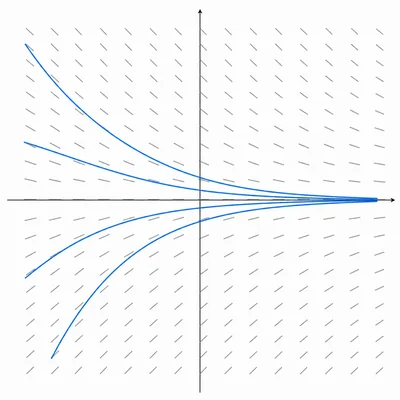
A slope field represents the differential equation y' + y = 0. Describe the general shape of its solutions and write the general solution.
- 8
Solve the differential equation y' + (2/x)y = x^2 for x > 0.
- 9
Solve the initial value problem y' + (1/x)y = 4x, with y(1) = 5 and x > 0.
- 10
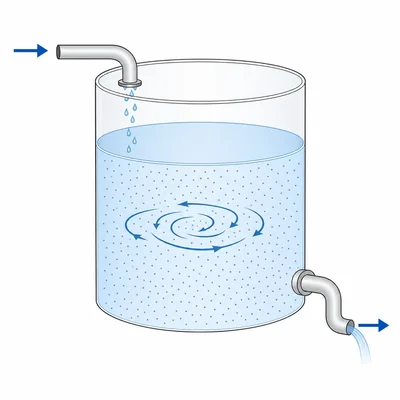
A tank starts with 100 liters of water containing 20 grams of salt. Brine containing 3 grams of salt per liter enters at 2 liters per minute, and the well-mixed solution leaves at 2 liters per minute. Let S(t) be the grams of salt after t minutes. Write the first-order linear differential equation for S(t), then solve it.
- 11
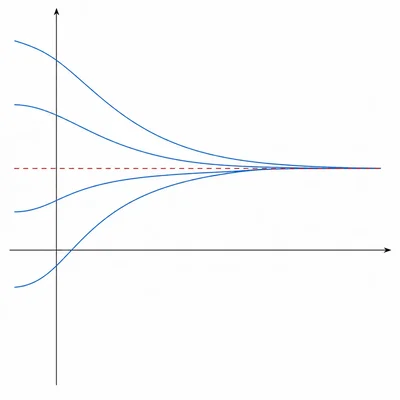
The graph of several solutions to y' + 2y = 4 is shown. What horizontal line do all solution curves approach as x increases, and why?
- 12
Explain the error in this work: To solve y' + 5y = 10, a student writes the integrating factor as 5e^x and then multiplies the equation by 5e^x.