Practice writing numbers in scientific notation, comparing sizes, and making order of magnitude estimates in science contexts.
Read each problem carefully. Show your work using powers of ten and include units when they are given.
Using powers of ten to describe and estimate scientific quantities
Science - Grade 9-12
- 1
A wavelength of blue light is about 0.00000042 meters. Write this length in scientific notation.
- 2
Avogadro's number is about 6.02 x 10^23 particles per mole. Write this number in standard notation using digits.
- 3
Sunlight takes about 500 seconds to reach Earth. If light travels at 3.0 x 10^8 meters per second, estimate the distance from the Sun to Earth.
- 4
A proton has a mass of about 1.67 x 10^-27 kilograms. An electron has a mass of about 9.11 x 10^-31 kilograms. About how many times more massive is a proton than an electron?
- 5
A force is measured as 7.8 x 10^5 newtons. To the nearest power of ten, what is its order of magnitude?
- 6
Compare 2.5 x 10^-4 grams and 8.0 x 10^-5 grams. Which mass is larger, and by what factor?
- 7
A classroom shelf has 40 textbooks, and each textbook has about 300 pages. Estimate the total number of pages in scientific notation and give its order of magnitude.
- 8
A molecule is about 1.3 x 10^-9 meters wide. Since 1 nanometer equals 1 x 10^-9 meters, write the molecule's width in nanometers.
- 9
A robot travels 4.2 x 10^6 meters, then travels another 7.5 x 10^5 meters. What total distance did it travel in scientific notation?
- 10
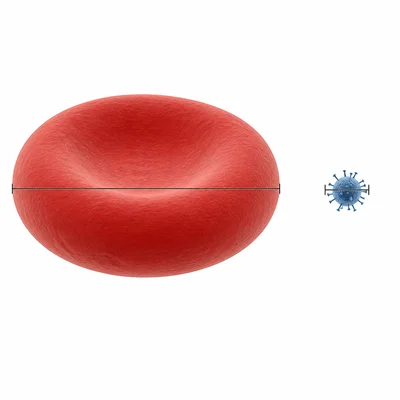
A red blood cell is about 8 x 10^-6 meters across, and a virus is about 1 x 10^-7 meters across. About how many times wider is the red blood cell than the virus?
- 11
The mass of a small asteroid is estimated to be 3 x 10^12 kilograms. The mass of a spacecraft is about 2 x 10^5 kilograms. About how many times more massive is the asteroid than the spacecraft?
- 12
Estimate the number of seconds in one year using 365 days per year, 24 hours per day, and 3600 seconds per hour. Write your answer in scientific notation.
- 13
A solution has a concentration of 0.00035 moles per liter. Write the concentration in scientific notation, then give the nearest power of ten.
- 14
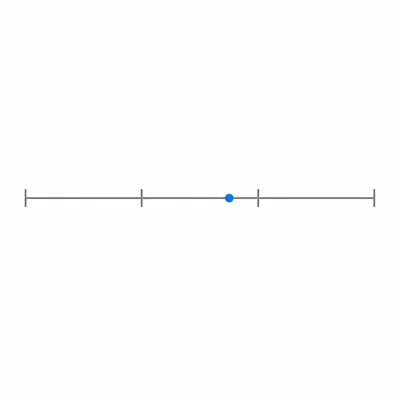
On a logarithmic scale marked 10^-3, 10^-2, 10^-1, and 10^0, place 5 x 10^-2 in the correct interval and state which power of ten it is closer to.
- 15
A small drop of water has a mass of about 0.05 grams. Water has a molar mass of about 18 grams per mole, and 1 mole contains about 6 x 10^23 molecules. Estimate the number of water molecules in the drop.