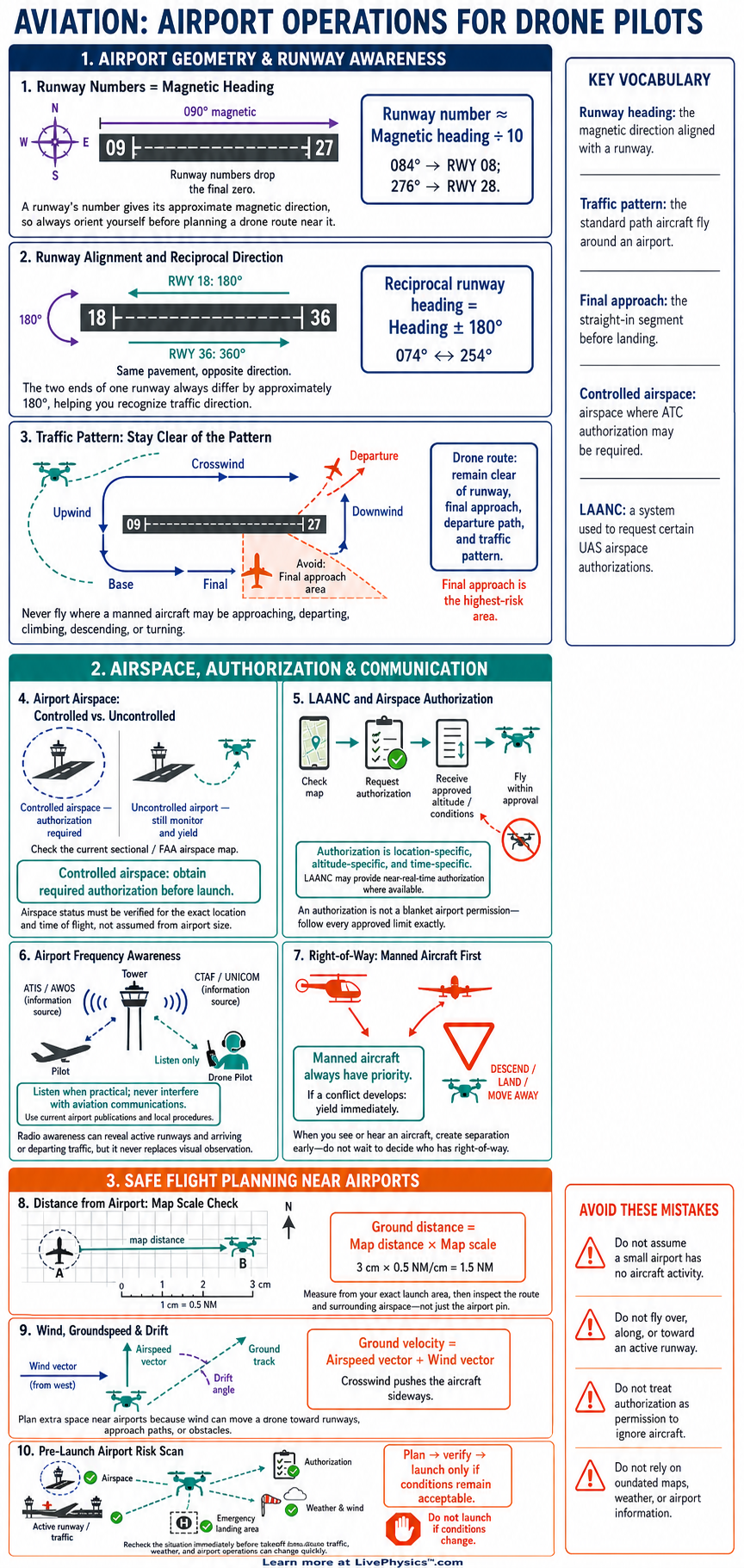
Airport operations create one of the highest-risk environments for drone pilots. Manned aircraft may fly low, move quickly, and follow predictable routes that a drone can disrupt. This cheat sheet helps pilots identify airport activity, understand common operating areas, and make safer decisions before every flight.
It is useful for recreational and commercial drone operations near any aerodrome or heliport.
The key ideas are airspace awareness, runway and traffic-pattern recognition, communication, and separation from aircraft. Runway numbers show magnetic direction, while traffic patterns organize aircraft arriving and departing. Drone pilots must check local rules, published restrictions, notices, and air traffic requirements before operating.
When there is uncertainty about aircraft activity or authorization, the safest action is to remain clear and not launch.
Key Facts
- A runway numbered 09 has an approximate magnetic heading of 090 degrees.
- The opposite end of a runway differs by 180 degrees, so the opposite of runway 09 is runway 27.
- Aircraft usually take off and land into the wind because headwind reduces the ground distance needed for takeoff and landing.
- A standard traffic pattern includes departure, crosswind, downwind, base, final, and landing legs.
- A left traffic pattern uses left turns, while a right traffic pattern uses right turns.
- Drone pilots must remain clear of runways, approach paths, departure paths, and any area that could interfere with aircraft.
- Controlled airspace near an airport may require prior authorization before a drone flight.
- If an aircraft approaches a drone operating area, the drone pilot should yield immediately and land or move clear.
Vocabulary
- Aerodrome
- An aerodrome is an area used for aircraft takeoff, landing, and ground movement, including an airport or smaller landing site.
- Runway
- A runway is a defined rectangular surface prepared for aircraft takeoff and landing.
- Traffic pattern
- A traffic pattern is a standard route aircraft fly around an airport to organize arrivals and departures.
- Controlled airport
- A controlled airport has an operating control tower that gives instructions to manage aircraft movement.
- Uncontrolled airport
- An uncontrolled airport has no operating control tower, so pilots use published procedures and radio reports to coordinate.
- NOTAM
- A NOTAM is an official notice that gives pilots time-sensitive information about hazards, restrictions, or changes affecting flight.
Common Mistakes to Avoid
- Assuming an uncontrolled airport has no restrictions is wrong because aircraft can still arrive, depart, and fly traffic patterns without a tower.
- Using only distance from the airport boundary is wrong because approach and departure routes can extend far beyond the physical airport.
- Treating runway numbers as exact compass headings is wrong because they are rounded magnetic headings and can change when magnetic variation changes.
- Relying on a radio scan instead of visual observation is wrong because not every aircraft broadcasts or makes a radio call.
- Flying after receiving authorization without checking current conditions is wrong because weather, temporary restrictions, and aircraft activity can change before launch.
Practice Questions
- 1 Runway 18 has an approximate magnetic heading of 180 degrees. What number is painted on the opposite runway end?
- 2 A drone site is near the extended centerline of runway 27. What magnetic direction does runway 27 approximately face?
- 3 List the normal sequence of legs in a standard airport traffic pattern after departure.
- 4 A drone pilot has authorization near an airport but sees an aircraft approaching at low altitude. Explain the safest immediate action and why it takes priority over continuing the mission.
Understanding Airport Operations for Drone Pilots
An airport is more than a paved runway. It includes approach paths, departure paths, taxiways, holding areas, parking ramps, and nearby airspace used by aircraft. Aircraft often fly at low altitude close to an airport, especially during takeoff and landing.
A drone can be difficult for a pilot to see, even in daylight. A small collision can damage an aircraft, distract a pilot during a critical phase of flight, or cause an emergency. This is why drone pilots must plan for aircraft movement before setting up their equipment.
Runway markings and numbers help describe where aircraft operate. A runway numbered 09 points approximately east on a magnetic heading of 090 degrees. The opposite end is numbered 27 because its direction differs by 180 degrees.
Aircraft normally take off and land into the wind, so the active runway can change as weather changes. Drones should never operate over a runway, in its approach or departure path, or anywhere that could force an aircraft to alter its route. Helicopters require extra attention because they may arrive, depart, hover, or use routes outside the usual runway pattern.
Many smaller airports use a standard traffic pattern to make aircraft movement predictable. Aircraft usually depart straight ahead, turn onto crosswind, fly downwind parallel to the runway, turn onto base, and then fly final toward the runway. The pattern altitude and direction may be published for each airport.
A left traffic pattern uses left turns, while a right traffic pattern uses right turns. Drone pilots should study an airport diagram and identify these paths before flight. They should also remember that aircraft may not always follow a standard pattern due to weather, training, emergencies, or air traffic instructions.
Controlled airports have an operating control tower that manages aircraft movement on runways and in nearby controlled airspace. Drone operations may require authorization through the applicable national aviation system or a designated authorization service. Uncontrolled airports do not have a tower, but they can still be busy and hazardous.
Pilots may announce their position and intentions on a common radio frequency. Listening to aviation radio can improve awareness where it is legal and practical, but it does not replace required authorization, visual observation, or knowledge of local procedures.
Good airport planning starts well before launch. Check an official airspace map, airport information, temporary flight restrictions, weather, and notices to air missions. Select a site well away from aircraft routes and establish a visual observer when possible.
Continuously scan and land immediately if an aircraft approaches or if the situation becomes unclear. Focus study time on reading airport diagrams, recognizing runway orientation, and understanding the rules that apply in the country where the drone is flown. Local aviation authorities always provide the controlling requirements.