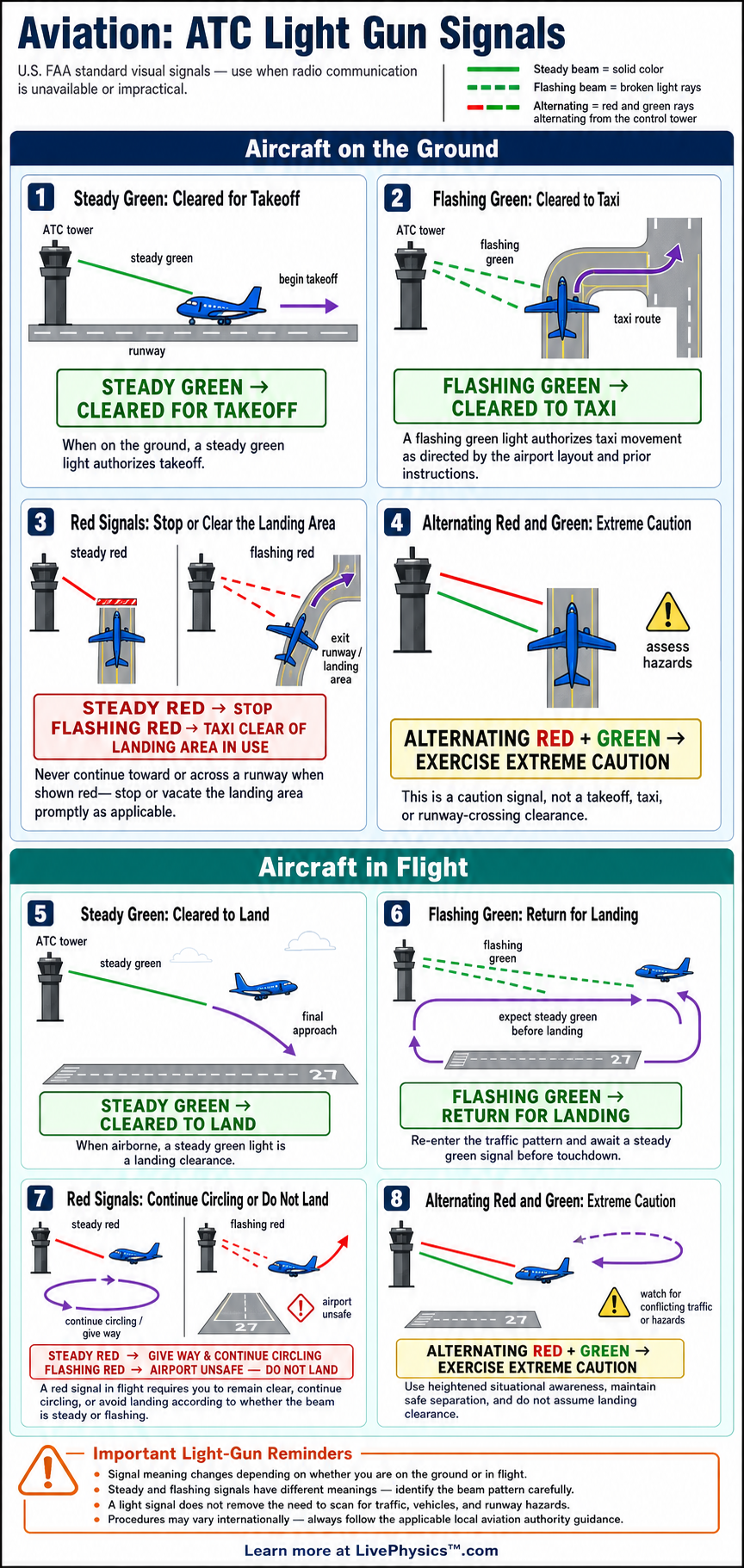
ATC light gun signals give pilots a visual way to receive instructions when radio communication is unavailable, unreliable, or impractical. Controllers use colored light beams from the control tower to direct aircraft on the airport surface or in the traffic pattern. This cheat sheet helps pilots quickly connect each color and beam pattern to the correct action.
Fast recognition is important because these signals may be used during abnormal or urgent communication situations.
The meaning of a light signal depends on whether the aircraft is on the ground or in flight. A steady green signal authorizes takeoff on the ground and landing in flight, while a steady red signal requires stopping on the ground and continued circling in flight. Flashing signals generally provide movement, return, or safety instructions.
Alternating red and green always means exercise extreme caution.
Key Facts
- A steady green light means cleared for takeoff to an aircraft on the ground and cleared to land to an aircraft in flight.
- A flashing green light means cleared to taxi to an aircraft on the ground and return for landing to an aircraft in flight.
- A steady red light means stop to an aircraft on the ground and give way to other aircraft and continue circling to an aircraft in flight.
- A flashing red light means taxi clear of the runway in use to an aircraft on the ground and airport unsafe, do not land to an aircraft in flight.
- A flashing white light means return to the starting point on the airport for an aircraft on the ground.
- An alternating red and green light means exercise extreme caution whether the aircraft is on the ground or in flight.
- The correct interpretation of an ATC light gun signal depends on both the color pattern and the aircraft’s location.
Vocabulary
- ATC light gun
- An airport tower device that sends colored visual signals to aircraft or vehicles when voice communication cannot be used.
- Steady signal
- A continuous light beam that remains on without flashing.
- Flashing signal
- A light beam that repeatedly turns on and off to communicate a specific instruction.
- Taxi
- To move an aircraft on the airport surface under its own power, excluding takeoff and landing.
- Traffic pattern
- The standard path aircraft fly near an airport when arriving, departing, or preparing to land.
- Runway in use
- The runway currently selected by air traffic control for aircraft arrivals, departures, or both.
Common Mistakes to Avoid
- Treating steady green as a universal landing clearance is wrong because it means cleared for takeoff when the aircraft is on the ground.
- Confusing flashing red with steady red is wrong because flashing red directs a ground aircraft to taxi clear of the runway, while steady red means stop.
- Assuming alternating red and green gives permission to continue is wrong because it means exercise extreme caution and does not provide a movement clearance.
- Using the flashing white meaning while airborne is wrong because flashing white applies to an aircraft on the airport surface, not an aircraft in flight.
- Looking only for the color and ignoring the beam pattern is wrong because steady and flashing versions of the same color can require completely different actions.
Practice Questions
- 1 An aircraft is holding short of the runway and receives a steady green light from the tower. What action is authorized?
- 2 An aircraft on final approach receives a flashing red light from the tower. What must the pilot do?
- 3 A taxiing aircraft receives a flashing white light. Where should the pilot go?
- 4 Explain why a pilot must know whether the aircraft is on the ground or in flight before acting on a steady red light.
Understanding ATC Light Gun Signals
A light gun is a directional signal lamp used by an air traffic control tower. It projects a colored beam toward a particular aircraft or vehicle. The controller aims the beam so the intended pilot can see it, although bright sun, weather, distance, and cockpit position can make a signal hard to identify.
Pilots should watch the tower carefully when they know the radio has failed. They should also continue looking outside for traffic, vehicles, and other hazards.
The same color can have different meanings in the air and on the ground. This difference matters because an aircraft preparing to depart has different needs from an aircraft approaching to land. A steady green light tells a ground aircraft that it is cleared for takeoff.
For an aircraft in flight, steady green means cleared to land. A flashing green light means cleared to taxi on the ground, but it tells an airborne aircraft to return for landing.
Red signals demand special attention. A steady red light means stop for an aircraft on the ground. In flight, it means give way to other aircraft and continue circling.
A flashing red light tells a ground aircraft to taxi clear of the runway in use. For an aircraft in flight, flashing red means the airport is unsafe and the pilot must not land. This may occur when the runway is blocked, an emergency is in progress, or another danger exists.
Flashing white applies to aircraft on the airport surface. It means return to the starting point on the airport. This can direct a pilot back to a ramp, parking area, or other original location after a taxi issue.
Alternating red and green is used both on the ground and in flight. It means exercise extreme caution. It does not itself authorize a takeoff, landing, taxi movement, or runway crossing.
Students should memorize each signal as a complete action rather than as a color alone. A useful study method is to make two columns labeled ground and flight, then place each beam pattern in both columns. Practice visual recognition because a flashing beam and a steady beam have very different meanings.
During real operations, pilots must follow applicable lost communications procedures, monitor the situation, and use sound judgment. Light gun signals are a backup method, but they remain an important part of safe airport operations.