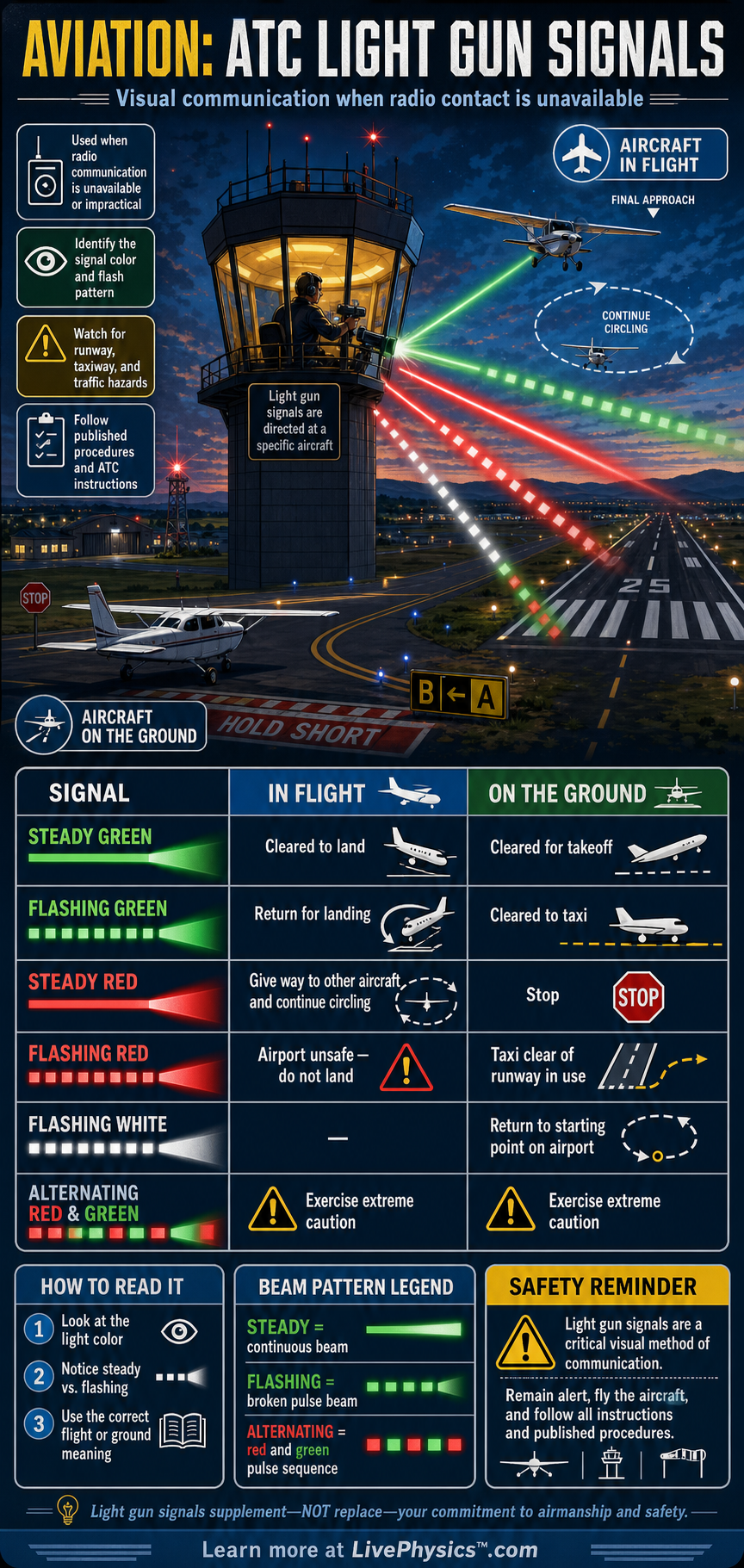
ATC light gun signals give pilots a backup way to communicate with air traffic control when radio contact is unavailable. A controller aims a colored beam toward an aircraft, and the color plus its pattern tells the pilot what action to take. The same signal can mean different things in the air and on the ground, so pilots must identify their situation first.
These signals matter most during radio failure, but pilots are expected to know them before an emergency occurs.
A light gun normally produces steady, flashing, or alternating red and green light. Steady green clears an aircraft to land when it is airborne, while it clears an aircraft for takeoff when it is on the ground. Red signals carry urgent restrictions, such as stopping on the surface or not landing from the air.
Pilots should acknowledge a received signal by rocking their wings in flight or moving the ailerons or rudder on the ground, when practical.
Understanding Aviation, ATC Light Gun Signals
Light gun signals are visual control instructions. They exist because radio equipment can fail in an aircraft, in the control tower, or in the communication path between them. A pilot who loses two way radio contact should keep watching the tower while following the applicable radio failure procedures.
The tower controller points the beam directly at the aircraft. In daylight, the pilot may need to look carefully for the beam because bright sunlight can make it hard to see.
The first step is deciding whether the aircraft is airborne or on the airport surface. This matters because steady green has two different meanings. For an aircraft in flight, steady green means cleared to land.
For an aircraft on the ground, it means cleared for takeoff. Flashing green means return for landing in the air, but it means cleared to taxi on the ground. A pilot must never assume a signal has the same meaning in every setting.
Red signals demand particular care. A steady red light means give way to other aircraft and continue circling for an aircraft in flight. It means stop for an aircraft on the ground.
A flashing red light tells an airborne pilot that the airport is unsafe and that landing should not be attempted. On the ground, flashing red directs the pilot to taxi clear of the landing area in use. This often means leaving the runway or another area needed by arriving aircraft, then waiting for a new instruction.
Flashing white applies only to aircraft on the ground. It directs the pilot to return to the starting point on the airport. This may mean returning to a ramp, parking area, or another location where the movement began.
Alternating red and green means exercise extreme caution, whether the aircraft is airborne or on the ground. It does not grant clearance for a takeoff, landing, or taxi movement. The pilot should slow down, watch for hazards, and seek a clearer instruction if possible.
Students should learn the signal chart as two connected sets, one for flight and one for ground operations. Use the color pattern first, then match it to the aircraft location. Practice with realistic scenes such as an airplane holding short of a runway or circling near the airport.
Remember that a light signal is not merely a color cue. It is a control instruction that affects separation from other aircraft, runway safety, and the next safe action. Local regulations and published procedures remain the final authority for pilots operating in a specific country.
Key Facts
- Steady green in flight = cleared to land
- Steady green on the ground = cleared for takeoff
- Flashing green in flight = return for landing
- Flashing green on the ground = cleared to taxi
- Steady red in flight = give way to other aircraft and continue circling
- Alternating red and green = exercise extreme caution
Vocabulary
- ATC
- Air traffic control is the service that directs aircraft to help maintain safe and orderly movement.
- Light gun
- A light gun is a handheld or mounted device that projects colored signals from an air traffic control tower.
- Steady light
- A steady light remains continuously illuminated instead of turning on and off.
- Flashing light
- A flashing light repeatedly turns on and off to communicate a specific control instruction.
- Landing area
- The landing area is the runway or other airport surface currently being used by arriving aircraft.
Common Mistakes to Avoid
- Using the ground meaning while airborne is wrong because several colors have different instructions depending on whether the aircraft is flying or on the surface. Identify your location before interpreting the signal.
- Treating flashing red as permission to land is wrong because it means the airport is unsafe for an aircraft in flight. Continue flying and do not attempt a landing.
- Reading alternating red and green as a clearance is wrong because it only directs the pilot to exercise extreme caution. It does not authorize takeoff, landing, or taxiing.
- Assuming a light gun replaces all radio failure procedures is wrong because pilots must still follow applicable regulations, published procedures, and safe operating judgment.
Practice Questions
- 1 An aircraft is holding short of a runway and receives a steady green light from the tower. What action is authorized?
- 2 An airplane is circling near an airport after a radio failure and receives a steady red light. State the required action.
- 3 A pilot on a taxiway sees alternating red and green light from the tower. Explain why the pilot should not enter the runway based on that signal alone.