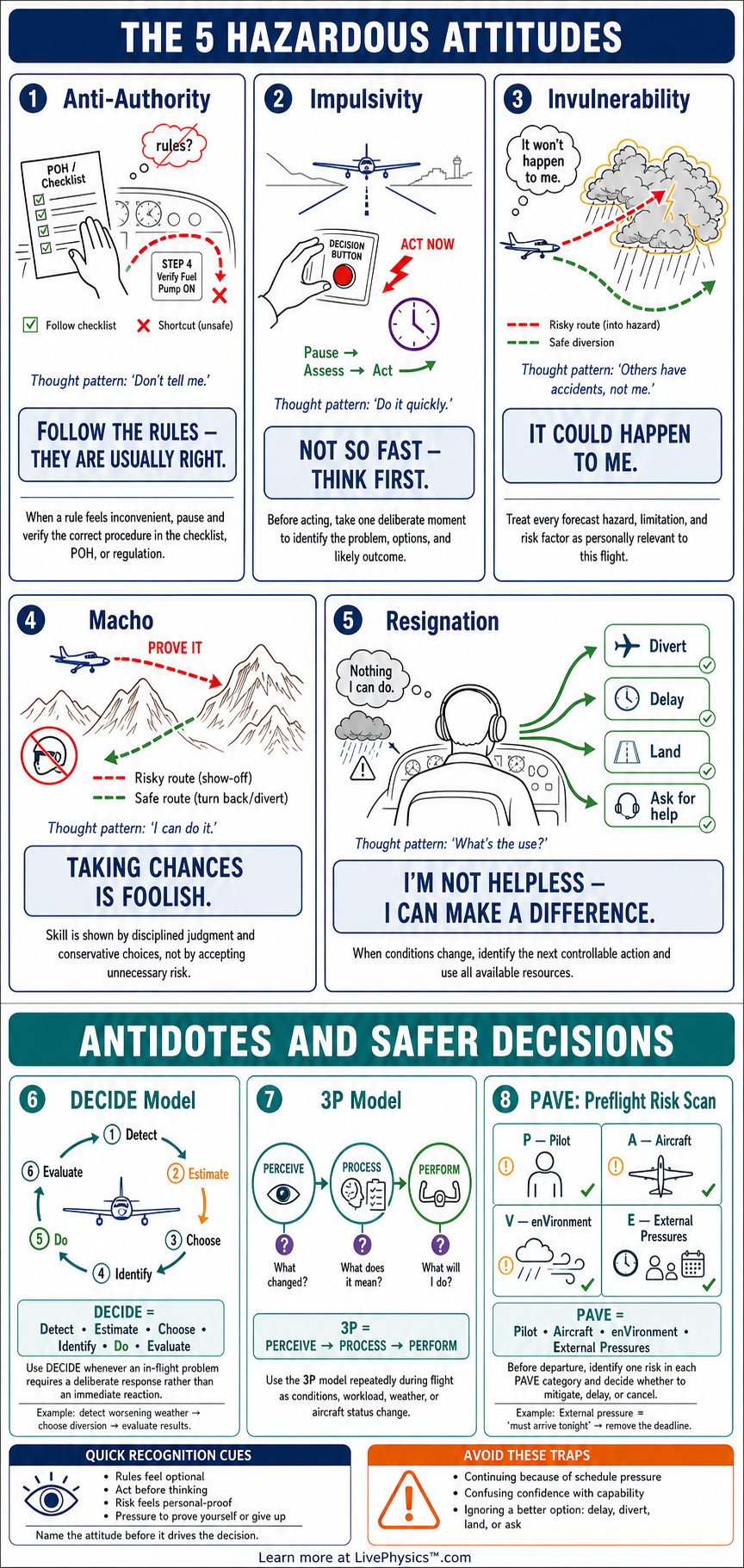
Hazardous attitudes are common thinking patterns that can weaken a pilot's judgment before and during flight. They can lead pilots to ignore procedures, rush decisions, accept unnecessary risk, or give up control of a situation. This cheat sheet helps student pilots recognize these attitudes early.
It also provides clear antidotes that support safer choices in the air and on the ground.
The five FAA hazardous attitudes are anti-authority, impulsivity, invulnerability, macho, and resignation. Each attitude has a short antidote statement that interrupts unsafe thinking and redirects attention to sound aeronautical decision-making. Pilots can pair these antidotes with structured tools such as the 5 Ps and the DECIDE model.
Repeating the right statement is useful only when it leads to a specific safe action.
Key Facts
- Anti-authority means resisting rules or advice, and its antidote is Follow the rules.
- Impulsivity means feeling pressure to act immediately, and its antidote is Not so fast.
- Invulnerability means believing an accident will not happen to you, and its antidote is It could happen to me.
- Macho means trying to prove skill by taking risks, and its antidote is Taking chances is foolish.
- Resignation means believing that useful action is impossible, and its antidote is I am not helpless.
- The 5 Ps risk review checks the plan, plane, pilot, passengers, and programming.
- The DECIDE model means detect, estimate, choose, identify, do, and evaluate.
- A safe decision rule is to slow down, use available information, and choose the option with the greatest safety margin.
Vocabulary
- Hazardous attitude
- A common unsafe thought pattern that can lead a pilot to make poor decisions.
- Antidote
- A short corrective statement that helps replace hazardous thinking with safer thinking.
- Aeronautical decision-making
- A systematic process pilots use to identify risks and choose safe actions.
- Risk management
- The process of recognizing hazards, evaluating their effects, and reducing unnecessary risk.
- 5 Ps
- A pilot risk review of the plan, plane, pilot, passengers, and programming.
- DECIDE model
- A decision-making method that guides a pilot from detecting a problem through evaluating the result.
Common Mistakes to Avoid
- Treating hazardous attitudes as traits that only affect other pilots is wrong because any pilot can show these attitudes under stress, fatigue, or time pressure.
- Repeating an antidote without changing the plan is ineffective because the antidote must lead to a safer action such as delaying, diverting, or requesting help.
- Confusing macho behavior with confidence is wrong because real confidence includes respecting limits, procedures, and conservative safety margins.
- Using the 5 Ps only before takeoff is a mistake because weather, aircraft status, fatigue, and passenger pressure can change during flight.
- Waiting until a problem becomes an emergency before acting is unsafe because early decisions usually provide more options and lower risk.
Practice Questions
- 1 A pilot gives anti-authority a risk rating of 4 out of 5 before a flight. State the correct antidote and describe one action the pilot should take before departure.
- 2 During a cross-country flight, a pilot rates fatigue at 3 out of 5 and worsening weather at 4 out of 5. Using the 5 Ps, identify two factors that should be reassessed and name one conservative decision.
- 3 A pilot sees an unfamiliar caution light but says, "I will deal with it after I land because I need to arrive on time." Identify the hazardous attitude and its antidote.
- 4 Explain why a pilot who chooses to divert because of deteriorating weather is demonstrating sound judgment rather than failure.
Understanding Hazardous Attitudes and Antidotes
Hazardous attitudes are not personality labels. Any pilot can experience them, including careful and experienced pilots. They often appear when there is pressure to arrive, poor weather, fatigue, unfamiliar equipment, or concern about disappointing passengers.
A pilot may not notice the attitude at first because it can feel like confidence, efficiency, or determination. Recognizing the thought pattern is the first step toward stopping an unsafe chain of events.
Anti-authority appears when a person resists rules, advice, or established procedures. The antidote is Follow the rules. Impulsivity creates pressure to act immediately without gathering enough information.
Its antidote is Not so fast. Invulnerability is the belief that an accident is unlikely to affect the pilot.
The antidote is It could happen to me. These attitudes can turn a manageable risk into a serious one when they prevent a pilot from slowing down and checking the facts.
Macho thinking treats unnecessary risk as proof of skill or courage. The antidote is Taking chances is foolish. A safe pilot demonstrates skill through planning, discipline, and good limits rather than dramatic actions.
Resignation occurs when a pilot believes that nothing useful can be done. The antidote is I am not helpless. This statement reminds the pilot that options usually exist, including delaying a flight, diverting, requesting assistance, going around, or declaring an emergency when needed.
The antidotes work best when pilots connect them to a decision process. The 5 Ps review the plan, plane, pilot, passengers, and programming. This review helps identify changes before they become urgent.
The DECIDE model helps a pilot detect a problem, estimate the need for action, choose a safe outcome, identify actions, do the action, and evaluate the result. A pilot should use these tools before departure and repeat them when weather, aircraft condition, time pressure, or personal condition changes.
In real flight operations, hazardous attitudes can appear in small statements. A pilot might say that a forecast will probably improve, that a warning light can wait until later, or that turning back would look embarrassing. These thoughts are warning signs, not final decisions.
Students should practice naming the attitude, saying the antidote aloud, and selecting a conservative action. Good aeronautical decision-making protects the pilot, passengers, aircraft, and people on the ground. It also builds habits that remain valuable throughout a flying career.