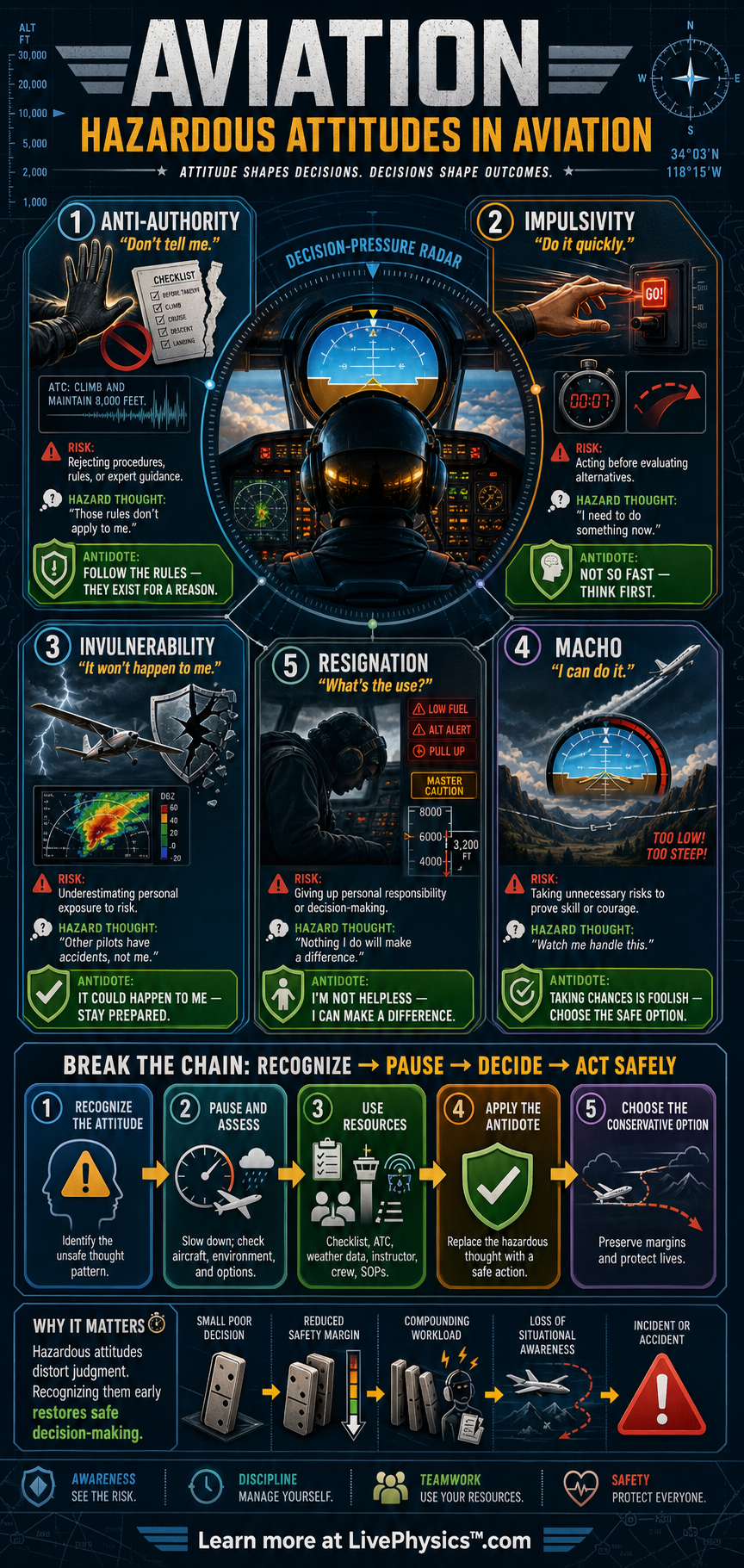
Hazardous attitudes are patterns of thinking that can lead pilots toward unsafe decisions. The FAA identifies five of these attitudes because they can appear during routine flights, stressful emergencies, or moments of overconfidence. A safe aircraft and good weather do not remove the risk created by poor judgment.
Pilots learn to recognize these thoughts before they affect a flight.
The five attitudes are anti-authority, impulsivity, invulnerability, macho, and resignation. Each one has a matching antidote phrase that redirects attention toward a safer action. These phrases are simple on purpose, since a pilot may need them when workload is high.
Good aeronautical decision making combines training, current information, aircraft limits, and an honest view of personal limits.
Understanding Aviation, Hazardous Attitudes in Aviation
Hazardous attitudes are not personality labels. Most pilots can experience any of them, especially when they feel rushed, tired, frustrated, or pressured to complete a flight. The danger comes when a thought turns into an action without a careful check of facts.
Aviation requires repeated choices about weather, fuel, route, altitude, aircraft condition, and personal readiness. A pilot who notices an unsafe thought has time to pause before that thought controls the next choice.
Anti-authority appears as resistance to rules, procedures, or advice. A pilot may think that a regulation does not apply to this particular flight. The antidote is that rules are usually right.
This does not mean rules solve every problem by themselves. It means that procedures often exist because earlier accidents revealed a real hazard. Checklists, minimum fuel requirements, weather limits, and air traffic instructions provide barriers against predictable errors.
Impulsivity pushes a person to act immediately. The thought may be that something must be done at once. Its antidote is to think first.
In a true emergency, pilots still act quickly, but training gives them a sequence for doing so. They first keep control of the airplane, then assess the situation, then use a checklist or memory procedure. In less urgent situations, a short pause can prevent a bad turn, an unsafe descent, or a rushed landing.
Invulnerability is the belief that bad outcomes happen to other people. Macho thinking tries to prove skill through unnecessary risk. Their antidotes are that accidents can happen to anyone and that taking chances is foolish.
These attitudes can show up when a pilot continues into worsening weather, flies too low for a better view, or refuses to divert after a plan fails. Skill in aviation includes knowing when to stop, delay, turn around, or land somewhere else.
Resignation is the belief that a pilot cannot make a difference. A person may give up mentally when conditions become difficult. The antidote is that a pilot is not helpless and can make a difference.
Useful options often remain, such as slowing down, climbing, diverting, asking air traffic control for help, declaring an emergency, or landing. Students should practice naming the attitude, saying its antidote, and choosing one specific safe action. This habit builds a decision process that works before pressure becomes overwhelming.
Key Facts
- The five FAA hazardous attitudes are anti-authority, impulsivity, invulnerability, macho, and resignation.
- Risk = Probability × Severity
- Fuel required = Fuel burn rate × Flight time + Reserve fuel
- Crosswind component = Wind speed × sin wind angle
- Anti-authority antidote = Follow the rules because they are usually right.
- Impulsivity antidote = Not so fast, think first.
Vocabulary
- Hazardous attitude
- A harmful pattern of thinking that can lead a pilot to make an unsafe decision.
- Anti-authority
- The attitude that resists rules, instructions, or advice because the pilot believes they do not apply.
- Impulsivity
- The urge to act immediately without taking time to assess the situation.
- Invulnerability
- The belief that accidents or bad outcomes happen to other people but not to oneself.
- Resignation
- The belief that a pilot has no control over the outcome and cannot improve the situation.
Common Mistakes to Avoid
- Treating hazardous attitudes as traits that only reckless pilots have. Any pilot can develop these thoughts when stress, fatigue, time pressure, or strong emotions affect judgment.
- Memorizing the five names without practicing an action. The antidote phrase must lead to a concrete choice, such as delaying departure, diverting, or requesting assistance.
- Confusing quick action with impulsivity. Immediate action is appropriate in some emergencies, but it should follow trained priorities and procedures rather than panic.
- Assuming confidence is the same as macho behavior. Real confidence respects aircraft limits, weather limits, and the option to stop a flight.
Practice Questions
- 1 A pilot burns 12 gallons of fuel per hour and plans to fly for 2.5 hours with a 5 gallon reserve. Calculate the minimum fuel required.
- 2 A 20 knot wind blows 30 degrees from the runway heading. Using sin 30 degrees = 0.5, calculate the crosswind component.
- 3 A pilot wants to continue toward worsening weather because turning back would feel embarrassing. Identify the hazardous attitude and state the safest antidote-based response.