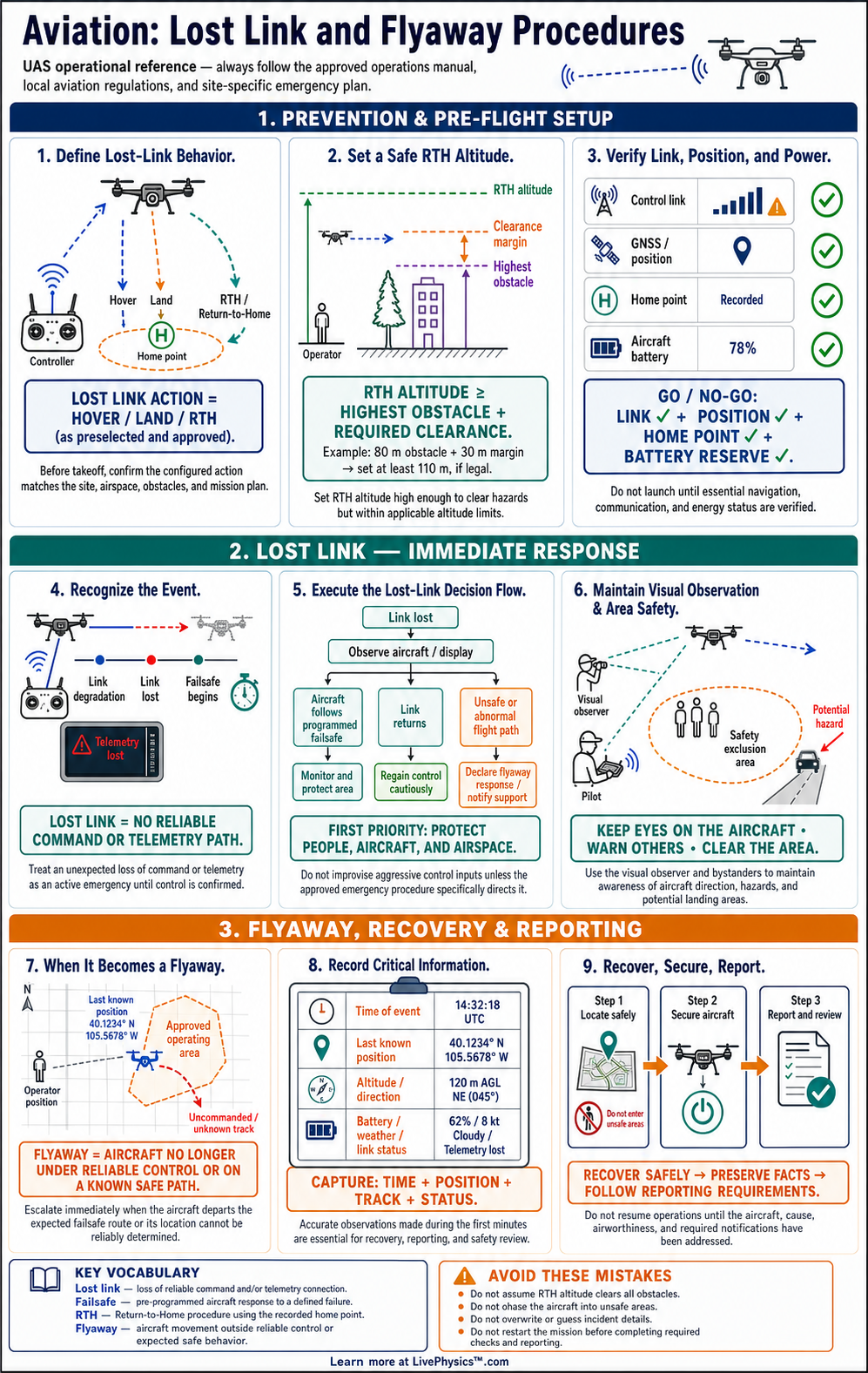
Lost link and flyaway events are serious UAS emergencies that require calm, planned action. A lost link occurs when the pilot station no longer communicates reliably with the aircraft. A flyaway occurs when the aircraft moves in an unintended direction or cannot be controlled as expected.
This cheat sheet helps UAS pilots and visual observers prepare for, manage, and report these events safely.
Safe response starts before takeoff with correct aircraft settings, a suitable launch site, and clear crew roles. Pilots must understand the aircraft's programmed lost link action, such as hovering, landing, or returning to home. They must also know how to regain control, protect people and property, and notify the right people after an event.
Good documentation turns an incident into useful safety learning.
Key Facts
- A lost link occurs when reliable command and control communication between the remote pilot and the UAS is interrupted.
- Before takeoff, verify that the home point is correct and that the return-to-home altitude clears all likely obstacles.
- The selected lost link action should be return to home, hover, or land, based on the specific mission and operating site.
- Maintain visual line of sight when required, because a visual observer can help track the aircraft during a link problem.
- If control is regained during an automated return, take over only when doing so creates a safer outcome than allowing the return to continue.
- A flyaway is unintended aircraft movement that does not respond as expected to normal pilot control inputs.
- After an event, preserve flight logs and record the time, location, weather, warnings, aircraft behavior, and corrective actions.
- Do not relaunch after a lost link or flyaway until the aircraft, controller, batteries, software, and mission settings have been checked.
Vocabulary
- Command and control link
- The radio or data connection that allows the remote pilot to send commands to the unmanned aircraft.
- Lost link
- A condition in which the aircraft and remote pilot station no longer have reliable command and control communication.
- Flyaway
- An event in which an unmanned aircraft moves unintentionally and cannot be controlled as expected.
- Return to home
- An automated aircraft function that navigates the UAS to its recorded home point, often at a selected altitude.
- Home point
- The stored location used by an aircraft for a return-to-home procedure.
- Visual observer
- A trained crewmember who assists the remote pilot by watching the aircraft and surrounding airspace.
Common Mistakes to Avoid
- Setting a return-to-home altitude below trees, poles, or buildings is unsafe because the aircraft may fly into an obstacle during its automated return.
- Assuming every signal warning is a full lost link is wrong because video, telemetry, and command signals can fail differently and require careful confirmation.
- Cancelling return to home immediately after a link reconnects is risky because the pilot may not yet understand the aircraft position, altitude, or hazard situation.
- Chasing a flyaway while ignoring airspace and ground hazards is wrong because the pilot must continue to protect people, property, and other aircraft.
- Deleting logs or failing to record event details is a mistake because evidence is needed to identify the cause and prevent a repeat event.
Practice Questions
- 1 A UAS has a return-to-home altitude of 60 meters, and the tallest nearby obstacle is 72 meters. What minimum change should the pilot make to provide a 20 meter obstacle clearance?
- 2 A controller battery is at 15 percent before takeoff, while the planned flight is expected to last 18 minutes. State two actions the pilot should take before launching.
- 3 During flight, the aircraft reports a lost link and begins returning to home. The pilot moves to a clearer location and regains control. List two checks the pilot should make before deciding whether to cancel the automated return.
- 4 Explain why a well-planned lost link procedure must be chosen before takeoff rather than decided only after communication is lost.
Understanding Lost Link and Flyaway Procedures
A command and control link connects the remote pilot's control station to the unmanned aircraft. This link carries flight commands to the aircraft and may carry telemetry, video, and system warnings back to the pilot. Link quality can drop because of distance, terrain, buildings, radio interference, low controller battery, or an obstructed antenna position.
A weak video feed does not always mean that control is lost, but it is an important warning sign. Pilots should treat repeated signal warnings as a reason to reduce distance and improve their position.
The lost link procedure must be selected and checked before every flight. Many aircraft use return to home as the default action. For this action to work safely, the home point must be correct, the return altitude must clear nearby obstacles, and the navigation system must have a reliable position fix.
Some missions require a different action, such as hovering or landing immediately. The selected action should match the site, weather, airspace limits, and risk to people on the ground. A visual observer should know the selected action and monitor the aircraft route during any automated return.
When a lost link occurs, the remote pilot should remain calm and avoid random control inputs. First, confirm the warning and check whether the aircraft is following its programmed response. Move to a position that improves line of sight while staying clear of hazards.
Check controller power, antenna orientation, and the correct aircraft selection when those checks can be made safely. If control returns, cancel an automated return only when the pilot can safely take over.
Continue the flight only if the cause is understood and conditions remain safe. Otherwise, land as soon as practical.
A flyaway is different from a normal automated flight mode or a planned return to home. It involves unintended movement that the pilot cannot correct through expected controls. A flyaway may result from navigation errors, compass problems, software faults, incorrect home point data, strong wind, or loss of control authority.
The pilot should use the emergency actions approved for that aircraft and operation. These may include changing to a stabilized manual mode, initiating a controlled landing, or using an emergency motor stop only when it prevents greater harm. The pilot should never chase the aircraft into unsafe areas or abandon awareness of people and airspace nearby.
After any lost link or flyaway, secure the aircraft and prevent another launch until it has been inspected. Record the time, location, weather, battery status, warnings, flight mode, and actions taken. Save flight logs, screenshots, and controller data before they are overwritten.
Report the event through the operator's safety process and notify aviation authorities when required by applicable rules. Studying the event can reveal whether improved preflight checks, better site selection, updated software, or clearer crew communication will reduce future risk.