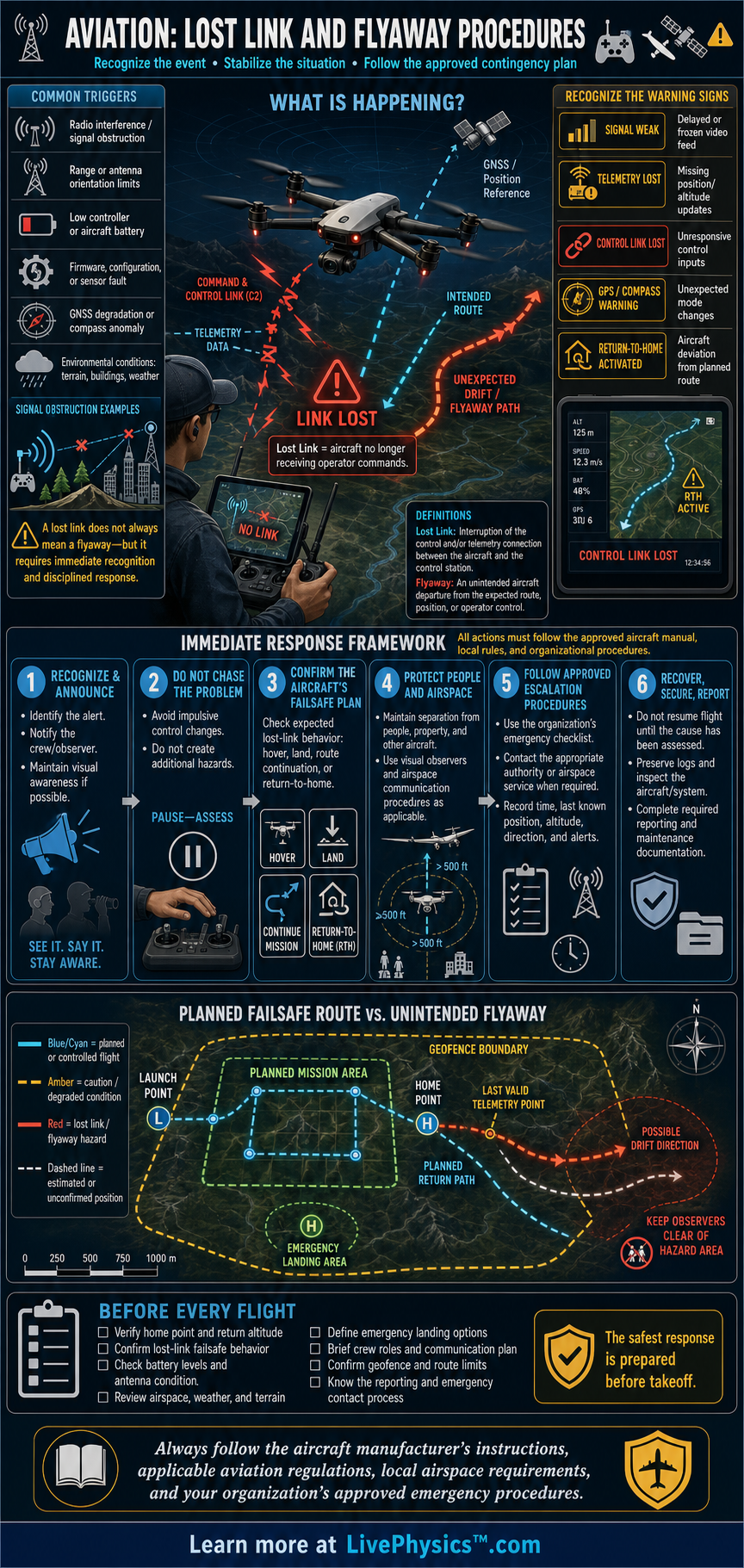
A lost link occurs when a remotely piloted aircraft no longer has a reliable command and control connection with its ground control station. A flyaway is an aircraft movement that is unintended or cannot be controlled as expected. These events matter because the aircraft may leave its planned operating area, create hazards for people or other aircraft, or be difficult to recover.
Clear procedures turn a confusing event into a structured safety response.
Most unmanned aircraft systems are programmed with a lost-link action before flight. The action may involve hovering, landing, returning to a home point, or flying a preplanned route to a recovery area. A flyaway can result from a lost link, but it can have other causes such as sensor errors, navigation faults, incorrect settings, or control-input problems.
Pilots and crews must understand the aircraft settings, airspace limits, emergency contacts, and reporting duties before launch.
Understanding Aviation, Lost Link and Flyaway Procedures
The command and control link carries pilot inputs from the ground station to the aircraft. It often carries telemetry back to the pilot. Telemetry can include position, altitude, battery state, speed, heading, and warnings.
A weak signal is not always a lost link. Signal quality can fall because of distance, terrain, buildings, trees, antenna orientation, electrical interference, or radio congestion.
The crew should monitor link quality during flight and respond early when it begins to decline. Moving closer, changing antenna position, or adjusting the aircraft route may prevent a complete loss.
Before a mission, the operator selects a lost-link procedure that fits the location and the aircraft. Return to home is common, yet it is not automatically safe in every case. The programmed return altitude must clear terrain, structures, and expected obstacles.
The home point must be accurate and located in a safe recovery area. Some missions need a controlled landing or a route to a designated contingency point instead. The aircraft may follow its programmed procedure even when the pilot cannot see its location, so planning must account for the entire route.
A flyaway means that the aircraft does not follow the expected command or programmed behavior. It may drift with the wind after propulsion failure, continue toward an incorrect waypoint, or respond incorrectly because it has bad navigation data. A compass problem can make heading control unreliable.
A global navigation satellite system fault can produce an incorrect position estimate. Mechanical damage, software faults, and incorrect control modes can contribute as well.
The first task is to identify what the aircraft is actually doing from available observations. The crew should avoid guessing when telemetry, visual observers, or recorded flight data provide better evidence.
A good response uses the procedure written for that aircraft and operation. The remote pilot should announce the emergency, note the time and last known position, and keep the ground station powered. The crew should try approved recovery actions only when they are likely to improve safety.
Repeated random commands can make the situation harder to interpret. Visual observers can track the aircraft direction and report landmarks. If the aircraft could affect controlled airspace, nearby aircraft, people, or critical infrastructure, the crew follows the required notification process without delay.
Students should treat lost-link planning as a risk-management task rather than a single button setting. Check the route, return altitude, battery reserve, geofence behavior, map data, antenna placement, and emergency landing sites. Practice the procedure in a safe area with an instructor or a simulated link loss when permitted.
After any event, preserve logs and write a factual timeline. This helps identify whether the cause was radio coverage, setup, weather, navigation, equipment condition, or human decision making. Careful review improves the next mission.
Key Facts
- A lost link is the loss of reliable command and control communication between the ground control station and aircraft.
- A flyaway is unintended or uncontrolled aircraft movement that may occur with or without a lost link.
- Distance = speed × time
- Time = distance ÷ speed
- Ground speed = airspeed + wind component
- Reserve battery energy = available battery energy - planned mission energy
Vocabulary
- Command and control link
- The communication connection used to send commands to an aircraft and receive its status data.
- Telemetry
- Data sent from an aircraft that reports information such as position, altitude, battery level, and system condition.
- Return to home
- An automated procedure in which an aircraft attempts to travel to its programmed home point.
- Geofence
- A programmed virtual boundary that can warn a pilot or limit aircraft movement outside an approved area.
- Contingency point
- A planned location or route used when normal flight cannot continue safely.
Common Mistakes to Avoid
- Assuming return to home is always safe. A return route can strike terrain or structures if the home point and return altitude were not planned for the operating area.
- Setting the home point before the aircraft has a reliable position. An incorrect home point can send the aircraft toward the wrong location during an automated recovery.
- Treating a weak radio signal as something to ignore. Declining link quality can provide time to reposition, shorten the route, or land before a full lost-link event occurs.
- Sending repeated unplanned commands during a flyaway. Random inputs can obscure the cause and may conflict with an aircraft's programmed emergency behavior.
Practice Questions
- 1 A UAS is drifting at a ground speed of 12 meters per second for 25 seconds after a control problem begins. How far does it travel in that time?
- 2 A UAS must return 1,800 meters to its home point at a ground speed of 15 meters per second. How many seconds will the return take?
- 3 A planned return-to-home path crosses a hill that is higher than the programmed return altitude. Explain why initiating return to home may be unsafe and describe one safer contingency option.