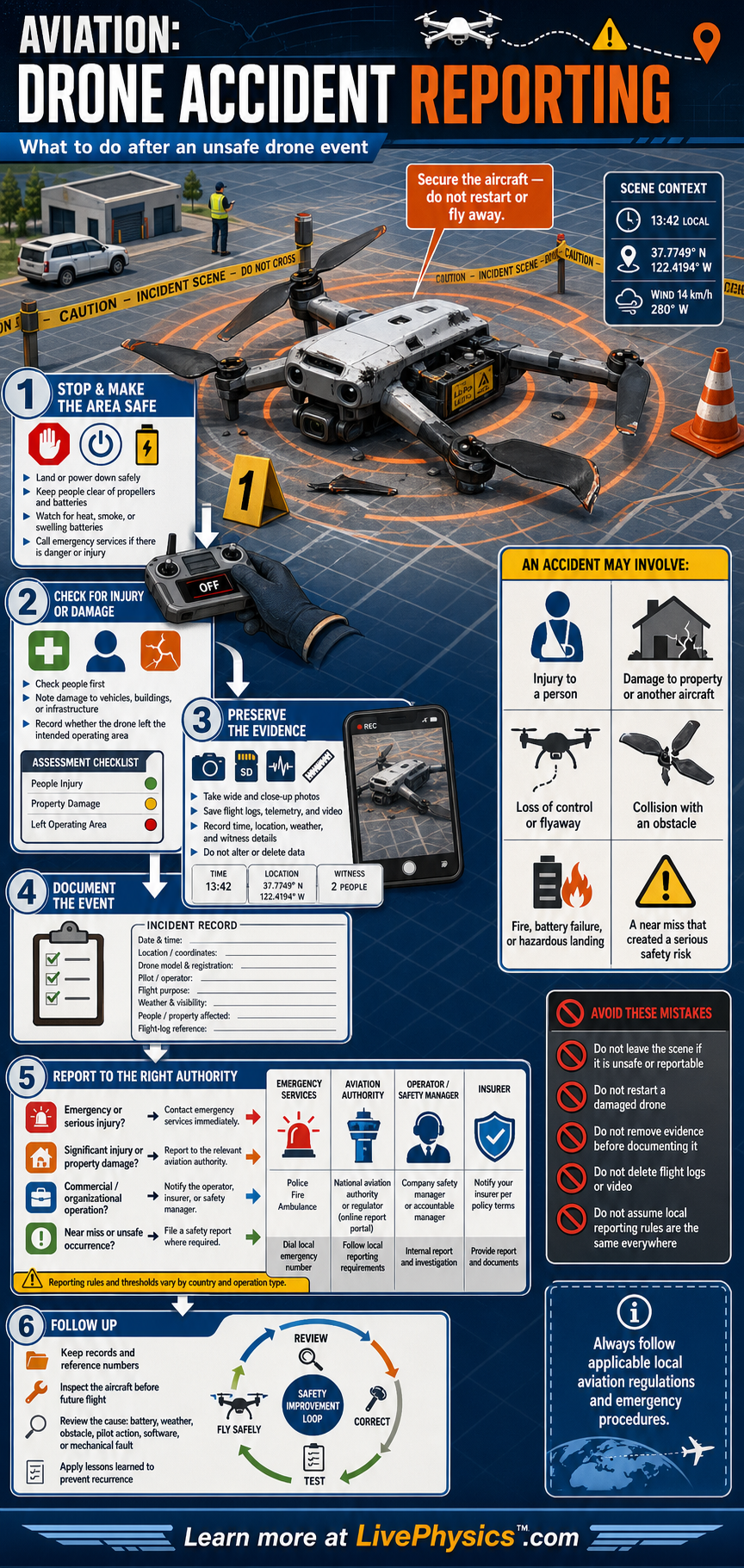
A drone accident can create safety risks even when the aircraft is small. A damaged propeller, exposed battery, or impact near people may turn a simple flight problem into a reportable event. Careful reporting helps aviation authorities understand hazards and prevent similar incidents.
It also gives the operator a clear record of what happened.
The first priority after an accident is safety. Stop the flight, keep people away from hazards, and do not handle a damaged lithium battery unless it is safe to do so. Preserve the scene when practical by taking photos and saving flight logs.
Then determine whether the event meets the reporting rule that applies to the operation.
Understanding Aviation, Drone Accident Reporting
Drone accident reporting begins at the scene. An operator should stop the motors, secure the controller, and prevent a second flight. Check for injured people before inspecting the aircraft.
Keep clear of damaged lithium batteries because they can overheat or catch fire after a crash. If there is a fire, serious injury, or immediate public danger, contact local emergency services first. Reporting to an aviation authority does not replace an emergency call.
For many small drone operations in the United States, the FAA Part 107 rule requires a report within 10 days after certain events. A report is required after a serious injury, a loss of consciousness, or qualifying property damage. Damage to the drone itself does not count toward the property damage threshold.
Damage to other property is reportable when the repair or replacement cost is more than 500 dollars. Operators should check the current FAA rules because reporting duties can differ by operating category, location, and event type.
Good evidence makes a report accurate. Take wide photos that show the site, nearby structures, and weather conditions. Take close photos of the drone, propellers, battery, payload, and any damaged property.
Save flight logs, controller records, video, maintenance records, and witness contact details. Write a timeline while details are fresh. Include the launch time, flight purpose, altitude, location, actions taken, and the time the incident ended.
A report should state facts rather than guesses. The operator can describe what was observed, such as a warning message, sudden drift, loss of control link, or collision with an object. It is useful to separate known facts from a possible cause.
Do not change log files or discard broken parts before recording them. A repaired drone may hide evidence that could explain a failure. Honest records protect people and help investigators identify patterns.
Students often encounter these ideas in flight planning, engineering design, and risk management. A preflight checklist reduces the chance of an accident, yet it cannot remove every risk. Learning the reporting process builds professional habits.
Focus on the event threshold, the reporting deadline, scene safety, and evidence preservation. A calm, organized response is more useful than trying to assign blame at the scene.
Key Facts
- For many FAA Part 107 operations, a qualifying accident report is due within 10 days.
- A report is required after a serious injury or loss of consciousness during a Part 107 operation.
- Qualifying property damage is damage to property other than the drone that exceeds $500 for repair or replacement.
- Damage to the drone itself is excluded from the Part 107 $500 property damage threshold.
- Battery energy in watt-hours is E = V × Ah.
- A clear incident timeline records launch time, event time, landing or impact time, and actions taken.
Vocabulary
- Accident report
- A formal record submitted to the proper authority after an event that meets reporting requirements.
- Part 107
- FAA rules that govern many small unmanned aircraft operations conducted for non-recreational purposes in the United States.
- Flight log
- Digital or written data that records details of a drone flight, such as time, position, altitude, and warnings.
- Property damage
- Physical harm to an item or structure that may require repair or replacement.
- Evidence preservation
- The process of protecting records, photos, parts, and other information so they remain useful after an incident.
Common Mistakes to Avoid
- Flying again immediately after a crash is unsafe because hidden damage can cause another loss of control and can overwrite useful flight data.
- Counting the cost of repairing the drone toward the Part 107 property damage threshold is wrong because the rule excludes damage to the unmanned aircraft itself.
- Waiting to write down details is risky because memory of warnings, weather, timing, and control inputs can fade quickly.
- Deleting flight logs or repairing damaged components before documenting them destroys evidence that may show what happened.
Practice Questions
- 1 During a Part 107 flight, a drone damages a parked car. The repair estimate is 300. Does the property damage amount meet the $500 reporting threshold?
- 2 A qualifying drone accident occurs on April 6. Using a 10-day reporting deadline, what calendar date is the report due?
- 3 A drone strikes a fence, but the operator sees no injury and estimates $150 in fence repairs. Explain what records the operator should preserve even if the event does not meet the Part 107 reporting threshold.