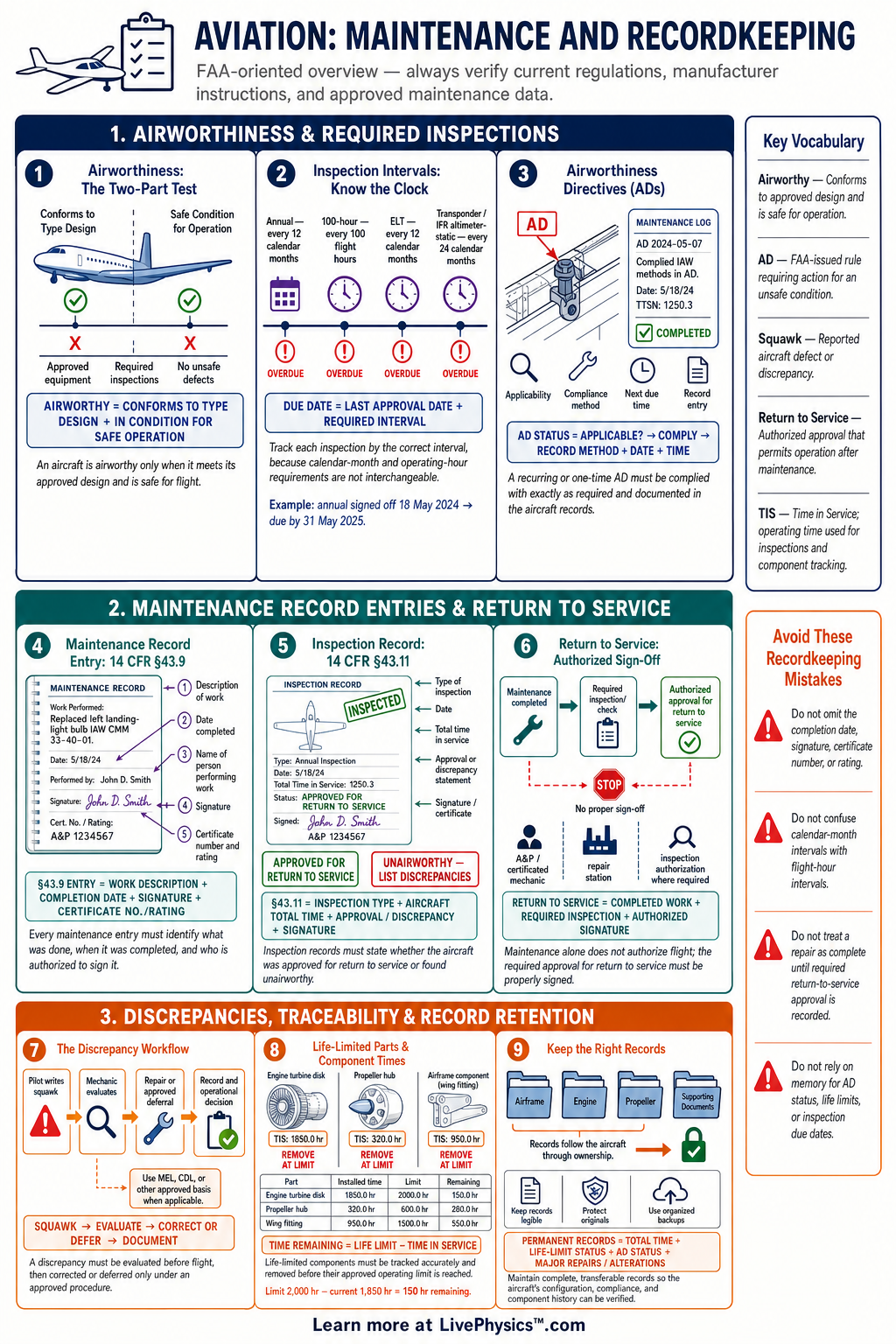
Aviation maintenance records show whether an aircraft has been maintained, inspected, and approved for return to service correctly. Pilots, owners, mechanics, inspectors, and buyers rely on these records to evaluate airworthiness. This cheat sheet organizes the most important FAA-oriented recordkeeping rules into a clear study reference.
It helps students connect maintenance work with the documentation that makes the work legally traceable.
The key regulations include 14 CFR sections 43.9, 43.11, 91.409, and 91.417. Maintenance entries document the work performed, while inspection entries document the inspection result and aircraft approval status. Some records must be kept for a limited time, while records showing life limits, overhaul status, and airworthiness directive compliance are retained permanently.
Accurate records protect safety, aircraft value, and regulatory compliance.
Key Facts
- Under 14 CFR 43.9, a maintenance record entry includes a description of the work, the date, the performer’s name, signature, certificate number, and rating.
- A return-to-service entry states that the aircraft or component is approved for return to service after the required work is completed.
- Under 14 CFR 43.11, an annual or 100-hour inspection record identifies the inspection type, its scope, the date, the aircraft total time, and the inspector’s signature and certificate details.
- An annual inspection is due every 12 calendar months, while a 100-hour inspection is due after 100 hours of time in service.
- Under 14 CFR 91.417, records of maintenance and 100-hour inspections are retained for one year or until the work is repeated or superseded.
- Records showing total time in service, life-limited part status, overhaul status, and airworthiness directive status are retained and transferred with the aircraft.
- An airworthiness directive entry includes the AD number, compliance method, compliance date, aircraft total time, and the next due time or date when the AD is recurring.
Vocabulary
- Airworthiness
- Airworthiness is the condition in which an aircraft conforms to its approved design and is in a condition for safe operation.
- Return to service
- Return to service is the formal approval that allows an aircraft or component to be used after required work or inspection.
- Airworthiness directive
- An airworthiness directive is an FAA rule that requires action to correct an unsafe condition in an aircraft, engine, propeller, or appliance.
- Annual inspection
- An annual inspection is a required aircraft inspection completed every 12 calendar months by an authorized inspector.
- Life-limited part
- A life-limited part is a component that must be removed from service after reaching a specified time, cycle, or other limit.
- Total time in service
- Total time in service is the accumulated operating time of an aircraft, engine, propeller, or component.
Common Mistakes to Avoid
- Writing only “repaired as needed” in a logbook entry is wrong because the record must describe the work well enough to identify what was done.
- Confusing an annual inspection with a 100-hour inspection is wrong because they have different due triggers, even though their inspection scope may be similar.
- Treating a service bulletin as automatically mandatory is wrong because a manufacturer bulletin is not an FAA airworthiness directive unless it is incorporated into an applicable requirement.
- Omitting the next due time for a recurring airworthiness directive is wrong because the record must make future compliance tracking possible.
- Discarding permanent aircraft records after a sale is wrong because records such as total time, life limits, and AD status must transfer with the aircraft.
Practice Questions
- 1 An aircraft received an annual inspection on May 18, 2025. During which calendar month is its next annual inspection due?
- 2 An aircraft has 2,438.6 hours total time after a 100-hour inspection. At what total time is the next 100-hour inspection due?
- 3 List four pieces of information that should appear in a maintenance record entry made under 14 CFR 43.9.
- 4 Explain why permanent records for life-limited parts and airworthiness directive compliance are important when an aircraft changes owners.
Understanding Maintenance and Recordkeeping
Maintenance records are part of the aircraft’s airworthiness history. The aircraft itself may appear clean and serviceable, but its legal status cannot be confirmed without complete records. A mechanic documents work after performing maintenance, preventive maintenance, rebuilding, or alteration.
Under 14 CFR 43.9, the entry identifies the work performed, the date, the name of the person who performed the work, and that person’s signature, certificate number, and rating. The entry must also state that the aircraft was approved for return to service when appropriate.
Inspection records require additional information because an inspection evaluates the overall condition of an aircraft or component. Under 14 CFR 43.11, an annual or 100-hour inspection entry includes the type of inspection and a brief description of its scope. If the aircraft passes, the record states that it has been inspected in accordance with the inspection and was determined to be in airworthy condition.
If it does not pass, the record explains that it is not approved for return to service and lists the discrepancies. This distinction matters because an inspection can reveal problems that prevent legal flight.
The owner or operator has major responsibilities under 14 CFR 91.417. Records of maintenance, preventive maintenance, alterations, and 100-hour inspections are kept until the work is repeated, replaced by other work, or for one year after the work is performed. Records of annual inspections, progressive inspections, and certain other inspections are kept until the next inspection is completed.
Some records stay with the aircraft for its entire life. These permanent records include total time in service, current life-limited part status, overhaul status, and the current status of applicable airworthiness directives.
Airworthiness directives are legally enforceable FAA rules that correct unsafe conditions. A proper AD record identifies the directive, its revision if applicable, the method of compliance, the date, and the aircraft total time when compliance occurred. If recurring action is required, the record also shows the next due time or date.
Students should learn to separate an AD from a service bulletin. A service bulletin comes from a manufacturer and may be recommended, while an AD is mandatory unless an approved alternative method of compliance applies.
Careful recordkeeping has practical value beyond passing an inspection. Complete logs help a mechanic plan future work and help an owner prove that required inspections were completed. They also affect resale value because buyers want evidence of damage repairs, component times, and compliance history.
When studying, focus on who may perform and approve work, what information each entry needs, and how long the record must be retained. Always compare a sample logbook entry with the exact wording required by the applicable regulation.