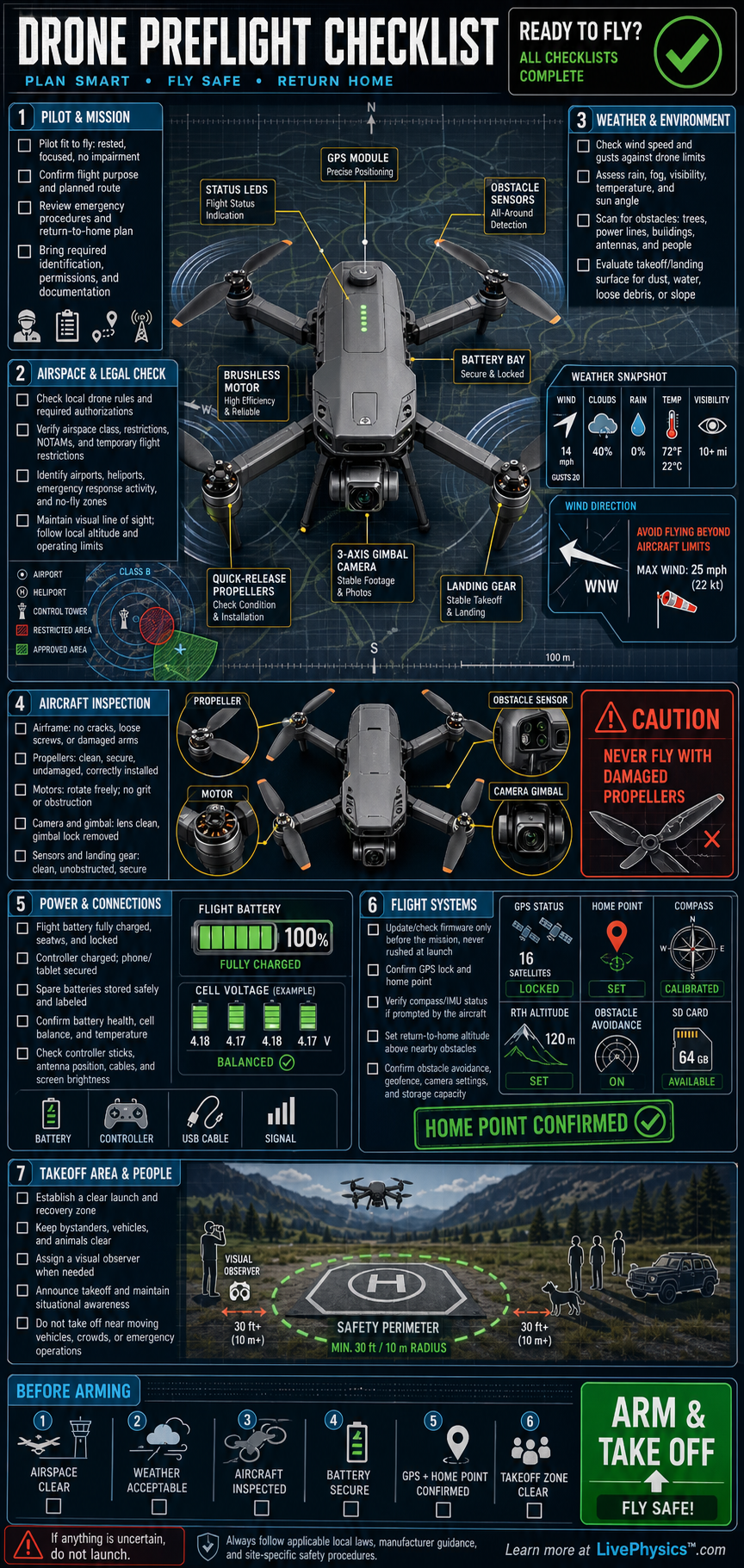
A drone preflight checklist is a structured inspection completed before every flight. It helps a pilot find problems while the aircraft is still on the ground, where they are easier and safer to fix. Small issues such as a loose propeller, low battery, or poor GPS signal can quickly become serious once the drone is airborne.
A consistent checklist protects people, property, and the aircraft.
Preflight work includes checking the airframe, power system, controls, sensors, weather, and planned flight area. The pilot confirms that the camera gimbal is clear, motors spin freely, status lights show normal operation, and the landing zone is safe. They also review wind, obstacles, airspace limits, and battery reserve before takeoff.
This process turns a flight from a quick launch into a deliberate aviation decision.
Understanding Aviation, Drone Preflight Checklist
A preflight checklist works because it moves attention from memory to a repeatable process. People can forget steps when they feel rushed, distracted, or excited to fly. A written sequence gives the pilot the same order each time.
Many pilots start with the flight area, then inspect the aircraft, then power it on and verify its electronic systems. This order prevents a pilot from discovering an unsafe site after the drone is ready to launch.
The physical inspection begins with the frame and propulsion system. Look for cracks in arms, loose screws, bent landing gear, and damage near the camera gimbal. Each propeller must be the correct type, firmly attached, and free of chips or warping.
A damaged propeller can create vibration, which reduces camera quality and makes the flight controller work harder. Motors should turn smoothly by hand when the drone is powered off. Dirt, sand, or wrapped grass can block a motor and cause uneven thrust.
Power checks deserve special care because battery problems can end a flight suddenly. Inspect the battery case for swelling, cracks, hot spots, or damaged contacts. Confirm it locks fully into the battery bay.
Check that its charge is enough for the planned route, takeoff, landing, and a reserve for unexpected wind or delays. Battery voltage can drop under heavy load, especially in cold weather. The pilot should avoid launching with a battery that is old, damaged, or poorly balanced between its cells.
Next, the pilot checks navigation and control systems. The controller, mobile device, and drone need a reliable connection before flight. GPS reception should be strong enough for the intended mode, and the home point should match the actual takeoff location.
Obstacle sensors need clean lenses and enough light to operate properly. The compass and inertial sensors should report normal status. A pilot must understand that sensors assist flight but do not guarantee that the aircraft will avoid every wire, branch, wall, or moving object.
The final decision depends on the environment and flight plan. Check wind direction, gusts, visibility, temperature, nearby people, and possible obstacles. Plan a clear takeoff and landing area with room to react if the drone drifts.
Review local airspace rules and keep the drone within visual line of sight when required. During learning, focus on building the habit of stopping when one item is uncertain. A delayed flight is usually safer than a launch based on an assumption.
Key Facts
- Thrust > weight is required for a drone to climb.
- Weight = mass × g, where g is about 9.8 m/s² near Earth.
- Flight time ≈ usable battery capacity / average current draw.
- Usable battery capacity = rated capacity × safe discharge fraction.
- Ground speed = airspeed + wind component in the direction of travel.
- Kinetic energy = 1/2 mv², so faster flight greatly increases impact energy.
Vocabulary
- Preflight inspection
- A systematic check of an aircraft, its controls, and its flight environment before takeoff.
- Home point
- The recorded location that a drone may use as its return destination during a return-to-home procedure.
- GPS
- A satellite-based positioning system that helps a drone estimate its location and hold position.
- Gimbal
- A motorized mount that stabilizes a drone camera while the aircraft moves.
- Obstacle sensor
- A device that detects nearby objects to help a drone avoid collisions in supported flight modes.
Common Mistakes to Avoid
- Launching without inspecting propellers. Small chips, cracks, or loose propellers can create vibration and loss of control, so inspect each one before powering up.
- Treating a full battery indicator as proof that the flight is safe. Battery charge does not reveal cell damage, cold-temperature performance, or whether enough reserve remains for landing.
- Trusting obstacle sensors to detect every hazard. Thin wires, reflective surfaces, dark objects, and poor lighting can prevent sensors from detecting obstacles reliably.
- Setting the home point without checking its location. An incorrect home point can send a returning drone toward an unsafe area instead of the takeoff zone.
Practice Questions
- 1 A drone battery has a rated capacity of 6000 mAh. The pilot plans to use only 80 percent of its capacity, and the average current draw is 15 A. Estimate the available flight time in minutes.
- 2 A drone flies at 12 m/s relative to the air. It travels 300 m directly into a 4 m/s headwind, then returns with the same wind behind it. Calculate the time for each leg and the total travel time.
- 3 A pilot finds a small chip on one propeller, but the drone powers on normally and reports strong GPS reception. Explain why the pilot should not launch until the propeller is replaced.