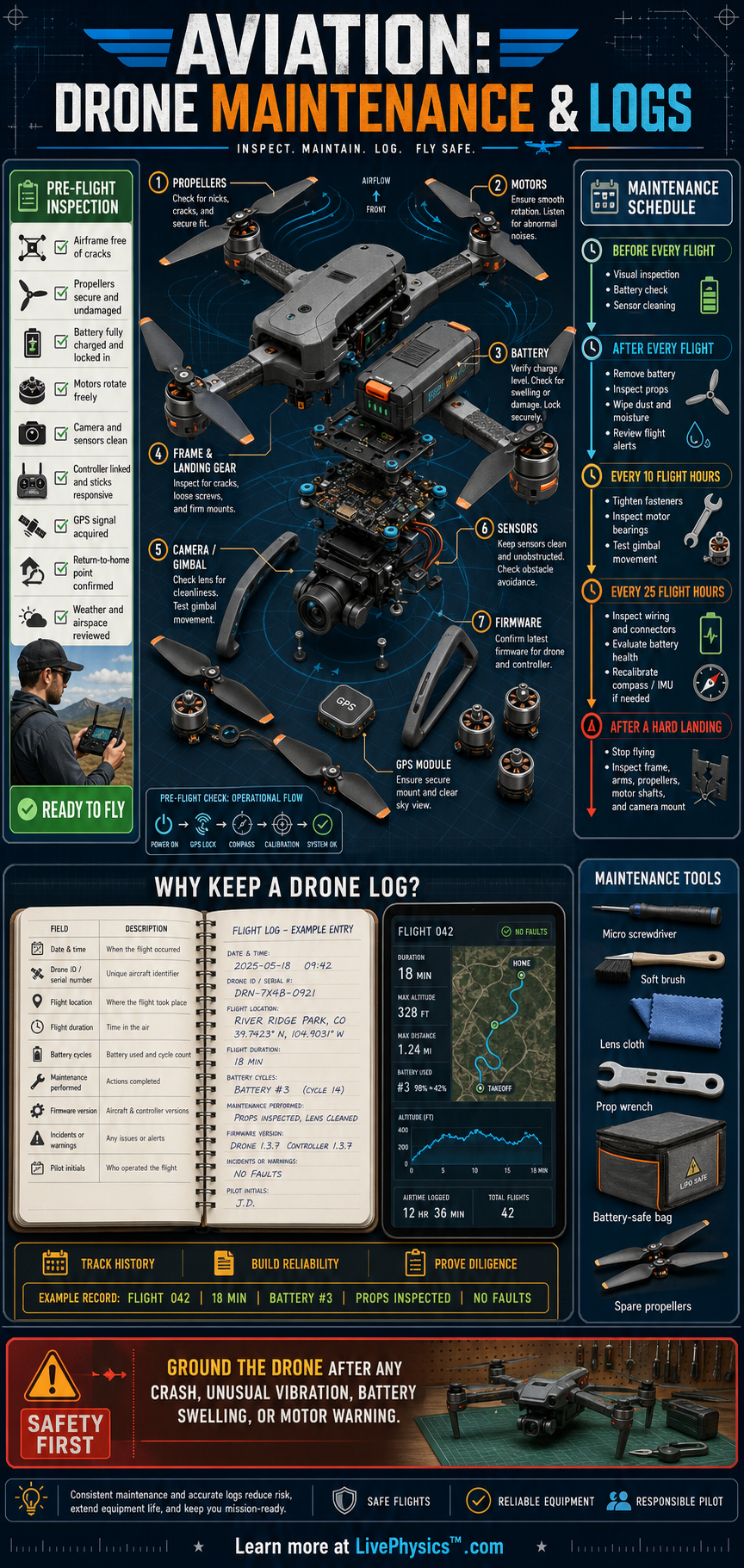
A drone is an aircraft, even when it fits in a backpack. Its motors, propellers, battery, sensors, and software must work together for a stable flight. Regular maintenance reduces the chance of crashes, lost aircraft, damaged property, and battery failures.
Clear logs turn small observations into useful evidence before a serious problem develops.
A good maintenance routine starts before takeoff and continues after landing. The pilot inspects parts that wear out, records flight time, and checks for warnings in the flight app. Service records help identify patterns, such as one motor running hotter than the others or a battery losing capacity quickly.
For commercial work, accurate logs can support safe operations and show that required inspections were completed.
Understanding Aviation, Drone Maintenance and Logs
A quadcopter stays airborne because its four propellers create upward thrust. The flight controller changes motor speeds many times each second to keep the aircraft level or move it. This means a small problem in one propeller, motor, or arm can affect the whole system.
A cracked propeller may create vibration. Vibration can blur camera footage, loosen fasteners, and confuse sensitive sensors. Inspect propellers under good light, then replace any blade with cracks, chips, bends, deep scratches, or a loose hub.
Battery care deserves special attention because lithium polymer batteries store a large amount of energy. Check each battery case for swelling, dents, leaks, damaged contacts, and unusual heat. Use the charger and charging settings specified by the manufacturer.
Let a hot battery cool before charging it. Record charge cycles, flight duration, warnings, and any battery that reaches low voltage sooner than expected. Store batteries at the recommended storage charge when they will not be used for several days.
A preflight inspection is a short, repeatable check before every launch. Confirm that the frame arms lock firmly and that landing gear, camera gimbal, and payload mounts are secure. Inspect motor bells for dirt or damage, then rotate them gently by hand with the power off.
They should turn smoothly without grinding or side-to-side play. Check that the propellers are installed in the correct positions and directions. Verify that the remote controller, aircraft, and mobile device have enough power for the planned mission.
Maintenance logs give each aircraft a history. A useful entry includes the date, aircraft identification, pilot, location, flight time, battery used, maintenance performed, and faults found. It should state what action was taken, such as replacing a propeller or cleaning a motor.
Record firmware versions after updates because software can change flight behavior and available features. Keep a separate record for repairs, inspections, crashes, hard landings, and parts replaced. Follow the manufacturer instructions and the rules that apply to the type of operation.
Students often meet these ideas in robotics, electronics, photography, mapping, and engineering labs. The important habit is to connect an observation with a record and a decision. A vibration is not just an annoyance.
It is a clue that can lead to inspection of a propeller, motor, mount, or frame. A log is more useful when it is specific and written immediately after the flight. Focus on consistent checklists, careful battery handling, and knowing when to stop flying until a fault is inspected.
Key Facts
- A quadcopter needs total thrust greater than its weight to climb.
- Total thrust = thrust from motor 1 + thrust from motor 2 + thrust from motor 3 + thrust from motor 4
- Flight time = landing time - takeoff time
- Battery energy in watt-hours = battery voltage × battery capacity in amp-hours
- Inspect propellers before each flight and replace damaged blades rather than trying to straighten them.
- A complete maintenance log records the date, aircraft ID, flight time, battery ID, discrepancy, and corrective action.
Vocabulary
- Preflight inspection
- A systematic check of an aircraft and its equipment before takeoff.
- Flight controller
- The onboard computer that uses sensor data to control motor speed and stabilize the drone.
- Lithium polymer battery
- A rechargeable battery commonly used in drones because it can supply high current with low weight.
- Discrepancy
- A fault, unusual condition, or damaged part found during an inspection or flight.
- Firmware
- Software stored in a device that controls how its hardware operates.
Common Mistakes to Avoid
- Flying with a chipped or bent propeller because the damage looks minor. Even small blade damage can create vibration and uneven thrust, so replace the propeller before flight.
- Charging a warm, swollen, or damaged battery. Heat and physical damage increase battery risk, so stop using the pack and follow the manufacturer disposal guidance.
- Writing vague log entries such as "checked drone." A useful log identifies the aircraft, date, fault found, work performed, and the person who completed the work.
- Installing propellers in the wrong positions or directions. A quadcopter relies on matched clockwise and counterclockwise rotation, so verify markings before arming.
Practice Questions
- 1 A drone completes three flights lasting 12 minutes, 18 minutes, and 15 minutes. What total flight time should be entered in its log?
- 2 A battery has a nominal voltage of 14.8 V and a capacity of 5.0 Ah. Calculate its approximate energy in watt-hours.
- 3 A pilot notices new vibration in video footage after a hard landing, but the drone can still hover. Explain why the pilot should stop flying and name two components to inspect.