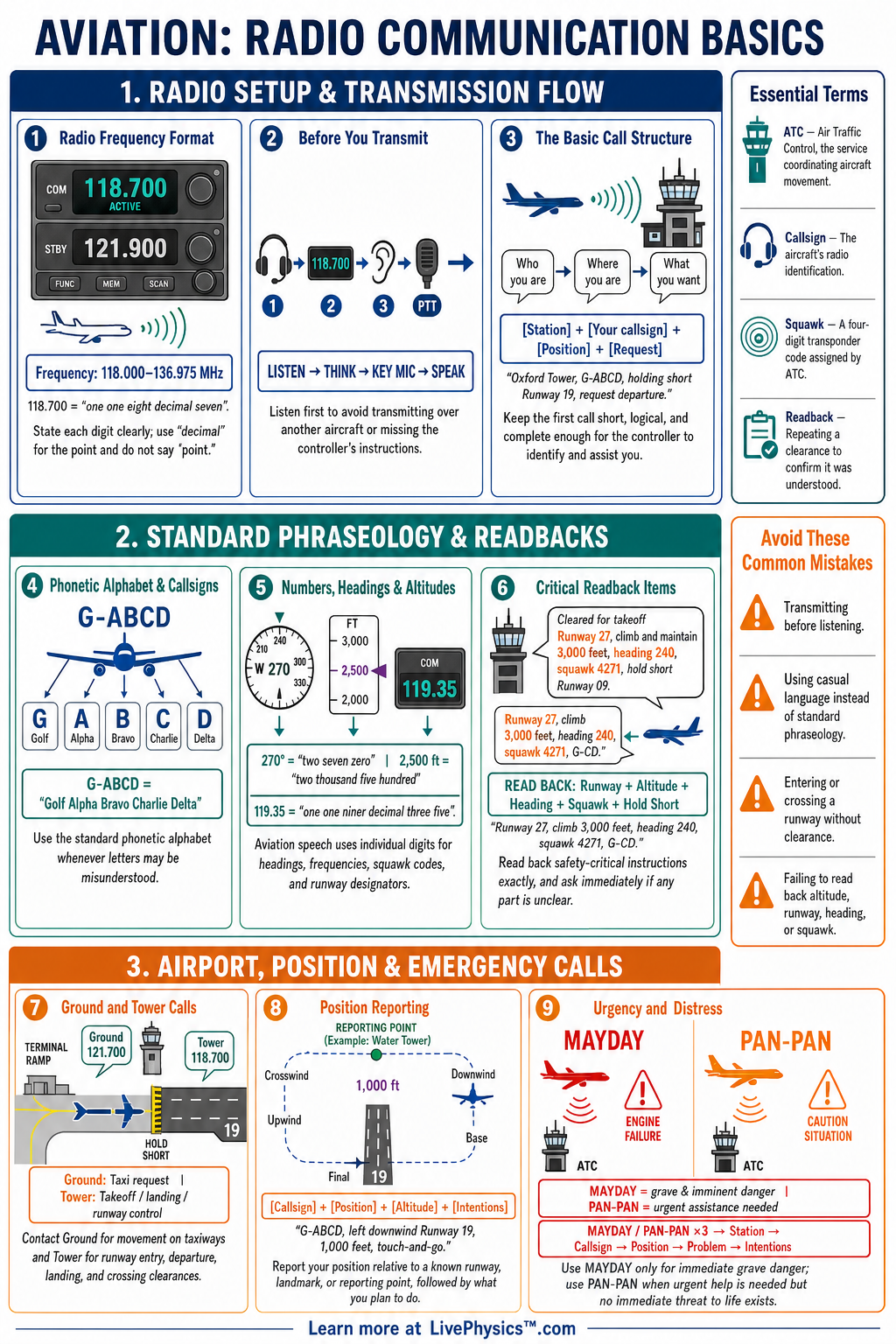
Aviation radio communication helps pilots, controllers, and other crews share clear information in busy airspace. This cheat sheet gives students a practical structure for listening, transmitting, and responding on aviation frequencies. It supports safer flight operations by reducing confusion about who is speaking, where an aircraft is, and what it intends to do.
Students need these basics before using radio procedures in simulation, flight training, or operational planning.
A standard transmission identifies the station being called, identifies the aircraft, states position or request, and ends with any needed information. Pilots use the phonetic alphabet, standard number pronunciation, and concise phraseology to make messages understandable. Important skills include making a correct initial call, reading back safety-critical instructions, changing frequencies, and handling an emergency.
Good radio work depends on careful listening as much as clear speaking.
Key Facts
- A basic initial call is station name, aircraft call sign, position, altitude, and request.
- Listen before transmitting so that you do not block an ongoing call or miss an instruction.
- Use the phonetic alphabet for letters, such as Alpha, Bravo, Charlie, and Delta.
- Speak a frequency such as 121.5 as one two one decimal five.
- Read back assigned runway, altitude, heading, speed, route, clearance, and frequency instructions when required.
- Roger means I have received your transmission, while wilco means I understand and will comply.
- Mayday indicates grave and imminent danger, while pan pan indicates an urgent situation that is not immediately life-threatening.
- If an instruction is unclear, say confirm or say again rather than acting on an assumption.
Vocabulary
- Call sign
- A call sign is the unique radio identity used to identify an aircraft or ground station.
- ATC
- Air traffic control is the service that directs and separates aircraft in controlled airspace and at many airports.
- Readback
- A readback is a pilot repeating an important instruction so the controller can check that it was understood correctly.
- Frequency
- A frequency is a specific radio channel used to communicate with a particular aviation station or service.
- Phonetic alphabet
- The phonetic alphabet uses standard code words such as Alpha and Bravo to make letters clear over radio.
- Squawk
- A squawk is a four-digit transponder code assigned or selected to help identify an aircraft on radar.
Common Mistakes to Avoid
- Transmitting without listening first is wrong because it can interrupt another call and hide an important controller instruction.
- Using casual language instead of standard phraseology is wrong because vague wording can be misunderstood in a noisy radio environment.
- Saying roger when an action is required is wrong because roger only confirms receipt, while wilco states that the instruction will be followed.
- Failing to read back a runway, altitude, heading, or frequency is wrong because these details can be safety-critical and errors may go unnoticed.
- Guessing after hearing an unclear clearance is wrong because a pilot must request clarification before taking action.
Practice Questions
- 1 You are aircraft G-ABCD, 10 miles north of Example Airport at 2,500 feet, and you want to land. Write a concise initial call to Example Tower.
- 2 A controller says, "G-ABCD, descend to 3,000 feet, turn right heading 090, contact Approach on 121.5." Write the required readback.
- 3 Convert the frequency 118.725 into standard spoken aviation form.
- 4 Explain why a pilot should ask for clarification after receiving an unclear instruction instead of choosing the most likely meaning.
Understanding Radio Communication Basics
A radio transmission should be short, orderly, and relevant. Before transmitting, listen first. This helps a pilot confirm that the frequency is active and prevents speaking over another aircraft or controller.
Write down important instructions when possible. Press the transmit switch, pause briefly, then speak at a steady pace. Releasing the switch promptly after the message keeps the frequency available for others.
The first call normally includes the station name, the aircraft type or call sign, position, altitude, and request. The exact details depend on the situation. A pilot calling a tower near an airport may report a location, altitude, and intended landing.
A pilot calling an area control unit may give an assigned call sign and request a clearance. Controllers may shorten an aircraft call sign only after they have used the full call sign and the pilot recognizes it.
Some instructions require a readback because an error could create an immediate safety risk. Pilots read back clearances, runway assignments, altitudes, headings, speeds, routes, and frequency changes when required by local procedures. A readback lets the controller detect a misunderstanding before the aircraft acts on it.
If an instruction is unclear, the pilot should request clarification rather than guess. Saying say again, confirm, or unable gives useful information and supports a safe outcome.
Aviation uses standard words because ordinary conversation can be ambiguous over radio. The phonetic alphabet makes letters distinct, so Alpha and Bravo are less likely to be confused than single spoken letters. Numbers also have defined pronunciations.
A frequency such as one two one decimal five is spoken carefully and without unnecessary words. Terms such as roger, wilco, affirm, negative, standby, and correction each have specific meanings. Roger means the message was received, while wilco means the instruction will be followed.
Radio communication matters in every phase of flight. It is used for taxi instructions, departure clearances, traffic information, weather reports, airspace entry, and arrival sequencing. In an emergency, the words mayday for grave and imminent danger or pan pan for urgency alert others quickly.
Students should practice listening to real or simulated transmissions, copying key details, and building messages before pressing the transmit switch. Accuracy, calm delivery, and disciplined listening are more valuable than sounding fast.