Doppler Effect Visualizer
Watch wavefronts compress in front of a moving source and stretch behind it. Adjust source speed through subsonic, sonic, and supersonic to see Mach cones form. Live frequency shift readouts for sound, water, and light waves.
Live Readout
Doppler Formulas
Classical Doppler (sound / water)
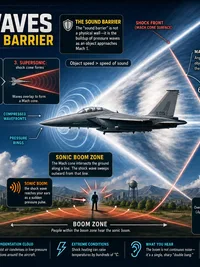
Mach cone half-angle (supersonic)
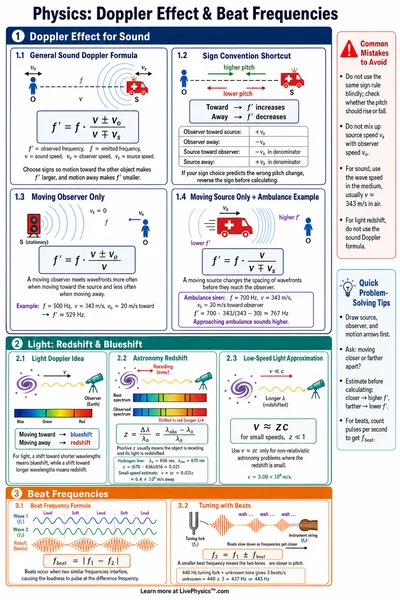
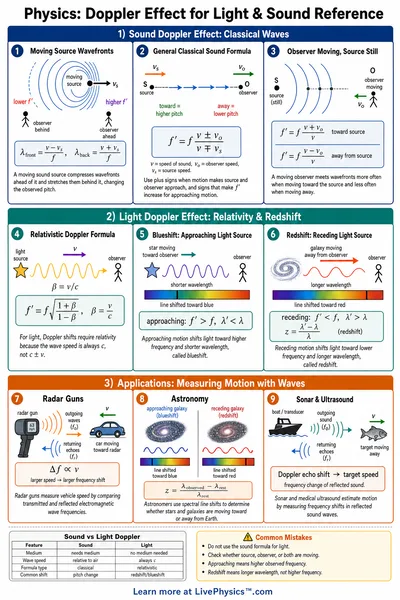
Sign convention, positive velocities are directed toward the opposite party. v_src positive = source moving toward observer; v_obs positive = observer moving toward source.
About the Doppler effect
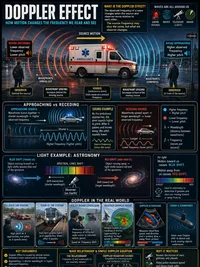
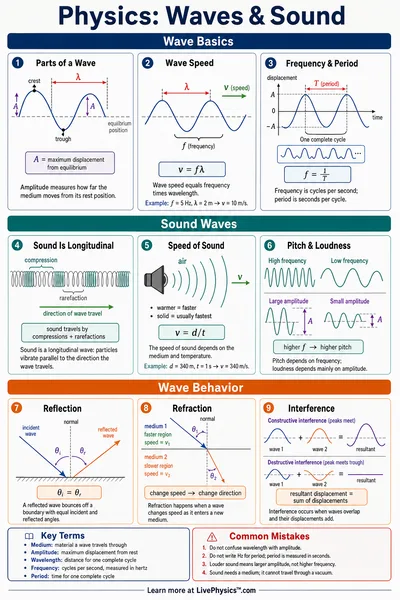
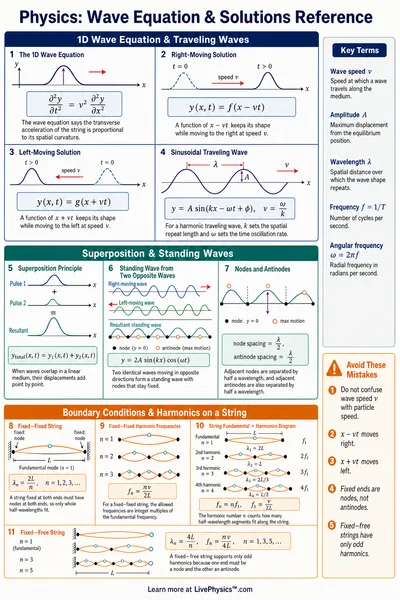
When a wave source moves toward an observer, the wavefronts arrive more frequently and the observed frequency is higher. When the source moves away, frequencies arrive less frequently and the observed frequency is lower. The Doppler effect is the same physics whether the waves are sound, water ripples, or light. It is how police radar measures car speed and how astronomers measure cosmic redshift.
Curriculum alignment
Supports AP Physics 1 sound and waves units, AP Physics 2 waves and optics, Honors Physics, and NGSS HS-PS4-1 (waves carry energy and information). The Mach cone at v greater than c offers a clean visual demonstration of supersonic shock formation, useful in aerospace and acoustics extensions.
How to use
- Source speed slider. Drag past Mach 1 to see the sonic boom and Mach cone form. The mode badge updates automatically.
- Click the canvas to relocate the observer (red dot) anywhere on the scene.
- Observer velocity. Negative values move the observer away from the source; positive values move it toward the source.
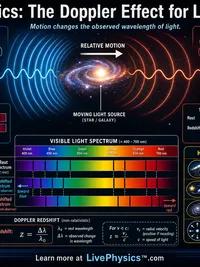
- Wave type selector. Switch to Light to apply the relativistic Doppler formula automatically.
Key concepts
- Wavefront compression. Ahead of a moving source, successive wavefronts are emitted from progressively closer positions, so the wavelength shortens and frequency rises.
- Mach number. The ratio of source speed to wave speed. At Mach 1, all wavefronts pile up into a shock. Above Mach 1, a conical shock wave (Mach cone) forms.
- Redshift and blueshift. Astronomers apply the relativistic Doppler formula to measure recession velocities of galaxies from spectral line shifts.