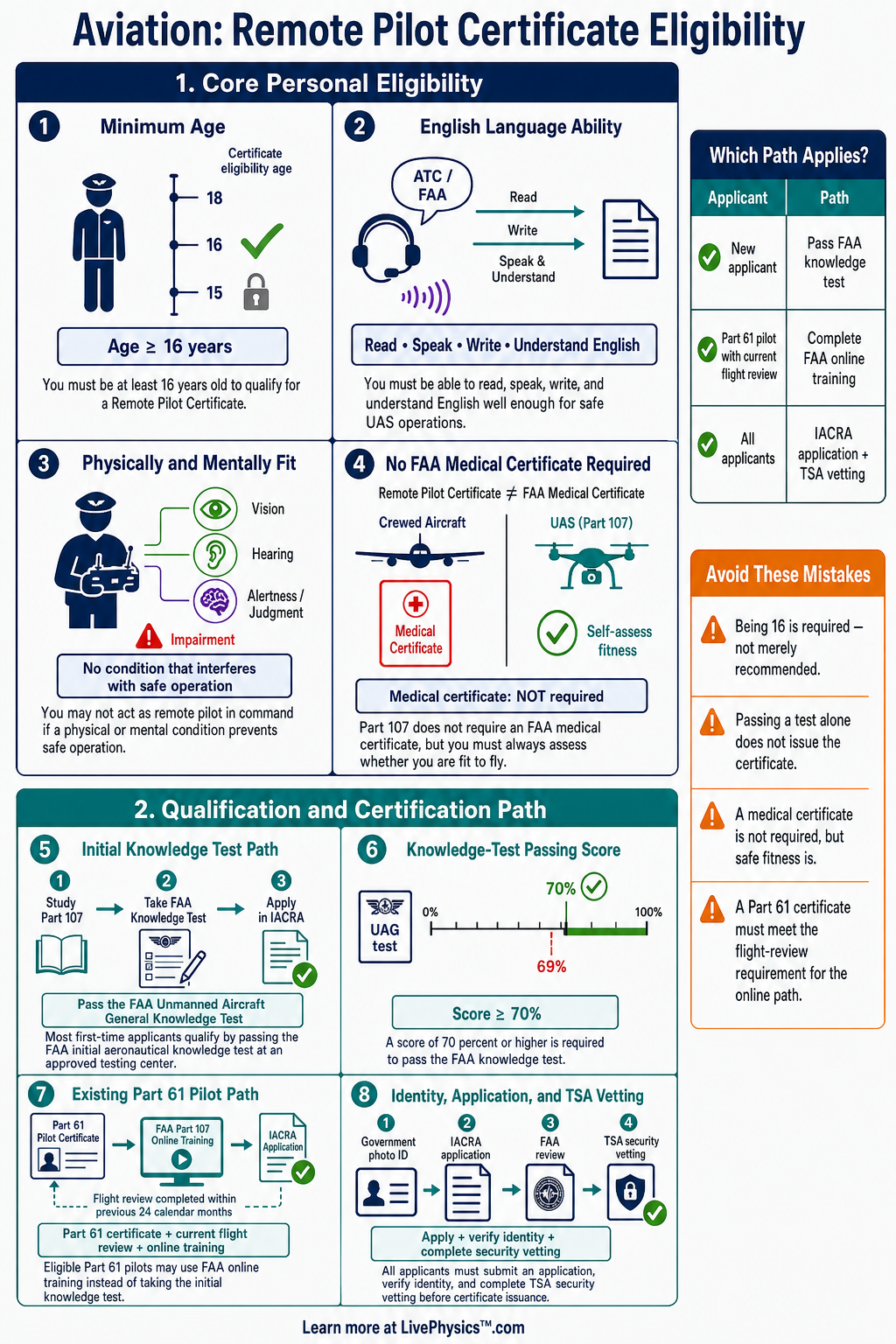
The FAA Remote Pilot Certificate allows a person to act as remote pilot in command for many small unmanned aircraft operations under Part 107. This cheat sheet explains who can qualify and the steps needed to earn the certificate. Students need these rules to plan a legal drone career path and understand the responsibilities of remote pilot in command.
Eligibility is only the first part of safe and lawful commercial drone flying.
Applicants generally must be at least 16 years old, be able to read, speak, write, and understand English, and be physically and mentally able to operate safely. Most applicants qualify by passing the FAA Unmanned Aircraft General knowledge test. Applicants who already hold a qualifying FAA pilot certificate may use an alternate training path.
Every applicant must complete a TSA security vetting process before receiving a permanent certificate.
Key Facts
- An applicant for an FAA Remote Pilot Certificate must be at least 16 years old.
- An applicant must be able to read, speak, write, and understand English.
- An applicant must be in a physical and mental condition that allows safe small unmanned aircraft operation.
- Most initial applicants must pass the FAA Unmanned Aircraft General knowledge test with a score of at least 70 percent.
- Every Remote Pilot Certificate applicant must complete TSA security vetting before receiving a permanent certificate.
- A current Part 61 pilot with a flight review completed within the previous 24 calendar months may qualify through FAA online training instead of the initial knowledge test.
- A remote pilot must complete FAA recurrent training every 24 calendar months to maintain aeronautical knowledge currency.
- A Remote Pilot Certificate allows Part 107 operations, but each flight must still comply with airspace, registration, Remote ID, and operational rules.
Vocabulary
- Remote Pilot Certificate
- An FAA airman certificate that authorizes a person to serve as remote pilot in command under Part 107.
- Remote Pilot in Command
- The person with final responsibility and authority for the safety and legality of a drone operation.
- Part 107
- The FAA regulation that governs many nonrecreational small unmanned aircraft operations.
- Aeronautical Knowledge Test
- An FAA exam that measures knowledge of aviation rules, airspace, weather, and safe drone operations.
- TSA Security Vetting
- A security review conducted before the FAA issues a permanent Remote Pilot Certificate.
- Recurrent Training
- Required FAA follow-up training that remote pilots complete every 24 calendar months.
Common Mistakes to Avoid
- Thinking that being 16 is enough to receive the certificate is wrong because applicants must also meet English, safety condition, testing or training, and TSA vetting requirements.
- Assuming a medical certificate is required is wrong because Part 107 does not normally require one, although the pilot must still be fit to operate safely.
- Believing that passing the knowledge test immediately creates a permanent certificate is wrong because the FAA application and TSA security vetting must still be completed.
- Using an old Part 61 flight review for the alternate pathway is wrong because the flight review must have been completed within the previous 24 calendar months.
- Treating the Remote Pilot Certificate as permission for every drone flight is wrong because airspace, registration, Remote ID, and operating rules may still limit a specific operation.
Practice Questions
- 1 A student is 15 years old, speaks English fluently, and passes the knowledge test with 88 percent. Is the student currently eligible to receive a Remote Pilot Certificate under Part 107.
- 2 An applicant scores 69 percent on the FAA Unmanned Aircraft General knowledge test. Does the applicant meet the required passing score.
- 3 A current Part 61 pilot completed a flight review 20 calendar months ago and finishes the FAA online small unmanned aircraft training. Which eligibility pathway can this pilot use.
- 4 Explain why holding a Remote Pilot Certificate does not by itself make every planned drone flight legal.
Understanding Remote Pilot Certificate Eligibility
A Remote Pilot Certificate is an FAA airman certificate. It is required when a person serves as remote pilot in command under Part 107. The remote pilot in command has final authority over the drone operation.
This person must make sure the flight follows FAA rules, avoids hazards, and can be stopped safely when conditions change. A person can fly for business, school, public safety, or other nonrecreational purposes under Part 107 when the operation meets the applicable rules.
The basic eligibility standard starts with age. An applicant must be at least 16 years old when applying for the certificate. The applicant must also be able to read, speak, write, and understand English.
English is important because aviation rules, airport information, airspace references, and communications use standard English terminology. The FAA also requires the applicant to be in a physical and mental condition that allows safe drone operation. A medical certificate is not normally required for a Remote Pilot Certificate, but a person must not operate when illness, medication, fatigue, or another condition makes safe operation difficult.
Most first time applicants take the FAA Unmanned Aircraft General knowledge test. This exam is often called the Part 107 knowledge test. It covers airspace, weather, loading and performance, airport operations, emergency procedures, regulations, and crew resource management.
A passing score is 70 percent or higher. After passing, the applicant uses the FAA application system to submit an airman certificate application. The FAA performs TSA security vetting before the permanent certificate is issued.
A current FAA Part 61 pilot certificate can provide another qualification path. An applicant using this path must have completed a flight review within the previous 24 calendar months. The applicant must also complete the FAA online small unmanned aircraft systems training course.
This route recognizes prior aviation training, but it does not remove the need to learn drone specific rules. The same safety responsibility applies whether a person qualifies through the knowledge test or through the existing pilot pathway.
Certificate holders must keep their knowledge current. Part 107 remote pilots complete recurrent online training every 24 calendar months. This training keeps pilots aware of rule changes, safety practices, and operating limits.
Students should focus on the difference between earning a certificate and conducting a particular flight. Holding a certificate does not automatically allow every operation. Airspace authorization, registration, Remote ID requirements, visual line of sight, and local restrictions can still affect a planned flight.