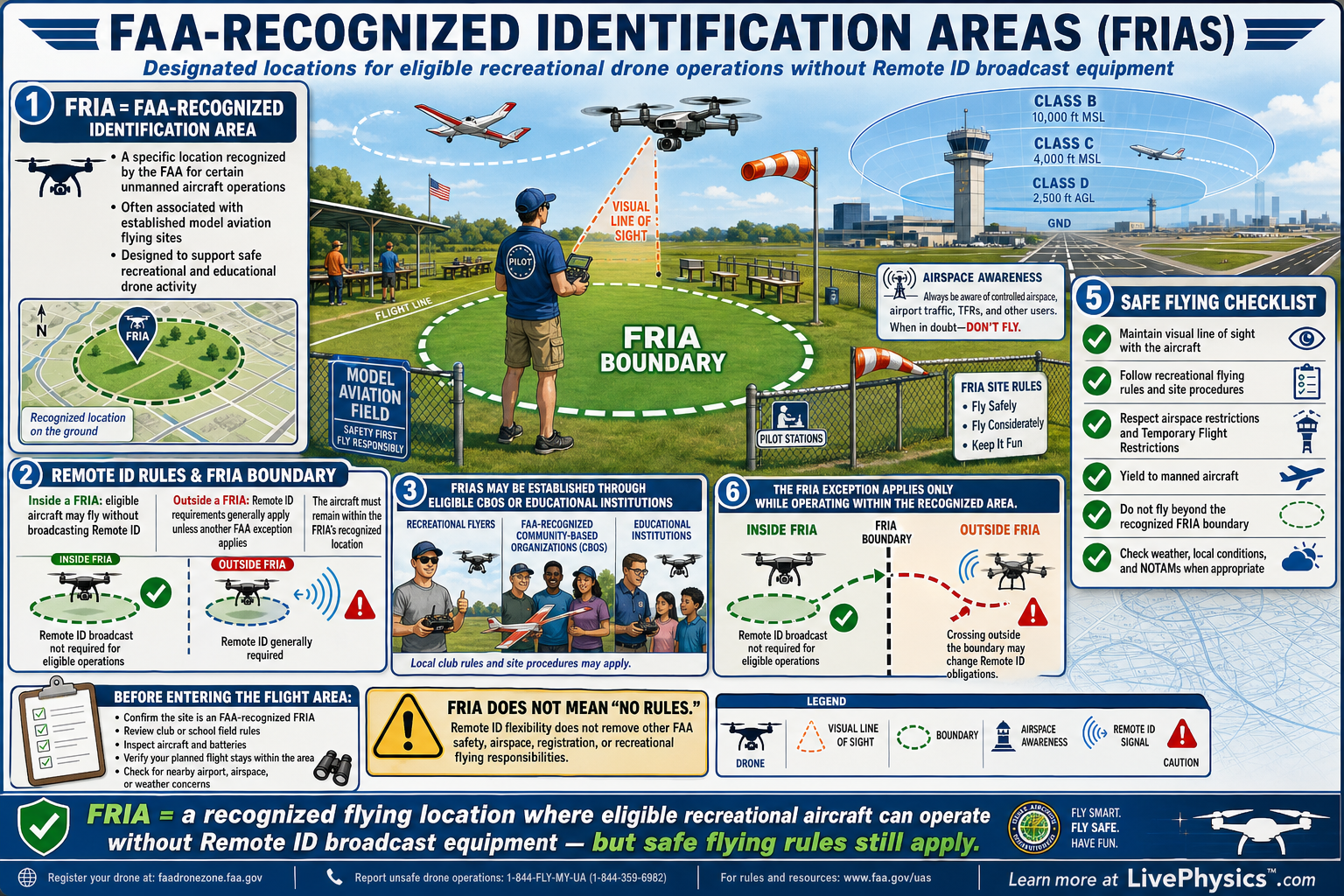
Within a FRIA, a pilot may operate without a Remote ID broadcast module if all other applicable rules are followed. The drone must remain inside the approved area and stay within the pilot's visual line of sight. A FRIA does not remove rules about airspace, altitude, registration, safety, or yielding to crewed aircraft.
Understanding Aviation, FAA Recognized Identification Areas
Remote ID works like a digital identification signal for drones. A drone with standard Remote ID sends identification and location information while it flies. Older model aircraft and many homebuilt drones may not have this equipment.
The FAA created FRIAs so these aircraft can still be used at approved sites. A FRIA is not simply any open park or field. It is a defined location that the FAA has recognized after an application from a community-based organization or an educational institution.
The boundary is one of the most important parts of a FRIA. A pilot using a drone without Remote ID must keep the aircraft within that boundary for the entire flight. Before flying, pilots should know where the boundary begins and ends.
A club may mark it with signs, maps, cones, or field landmarks. A pilot should not assume that a nearby parking lot, road, or open field belongs to the FRIA. Flying beyond the boundary can change the Remote ID requirement immediately.
FRIAs do not create a free pass through every aviation rule. Recreational flyers still need to follow the safety rules in federal law. They need to pass The Recreational UAS Safety Test, commonly called TRUST.
They must keep the drone in visual line of sight, give way to crewed aircraft, and follow the safety guidelines of a recognized community-based organization. Drone registration may still be required. Airspace rules still apply, so controlled airspace may require FAA authorization even when the launch point is inside a FRIA.
Students often meet this topic at model aircraft clubs, school engineering programs, and robotics courses. A school might use a FRIA to fly a student-built quadcopter that has no Remote ID hardware. A model aircraft club might use one for fixed-wing aircraft, helicopters, or gliders.
These sites support hands-on learning about lift, control surfaces, batteries, radio signals, and safe operating habits. The rule is tied to the location, not to the pilot's skill level or the type of aircraft.
When learning about FRIAs, separate three ideas clearly. First, identify whether the drone has standard Remote ID or uses a broadcast module. Second, check whether the planned flight stays entirely inside an FAA-recognized FRIA.
Third, check all the other operating requirements, including airspace and visual line of sight. Pilots should use current FAA resources and local club information because site boundaries or operating procedures can change. Careful planning before takeoff prevents a simple model flight from becoming an unsafe or noncompliant operation.
Key Facts
- FRIA = FAA-Recognized Identification Area.
- A drone without Remote ID may fly only within an FAA-recognized FRIA when Remote ID would otherwise be required.
- Flight position inside FRIA boundary = Remote ID broadcast not required.
- Altitude <= 400 ft AGL for recreational operations in Class G airspace.
- The drone must remain within visual line of sight of the pilot or visual observer.
- A FRIA does not replace FAA airspace authorization, registration rules, TRUST, or the duty to yield to crewed aircraft.
Vocabulary
- FRIA
- A defined site recognized by the FAA where drones may operate without broadcasting Remote ID when other rules are met.
- Remote ID
- A system that broadcasts identification and location information from a drone during flight.
- Visual line of sight
- The ability to see a drone directly with unaided vision well enough to control it safely.
- Controlled airspace
- Airspace around many airports where drone pilots usually need FAA authorization before flying.
- Community-based organization
- An FAA-recognized group that provides safety guidelines and support for recreational model aircraft pilots.
Common Mistakes to Avoid
- Assuming any large field is a FRIA. Only the specific site and boundary recognized by the FAA qualify, so check the approved location before flying.
- Flying a non-Remote-ID drone past the FRIA boundary. The exemption applies only inside the boundary, even if the aircraft is still easy to see.
- Treating a FRIA as permission to enter controlled airspace. Airspace authorization requirements still apply and must be checked separately.
- Ignoring normal recreational safety requirements. A FRIA does not remove the need for TRUST, visual line of sight, safe operation, or yielding to crewed aircraft.
Practice Questions
- 1 A recreational pilot is flying in Class G airspace from an approved FRIA. If the local field rule allows no lower limit, what is the highest altitude in feet above ground level the pilot may generally fly under the recreational limit?
- 2 A FRIA boundary extends 300 feet east of the pilot. A drone without Remote ID is flown 340 feet east of the pilot and leaves the boundary by 40 feet. How far outside the FRIA is the drone?
- 3 A pilot has a drone without Remote ID and wants to fly from an approved FRIA near controlled airspace. Explain why being inside the FRIA does not automatically allow the flight.