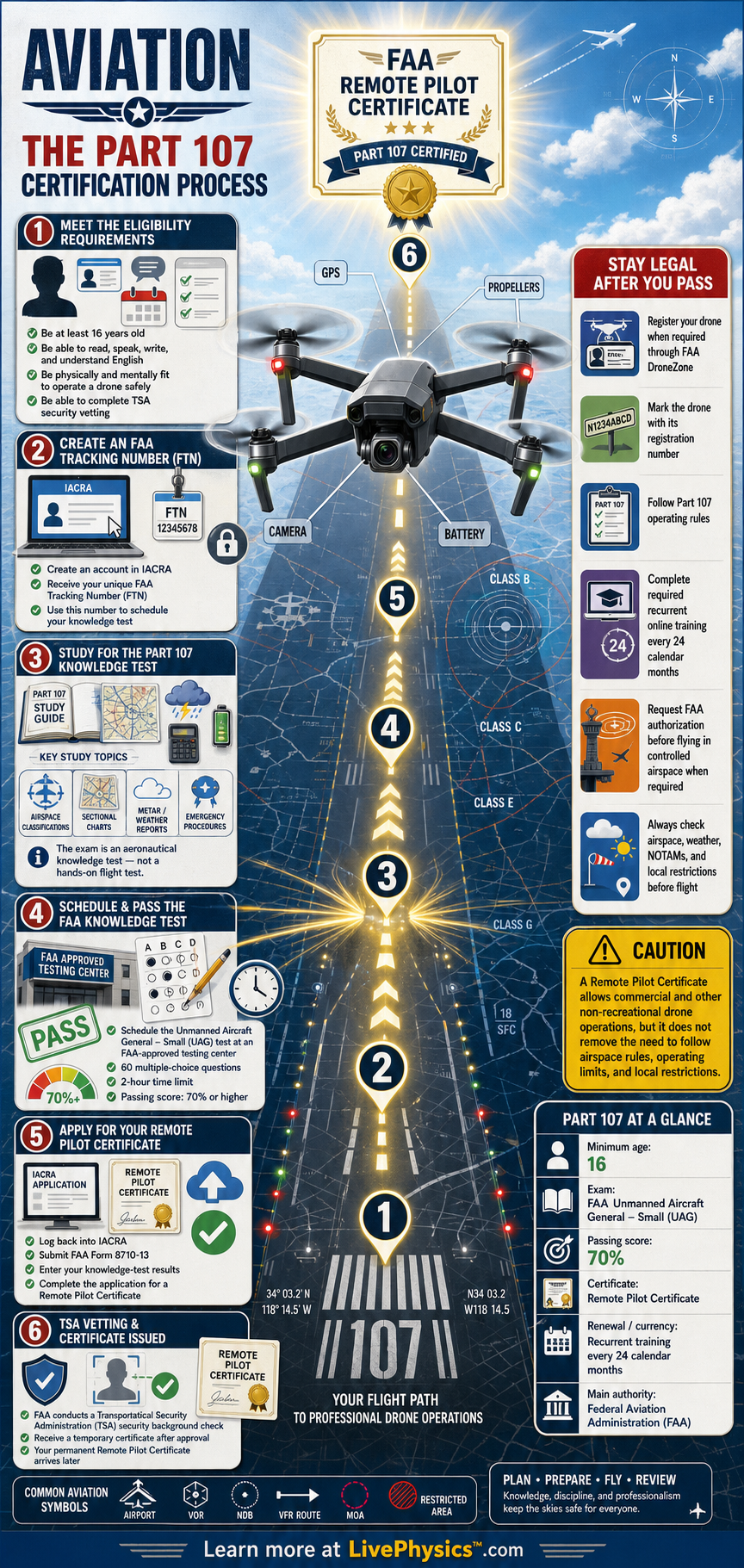
The FAA Part 107 Remote Pilot Certificate is the main credential for people who fly small drones for work or other nonrecreational purposes in the United States. It shows that a pilot understands the airspace, weather, operating rules, and safety decisions involved in drone flight. The process has several clear stages, from checking eligibility to passing the FAA knowledge test.
A certificate matters because commercial drone work can affect people, property, and other aircraft.
Most new applicants begin by creating an FAA Tracking Number and studying for the Unmanned Aircraft General knowledge test. After passing, they use IACRA to submit an application for a Remote Pilot Certificate. The Transportation Security Administration completes a security background check before the FAA issues the temporary certificate.
Pilots must keep their knowledge current by completing recurrent training every 24 calendar months.
Understanding Aviation, The Part 107 Certification Process
Part 107 applies to civil small unmanned aircraft operations that do not qualify as recreational flying. A small unmanned aircraft weighs less than fifty five pounds at takeoff, including everything attached to it. The rule covers many jobs, such as roof inspections, construction mapping, photography, agriculture, and real estate images.
Holding the certificate does not mean a person can ignore the operating limits. It means the pilot has demonstrated the basic aeronautical knowledge needed to make safer decisions.
A new applicant first checks the FAA eligibility rules. The applicant must be at least sixteen years old and must be able to read, speak, write, and understand English. They need a physical and mental condition that allows safe flight.
Next, the applicant creates an FAA Tracking Number through the Integrated Airman Certification and Rating Application system, usually called IACRA. This number connects the test result and certificate application to the right person.
The knowledge test is taken at an FAA-approved testing center. It focuses on topics that affect every flight plan. Students study airspace classes, sectional charts, airport operations, radio communication, weather reports, loading, emergency procedures, and Part 107 regulations.
The required score is seventy percent or higher. Memorizing isolated facts is not enough. A pilot needs to connect a chart symbol or weather condition to a real decision about where, when, and how to fly.
After passing the test, the applicant starts the remote pilot application in IACRA. An authorized person verifies the application and submits it to the FAA. The Transportation Security Administration then conducts a security background check.
Once that check is complete, the applicant can usually access a temporary Remote Pilot Certificate through IACRA. The permanent plastic certificate arrives later by mail. A person who already holds a current Part 61 pilot certificate has a different path that uses online training instead of the initial knowledge test.
Certification is only the start of responsible operations. A remote pilot in command must inspect the drone, plan the flight, check airspace restrictions, and assess hazards before launch. Many operations require visual line of sight, daylight or properly equipped twilight flight, and a maximum altitude of four hundred feet above ground level.
Some flights need FAA authorization or a waiver. Students should focus on building a repeatable process. Check the mission, check the aircraft, check the airspace, then make a conservative decision when conditions are uncertain.
Key Facts
- Minimum applicant age = 16 years
- Small unmanned aircraft maximum takeoff weight < 55 lb
- Knowledge test passing score = 70%
- Maximum routine altitude = 400 ft above ground level
- Recurrent training interval = 24 calendar months
- Visual line of sight distance = pilot or visual observer can see the aircraft
Vocabulary
- Remote Pilot in Command
- The person who has final responsibility for the safety and legal compliance of a Part 107 drone operation.
- IACRA
- The FAA online system used to create and process airman certificate applications.
- FAA Tracking Number
- A unique identification number that links an applicant to FAA testing and certification records.
- Airspace authorization
- FAA permission required before flying a drone in certain controlled airspace areas.
- Visual line of sight
- A condition in which the remote pilot or visual observer can see the drone well enough to control it safely.
Common Mistakes to Avoid
- Studying only drone controls. The knowledge test emphasizes aviation topics such as airspace, weather, charts, and regulations rather than only flight skills.
- Assuming a passing test score immediately creates a certificate. The applicant must still complete the IACRA application and pass the Transportation Security Administration background check.
- Treating Part 107 certification as permission to fly anywhere. Controlled airspace, temporary flight restrictions, and certain advanced operations can require extra FAA approval.
- Forgetting recurrent training after certification. A remote pilot must complete recurrent training every 24 calendar months to keep operating under Part 107.
Practice Questions
- 1 A student answers 45 of 60 knowledge test questions correctly. Calculate the percentage score and decide whether it meets the required passing score.
- 2 A drone operation is planned at 520 feet above ground level. Compare this altitude with the routine Part 107 maximum altitude and calculate how far above the limit it is.
- 3 Explain why a remote pilot should check airspace restrictions before launch even when the drone weighs less than 55 pounds and the pilot holds a Remote Pilot Certificate.