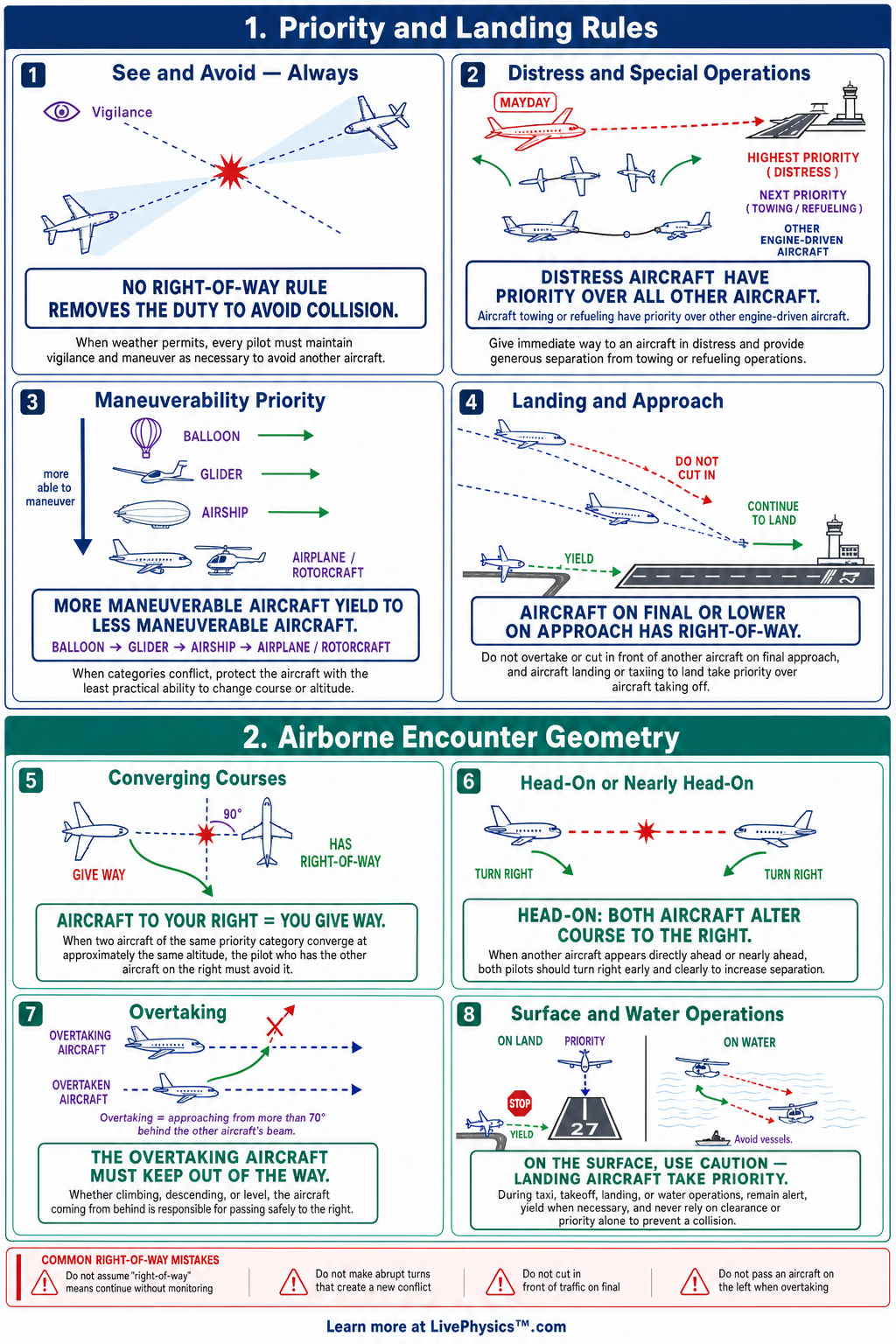
Aviation right-of-way rules help pilots predict the actions of other aircraft and avoid collisions. They apply whenever aircraft operate near one another, whether in the air, on the ground, or on water. This cheat sheet organizes the major FAA-style rules into quick decisions that support safe visual scanning and timely maneuvering.
Students need these rules for flight training, written exams, and practical cockpit judgment.
The central rule is that every pilot must remain vigilant and take action to avoid a collision. The aircraft with right-of-way should maintain course and speed when safe, while the other aircraft gives way early and clearly. Converging, head-on, and overtaking situations each have a specific priority rule.
Landing aircraft, aircraft in distress, balloons, gliders, and airships also have special priority considerations.
Key Facts
- When aircraft approach head-on or nearly head-on, each pilot must alter course to the right.
- When aircraft converge at approximately the same altitude, the aircraft that has the other aircraft on its right must give way.
- An overtaking aircraft must alter course to the right and remain clear of the aircraft being overtaken.
- Aircraft in flight and aircraft operating on the surface must give way to aircraft landing or on final approach to land.
- Among aircraft approaching to land, the lower aircraft has the right-of-way, but it must not cut in front of another aircraft on final approach.
- A balloon has right-of-way over any other category of aircraft, and a glider has right-of-way over an airship, airplane, or rotorcraft.
- An aircraft towing or refueling another aircraft has right-of-way over all other engine-driven aircraft.
- Every pilot must maintain vigilance and take action to avoid a collision, even when that pilot has the right-of-way.
Vocabulary
- Right-of-way
- Right-of-way is the priority an aircraft has in a traffic situation, requiring other aircraft to keep clear.
- Converging
- Converging describes aircraft approaching each other at an angle rather than directly head-on or from behind.
- Overtaking
- Overtaking occurs when one aircraft approaches another from behind to pass it.
- Final approach
- Final approach is the last straight portion of an approach path before landing on the intended runway or landing area.
- Give way
- Give way means maneuvering early and safely to avoid interfering with an aircraft that has priority.
- See and avoid
- See and avoid is the pilot responsibility to scan for traffic and prevent collisions through visual observation and safe action.
Common Mistakes to Avoid
- Assuming right-of-way removes the need to maneuver is wrong because every pilot must act as needed to prevent a collision.
- Turning left during a head-on encounter is wrong because both aircraft are required to turn right, creating a predictable separation path.
- Crossing in front of an aircraft during a converging situation is wrong because the aircraft with traffic on its right must give way and should avoid creating a close conflict.
- Treating a faster aircraft as automatically having priority is wrong because an overtaking aircraft always keeps clear of the aircraft it is passing.
- Forcing a landing because an aircraft is lower on approach is wrong because pilots must not cut in front of traffic on final and must go around when the approach is unsafe.
Practice Questions
- 1 Two airplanes are approaching nearly head-on at the same altitude. What direction must each pilot turn?
- 2 Aircraft A sees Aircraft B converging from its right at the same altitude. Which aircraft must give way, and what is a safe general action?
- 3 A glider, an airplane, and a balloon are approaching the same landing area. State their priority order from highest to lowest.
- 4 An aircraft with right-of-way notices that the other pilot is not maneuvering and a collision risk is increasing. Explain the action the pilot should take and the safety principle that requires it.
Understanding Right-of-Way Rules
Right-of-way is a system for making aircraft movement predictable, not a permission to continue toward danger. Federal aviation rules require vigilance from every pilot, even when that pilot has priority. A pilot who sees a collision risk must act if necessary.
This duty is often called see and avoid. It applies in visual conditions and is especially important near airports, in training areas, and along busy sightseeing routes.
When two aircraft approach head-on, or nearly head-on, each pilot alters course to the right. This gives both aircraft a simple, matching escape direction. When aircraft converge at approximately the same altitude, the aircraft that has the other on its right gives way.
The giving-way pilot should avoid crossing ahead when practical. A clear turn, climb, descent, or reduction in speed may be appropriate, but the maneuver must be safe and easy for the other pilot to understand.
An overtaking aircraft has less priority than the aircraft being passed. It must alter course to the right and keep clear, regardless of whether the other aircraft is climbing, descending, or level. This rule applies when one aircraft approaches another from behind on a line more than 70 degrees from the other aircraft's axis.
Pilots should not assume that a faster aircraft will always see them. Good scanning and position reports remain important defenses against overtaking conflicts.
Landing priority follows a separate set of rules. Aircraft in flight or operating on the surface must give way to aircraft that are landing or on final approach to land. An aircraft at a lower altitude generally has priority when approaching to land, but it must not cut in front of another aircraft on final approach or overtake it.
A pilot should never use the rule to force an unsafe landing. Go around early when spacing, runway occupancy, wind, or traffic makes the approach unsafe.
Some aircraft have special right-of-way because their ability to maneuver is limited. Balloons have priority over every other category. Gliders have priority over airships, airplanes, and rotorcraft.
Airships have priority over airplanes and rotorcraft, while aircraft towing or refueling another aircraft have priority over all engine-driven aircraft. Distress always comes first.
Study each rule with a simple traffic diagram, identify who must give way, then state the safest action. The best practical habit is to avoid creating close situations in the first place.