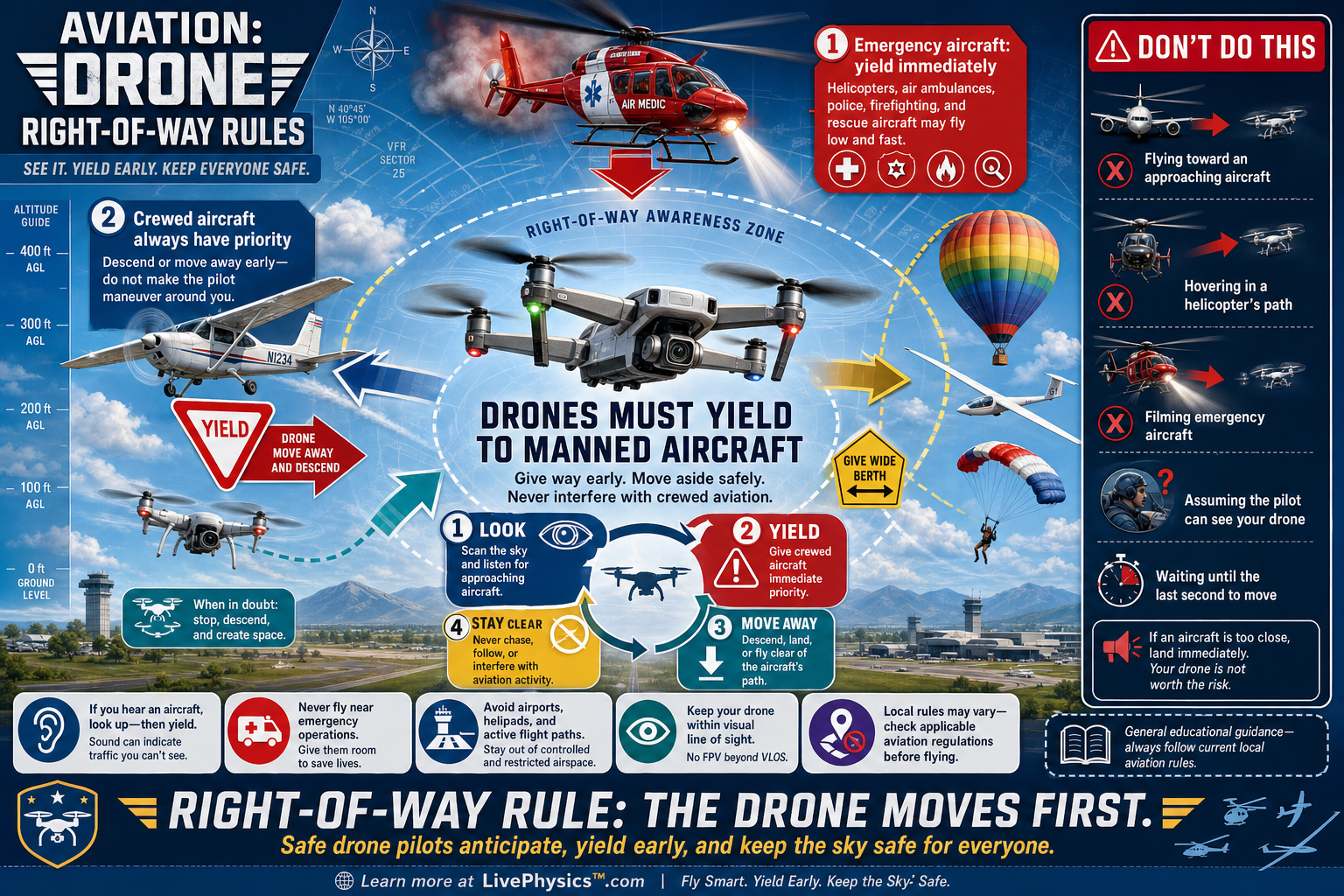
Drones share the sky with airplanes, helicopters, gliders, balloons, and other aircraft. The most important right-of-way rule is simple. Drones must yield to manned aircraft at all times.
This rule protects people in aircraft and people on the ground.
Yielding means acting early when a crewed aircraft may come near the drone. A remote pilot should move the drone away from the aircraft's path, descend if it is safe, or land when needed. The drone operator must keep watching the airspace, not just the screen.
Safe decisions depend on distance, direction, speed, and local flight rules.
Understanding Aviation, Drone Right-of-Way Rules
Right-of-way rules exist because aircraft cannot all stop or turn instantly. A helicopter may fly low while landing, searching, carrying medical crews, or working near power lines. Small airplanes may pass through low airspace near airports or rural fields.
A drone is much smaller than a crewed aircraft, so its pilot may not see it until it is dangerously close. The drone operator has the responsibility to avoid creating that risk.
Yielding starts with visual awareness. The remote pilot should scan the sky before takeoff and throughout the flight. Listen for engine noise, since sound can provide an early warning when an aircraft is hidden by trees or buildings.
Look in the direction from which an aircraft is approaching, then determine whether the drone could cross its path. If there is any doubt, move the drone away from the area and land if necessary.
A safe response depends on the situation. Flying sideways away from the aircraft's projected path is often safer than climbing, because climbing could place the drone at the same altitude as the aircraft. Descending can help when there is clear space below the drone.
Landing is the best option when a helicopter or airplane remains nearby. The operator should avoid sudden moves toward people, buildings, wires, or roads while yielding.
Airports deserve extra attention because aircraft are often low, fast, and following predictable routes. A drone near an airport can interfere with takeoff, landing, or an emergency approach. Local aviation rules may require authorization, distance limits, altitude limits, or special training before drone flight in controlled airspace.
A flight planning app can show airspace boundaries, though it does not replace active observation. Weather matters too, since haze, wind, and low clouds make it harder to spot aircraft and control the drone.
Students should focus on the difference between having control of a drone and having full awareness of the airspace. Camera views can be useful for framing images, but they narrow the operator's view. Visual line of sight makes it easier to see hazards, judge the drone's location, and react quickly.
Practice planning a clear landing area before every flight. Good drone pilots treat yielding as an early decision, not a last-second maneuver.
Key Facts
- Core rule, Drones must yield to all manned aircraft.
- Yield early by moving away from the aircraft's flight path, descending safely, or landing.
- Maintain visual line of sight so the drone and nearby aircraft can be monitored.
- Distance = speed × time.
- Relative closing speed = aircraft speed + drone speed when they move toward each other.
- Near airports and controlled airspace, check local authorization and altitude requirements before flight.
Vocabulary
- Right-of-way
- The priority to continue on a path when aircraft may otherwise conflict.
- Manned aircraft
- An aircraft carrying one or more people, such as an airplane or helicopter.
- Visual line of sight
- A condition where the remote pilot can directly see the drone without relying only on a camera.
- Controlled airspace
- Airspace where air traffic services manage aircraft movement and drone operations may need permission.
- Flight path
- The direction and route an aircraft is traveling through the air.
Common Mistakes to Avoid
- Waiting until an aircraft is very close before moving the drone. This leaves too little time to choose a safe direction or land without creating a new hazard.
- Climbing to get out of an aircraft's way. Climbing can put the drone closer to a low-flying airplane or helicopter, so move away from its path or descend when safe.
- Watching only the drone camera feed. A camera has a narrow view and may hide approaching aircraft, obstacles, or changes in the drone's position.
- Assuming a small drone is too small to matter. Even a small collision hazard can distract a crew or damage an aircraft during a critical phase of flight.
Practice Questions
- 1 A drone is flying at 12 m/s toward a helicopter that is flying toward it at 48 m/s. If they are 600 m apart on the same path, how many seconds remain before they meet if neither changes direction?
- 2 A remote pilot sees an airplane 900 m away approaching at 60 m/s. The drone needs 15 seconds to descend and land safely. How far away will the airplane be after those 15 seconds, assuming its speed stays constant?
- 3 A drone operator hears a helicopter but cannot see it because of trees near the flight area. Explain the safest immediate action and why relying on the drone camera would be risky.