Sign in to save

Bookmark this page so you can find it later.

Sign in to save

Bookmark this page so you can find it later.

Math high-school May 21, 2026

How Does Compound Interest Grow So Fast?

Exponential growth from interest on interest
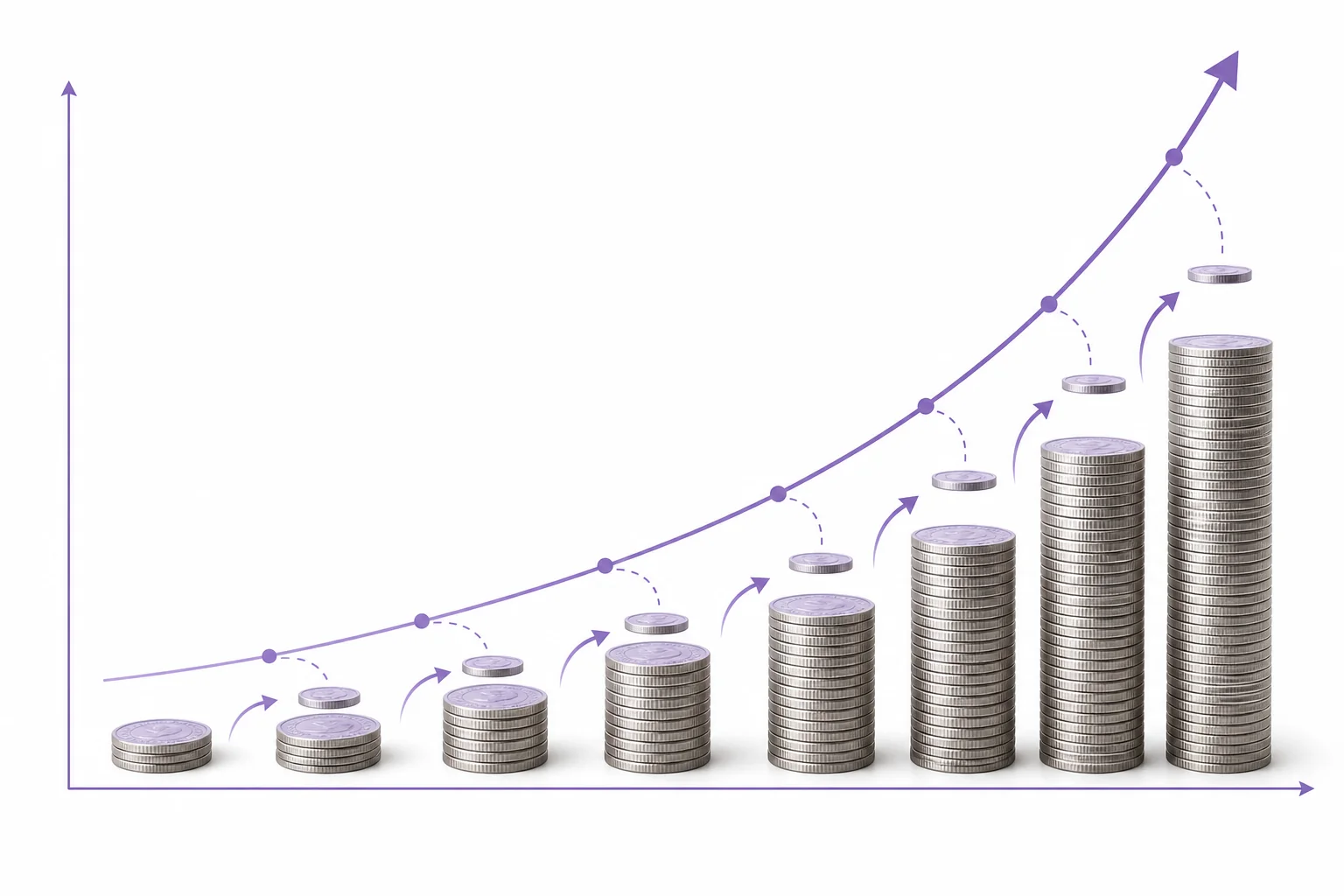
A growing stack of coins splits into yearly bars that curve upward, showing how a starting amount grows faster when interest is added to the balance.

Compound interest grows fast because each new interest payment gets added to the money that earns interest next time. The balance does not rise by the same number of dollars each year. It rises by a growing number of dollars because the base keeps getting larger.

Big Idea. Common Core HSF-LE.A.1 connects compound interest to exponential functions that grow by equal factors over equal intervals.

Compound interest is one of the clearest real life examples of exponential growth. You start with a principal, which is the original amount of money. After one interest period, the interest is added to that principal. During the next period, interest is paid on the larger balance. That small change makes the growth speed up. A savings account, a loan, and a credit card balance can all use this pattern. The same math also appears in population growth, bacteria growth, and some models of technology use. In high school algebra, compound interest is usually written as $A=P(1+r)^t$. The multiplier $(1+r)$ tells how much the balance changes each period. A graph of that rule bends upward, not because magic is happening, but because the same percent is applied to a larger amount each time. You can explore related growth patterns with LivePhysics math tools after building the model by hand.

Principal Starts the Pattern
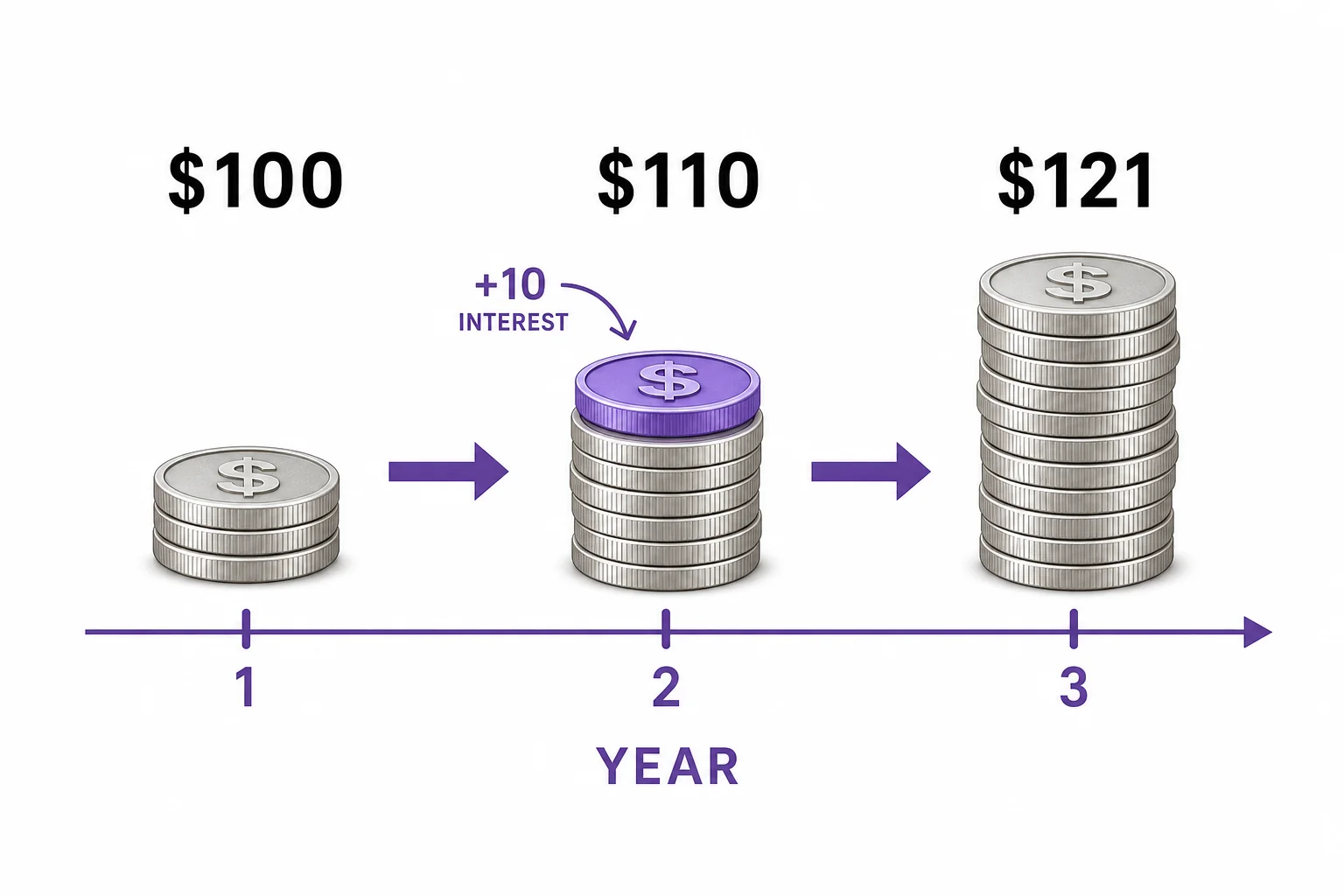
A three-step diagram shows 100 dollars becoming 110 dollars, then 121 dollars as each new balance becomes the base for the next interest calculation.
Each new balance becomes the next base
The principal is the starting amount. If you deposit 100 dollars, that 100 dollars is the first base for interest. With simple interest, the same interest amount is added each year. With compound interest, the base changes after every interest period. Suppose the account earns 10 percent per year. After one year, the account gains 10 dollars and becomes 110 dollars. The second year is not 100 plus another 10 dollars in the compound model. It is 10 percent of 110 dollars, which is 11 dollars. The balance becomes 121 dollars. That extra 1 dollar came from interest on the first interest payment. The difference looks small at first. Over many years, it becomes the main reason the graph curves upward.

Compound interest starts when interest becomes part of the balance.

Growth by a Factor
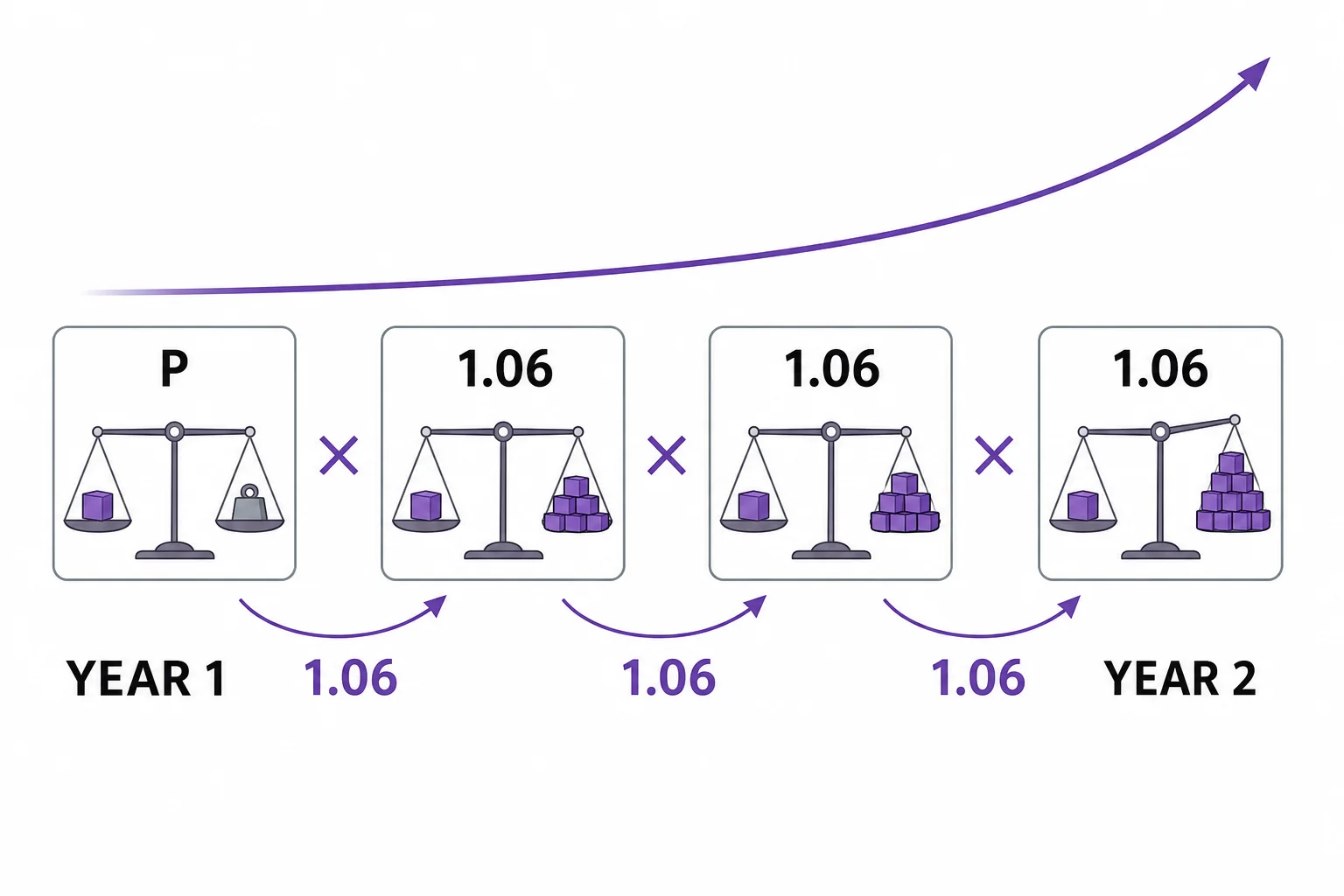
A balance is multiplied by the same factor each year, showing repeated multiplication by 1.06 across several time steps.
A fixed percent means a fixed multiplier
A percent increase can be written as a multiplication factor. A 10 percent increase means multiply by 1.10. A 5 percent increase means multiply by 1.05. This is why compound interest fits an exponential function. Each equal time step uses the same factor, not the same added amount. If the yearly rate is 6 percent, the balance after one year is $P(1.06)$. After two years it is $P(1.06)(1.06)$, or $P(1.06)^2$. After $t$ years, the model is $A=P(1+r)^t$, when the interest is compounded once per year. The exponent counts how many times the factor is applied. The rate $r$ is written as a decimal, so 6 percent becomes 0.06. The formula is compact, but the meaning is repeated multiplication.

Equal time steps use equal factors.

Why the Curve Bends Up
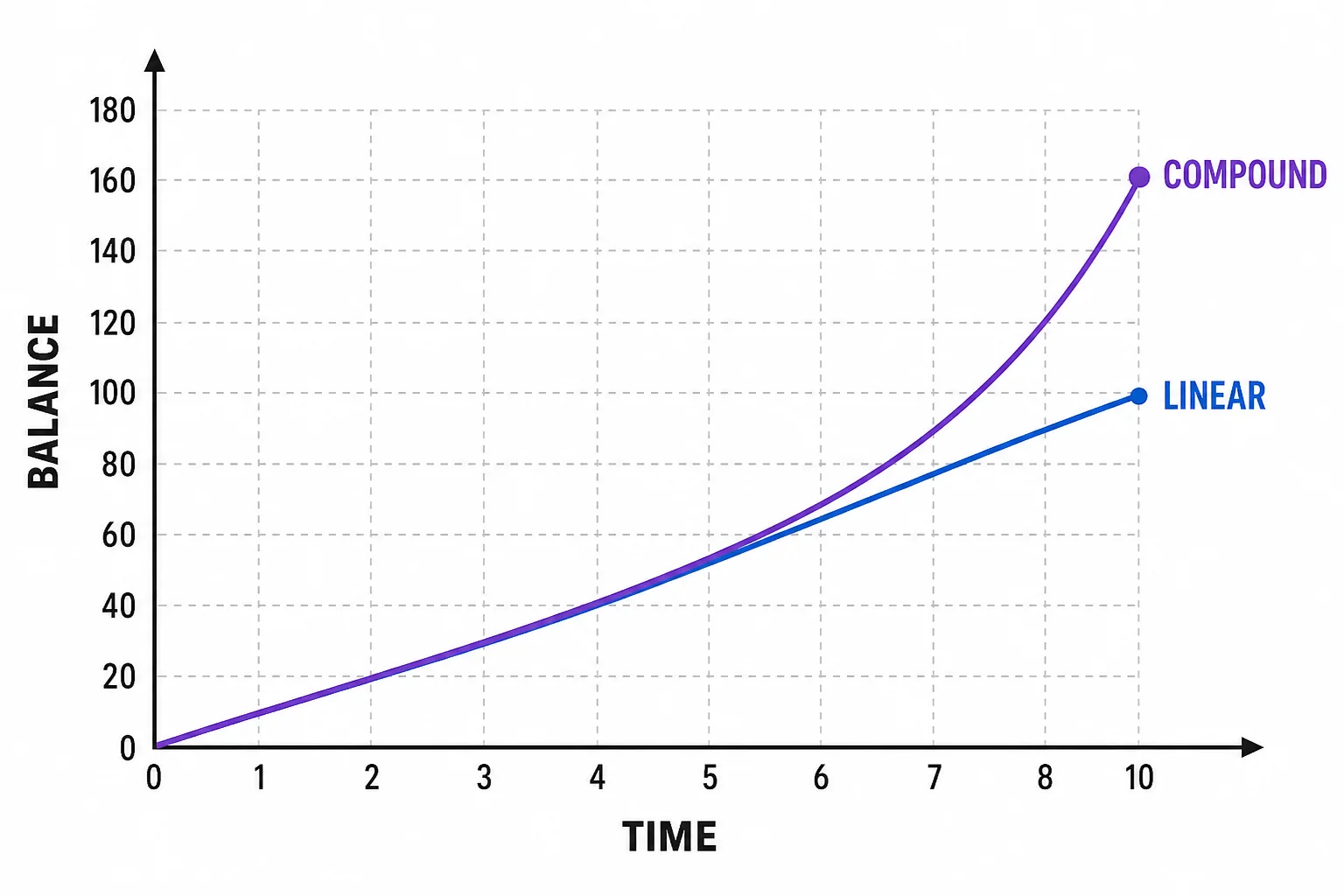
A coordinate graph compares a straight simple interest line with a curving compound interest line that rises faster over time.
Linear adds the same amount, exponential multiplies by the same factor
A linear graph grows by equal differences. A simple interest account might add 10 dollars each year, so the points form a straight line. A compound interest account grows by equal ratios. At 10 percent, each new balance is 1.10 times the last balance. The yearly dollar gain rises because the balance rises. The graph bends upward because the vertical jumps get larger over time. This does not mean the rate changed. The percent rate stayed the same. The input to that percent calculation changed. This is a key idea in the Common Core standards for linear and exponential models. Linear functions show constant change by addition. Exponential functions show constant percent change by multiplication. Compound interest is a concrete way to see the difference.

The percent can stay constant while the dollar change grows.

Doubling Time and the Rule of 72
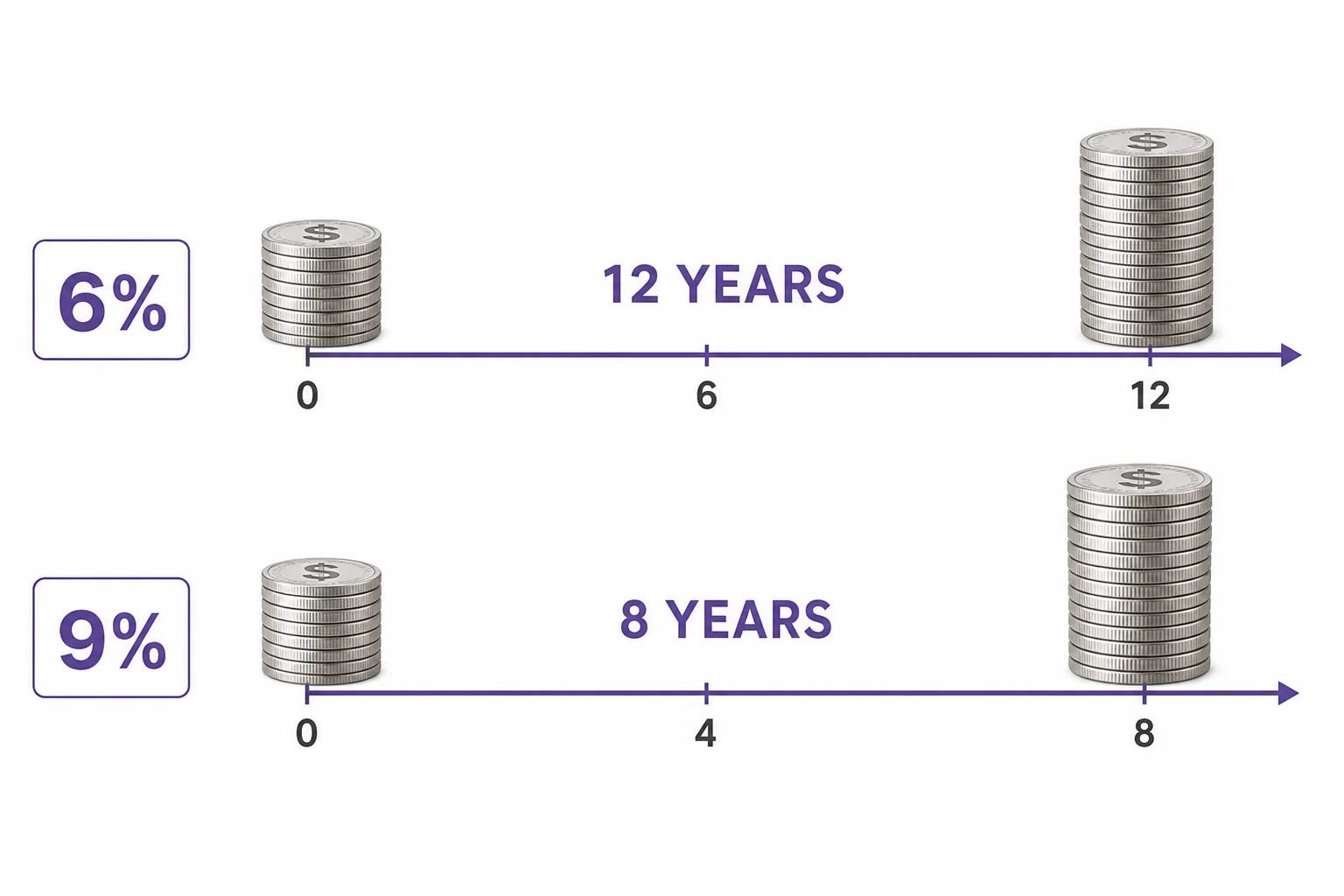
A timeline shows a balance doubling from one stack to two equal stacks, with examples for 6 percent and 9 percent annual interest.
The rule of 72 estimates when money doubles
Doubling time is the time it takes for a balance to become twice as large. It gives a quick way to understand exponential growth. At a higher interest rate, doubling happens sooner. One common estimate is called the rule of 72. Divide 72 by the annual percent rate to estimate the doubling time. At 6 percent interest, $72\div 6=12$, so the balance doubles in about 12 years. At 9 percent interest, $72\div 9=8$, so the balance doubles in about 8 years. The rule is not exact, but it is close for many common rates. In formula form, the estimate is $t\approx\frac{72}{r}$, where $r$ is the rate written as a percent. The rule works because exponential growth repeats the same factor over time.

Doubling time turns an exponential model into a quick mental estimate.

Compounding More Often
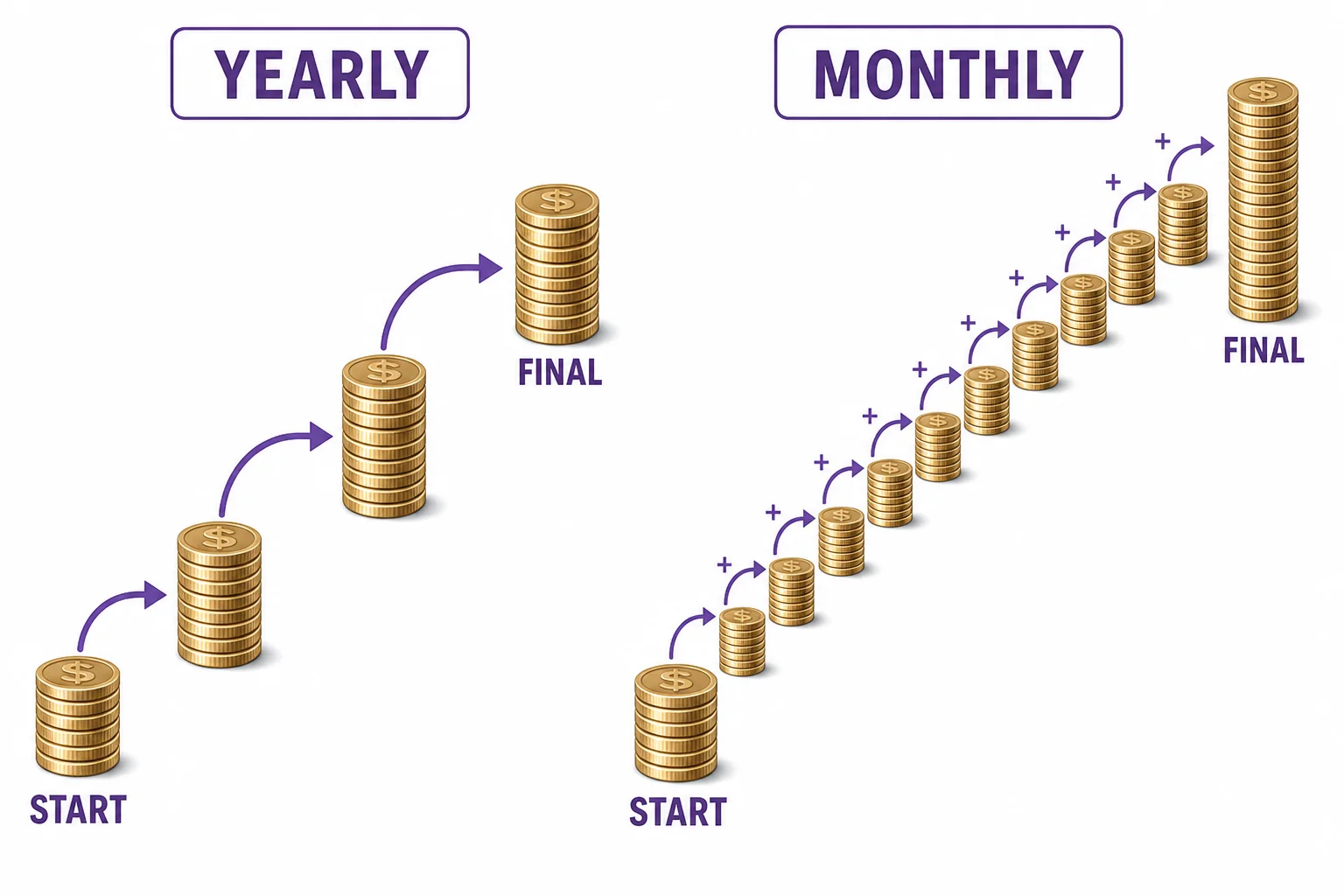
A yearly compounding path and a monthly compounding path compare how more frequent interest additions create a slightly larger final balance.
More compounding periods create more interest on interest
Interest can compound yearly, monthly, daily, or at other intervals. More frequent compounding adds interest to the balance more often. That gives each later calculation a slightly larger base. For example, 12 percent compounded yearly means one 12 percent increase in a year. The same annual rate compounded monthly means about 1 percent is applied each month. After each month, the new interest joins the balance. By the end of the year, the monthly plan is a little larger than the yearly plan. The standard model is $A=P(1+\frac{r}{n})^{nt}$, where $n$ is the number of compounding periods per year. The exponent $nt$ counts all the periods. More frequent compounding matters most over long times, or when balances and rates are large.

Compounding frequency changes how often the base is updated.

Vocabulary

Principal
The starting amount of money before interest is added.
Interest
Extra money earned or charged as a percent of a balance.
Compound interest
Interest calculated on the principal plus interest that has already been added.
Exponential growth
Growth by repeated multiplication by the same factor over equal time intervals.
Doubling time
The time it takes for a quantity to become twice as large.
Rule of 72
A quick estimate for doubling time found by dividing 72 by the annual percent rate.

In the Classroom

Build a compound table

20 minutes | Grades 9-12

Students start with a principal of 100 dollars and calculate yearly balances at 5 percent for 10 years. They compare the yearly dollar gains and explain why the gains increase.

Graph linear versus compound growth

30 minutes | Grades 9-12

Students graph simple interest and compound interest on the same axes. They identify which model has constant differences and which has constant ratios.

Test the rule of 72

25 minutes | Grades 10-12

Students choose several annual rates and estimate doubling time with the rule of 72. They then use the compound interest formula to check how close each estimate is.

Key Takeaways

  • Compound interest adds interest to the balance, so future interest is calculated on a larger amount.
  • A fixed percent increase is repeated multiplication, not repeated addition.
  • The formula $A=P(1+r)^t$ models yearly compounding when the rate is written as a decimal.
  • The rule of 72 estimates doubling time by dividing 72 by the annual percent rate.
  • More frequent compounding usually makes the final balance slightly larger.