Interest & Savings Simulator
Explore how money grows over time. Adjust principal, interest rate, years, and compounding frequency to see the real difference between simple and compound interest. All calculations run instantly in your browser.
Parameters
Quick Scenarios
Compound Frequency
Mode
Balance Over Time
Summary
Compound Final
$2,713
After 20 years
Simple Final
$2,000
At 5.0% simple
Compound Advantage
$713
Extra growth from compounding
Total Interest
$1,713
Simple $1,000
Rule of 72
Year-by-Year Breakdown
| Year | Simple | Compound | Difference |
|---|---|---|---|
| 0 | $1,000 | $1,000 | +$0 |
| 1 | $1,050 | $1,051 | +$1 |
| 2 | $1,100 | $1,105 | +$5 |
| 3 | $1,150 | $1,161 | +$11 |
| 4 | $1,200 | $1,221 | +$21 |
| 5 | $1,250 | $1,283 | +$33 |
| 6 | $1,300 | $1,349 | +$49 |
| 7 | $1,350 | $1,418 | +$68 |
| 8 | $1,400 | $1,491 | +$91 |
| 9 | $1,450 | $1,567 | +$117 |
| ... | |||
| 16 | $1,800 | $2,222 | +$422 |
| 17 | $1,850 | $2,336 | +$486 |
| 18 | $1,900 | $2,455 | +$555 |
| 19 | $1,950 | $2,581 | +$631 |
| 20 | $2,000 | $2,713 | +$713 |
Reference Guide
Simple vs Compound Interest
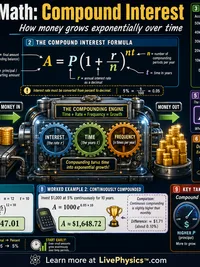
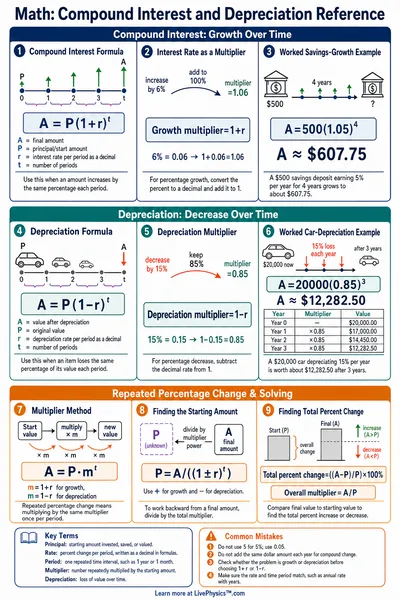
Simple interest grows by the same dollar amount each year. Compound interest grows by a percentage of the current balance, which includes previous interest.
Simple A = P(1 + rt)
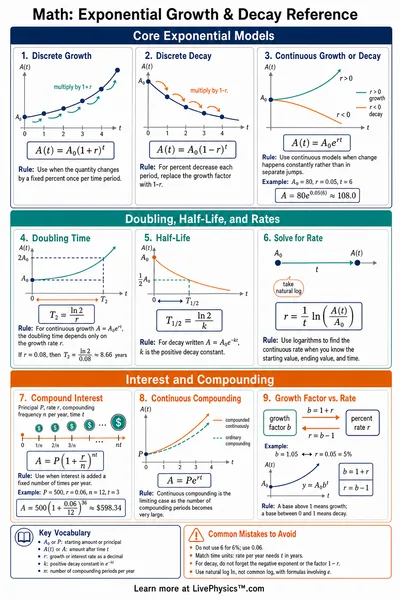
Compound A = P(1 + r/n)^(nt)
For the same rate and time, compound interest always produces a larger balance than simple interest when years > 1.
The Power of Compounding
Compounding frequency matters. The more often interest is calculated, the faster money grows. Monthly compounding always outperforms annual compounding at the same rate.
- Annual, once per year
- Quarterly, 4 times per year
- Monthly, 12 times per year
- Daily, 365 times per year
The Rule of 72 gives a quick estimate, divide 72 by the annual rate (as a percent) to find roughly how many years it takes to double your money.
Saving Early Matters
Time is the most powerful factor in compound growth. Starting with $1,000 at age 15 versus age 25 at 7% annual return makes a large difference by age 65.
Start at 15 ~$29,000 by age 65
Start at 25 ~$14,800 by age 65
Starting 10 years earlier nearly doubles the result.
Small monthly contributions added early also compound dramatically. Use the monthly contribution slider to see how regular saving accelerates growth.