Logarithm Explorer
Calculate logarithms in any base, solve log equations, and use the change-of-base formula. The graph shows both the logarithmic curve and its exponential inverse.
Graph
Parameters
Results
log2(8)
3.00000
Log Properties
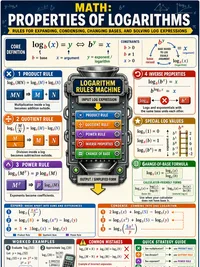
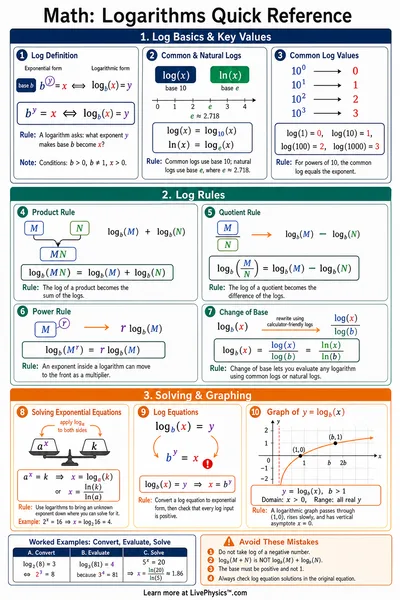
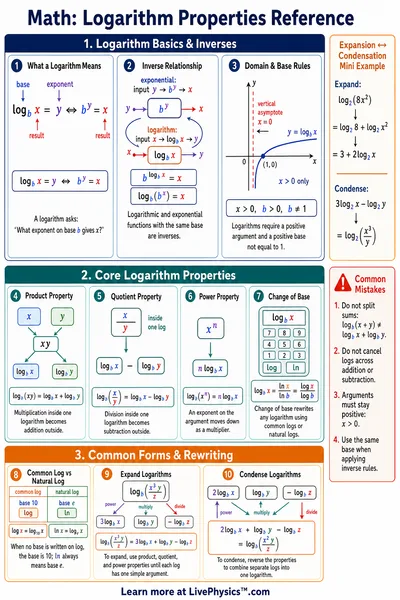
log(ab) = log(a) + log(b)
log(a/b) = log(a) - log(b)
log(a^n) = n · log(a)
log_b(1) = 0
log_b(b) = 1
Step-by-Step Calculation
1. Definition
2. Using change of base formula
3. Result
Reference Guide
Definition
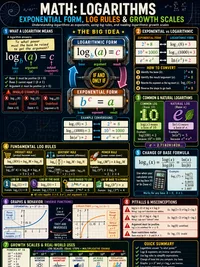
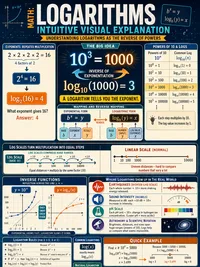
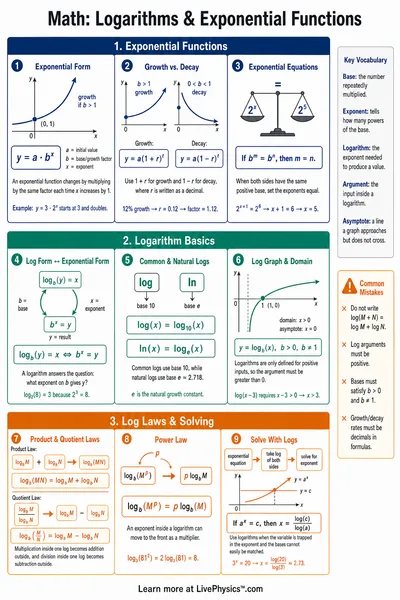
A logarithm answers the question "what exponent gives this result?" It is the inverse of exponentiation.
Change of Base
You can convert a logarithm to any other base using this formula.
Log Properties
Natural Logarithm
The natural log (ln) uses base e, where e is approximately 2.71828. It appears throughout calculus, physics, and probability because e has special properties related to continuous growth.
Related Content
Related Tools
MAP Growth Grade 3 Math Practice
Original independent MAP Growth Grade 3 Math skill practice with explanations, adjustable difficulty and first-attempt progress; no official RIT score.
MAP Growth Grade 4 Math Practice
Original independent MAP Growth Grade 4 Math skill practice with explanations, adjustable difficulty and first-attempt progress; no official RIT score.
MAP Growth Grade 5 Math Practice
Original independent MAP Growth Grade 5 Math skill practice with explanations, adjustable difficulty and first-attempt progress; no official RIT score.
MAP Growth Grade 6 Math Practice
Original independent MAP Growth Grade 6 Math skill practice with explanations, adjustable difficulty and first-attempt progress; no official RIT score.
Related Labs
Exponential & Logarithmic Modeling Lab
Model growth and decay with exponential functions. Compute half-life and doubling time, explore logarithmic inverses, and fit exponential and logarithmic models to data with R² comparison
Function Transformations Lab
Explore how a, b, h, and k transform parent functions. Shift, stretch, reflect, and find inverses for linear, quadratic, absolute value, square root, cubic, and reciprocal functions
Exponents & Radicals Lab
Explore exponent rules including product, quotient, power, zero, negative, and rational exponents. See step-by-step simplification and radical-exponent equivalence with growth visualizations