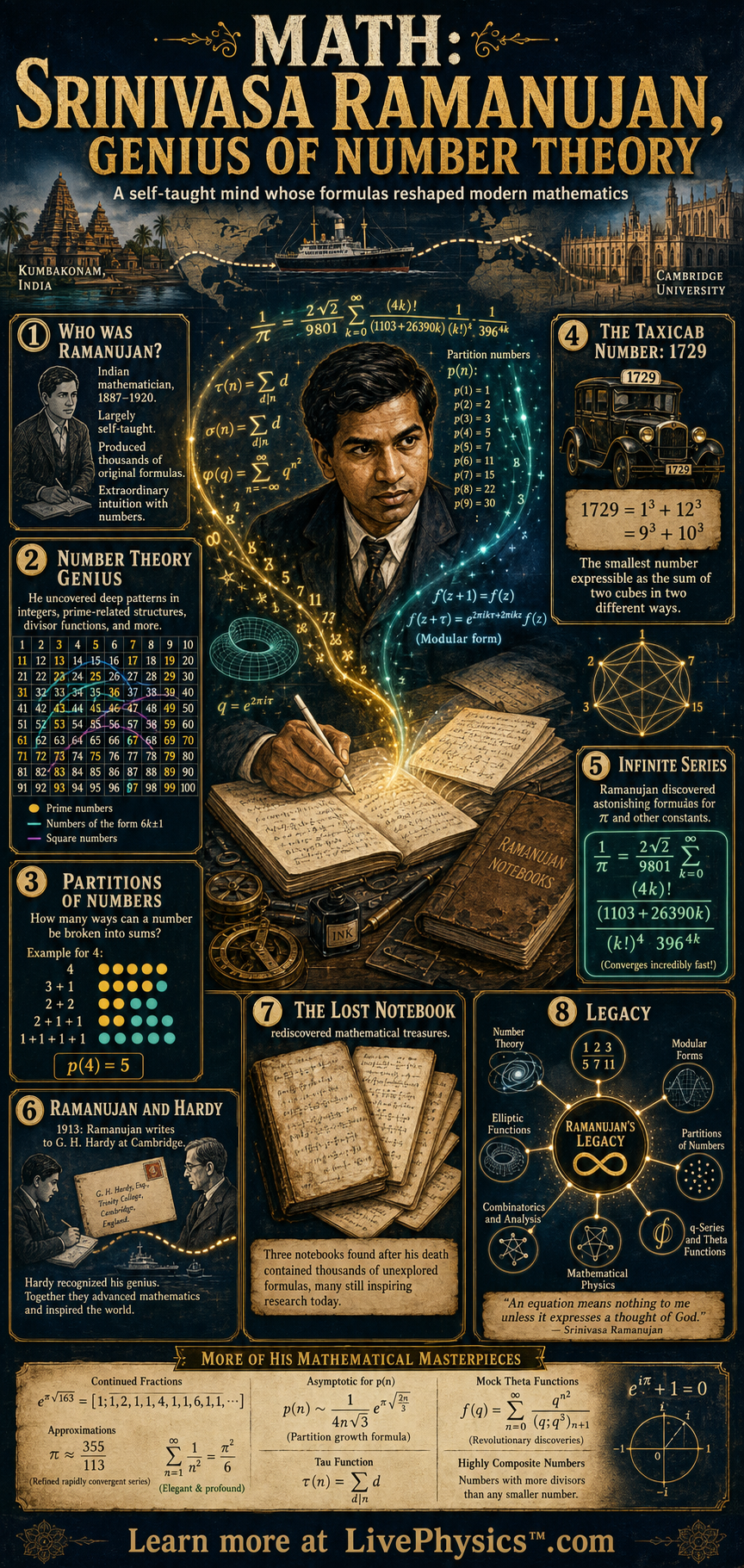
Srinivasa Ramanujan was an Indian mathematician whose extraordinary intuition changed number theory, infinite series, and the study of special functions. With little formal training, he filled notebooks with thousands of formulas, many of which were later proved and connected to deep areas of modern mathematics. His work matters because it shows how patterns in numbers can reveal hidden structure across algebra, analysis, and geometry.
Ramanujan's story also shows the power of curiosity, persistence, and creative mathematical thinking.
Understanding Srinivasa Ramanujan, Genius of Number Theory
Partition problems become difficult very quickly because the number of possible sums grows faster than everyday counting suggests. Mathematicians organize this growth with a generating function. Think of a long power series in which the coefficient attached to each power records one partition count.
Each positive whole number contributes a factor that represents using that part zero times, once, twice, or more. Multiplying all of these factors combines the choices.
This turns a counting problem into a problem about algebraic expressions. It gives a systematic way to search for patterns instead of listing every sum by hand.
Ramanujan noticed remarkable regularities in partition counts for certain groups of inputs. A statement that a count is divisible by a number is called a congruence. Such statements are useful because they reveal order hidden inside a sequence that otherwise looks irregular.
The proof is not usually a matter of checking many examples. It depends on studying how the generating function behaves when its input is changed in carefully chosen ways.
Later work connected these ideas to modular forms, highly symmetric functions that obey strict transformation rules. This connection explains why simple counting questions can lead to advanced mathematics.
His rapidly converging series for pi shows why infinite series can be practical, not merely theoretical. An infinite series adds infinitely many terms, so its value is understood through partial sums. A partial sum uses only the first few terms.
If the later terms become tiny very fast, the partial sum gives an excellent approximation. Ramanujan found series in which each new term adds many correct digits of pi. When learning series, students should separate two ideas.
One is convergence, meaning the partial sums approach a fixed value. The other is speed of convergence, meaning how quickly the approximation improves.
The Hardy-Ramanujan estimate for partition counts illustrates a different kind of mathematical result. It does not give the exact count for every input. Instead, it predicts the size of the count when the input is large.
The main feature is an exponential expression involving the square root of the input. This explains why partitions soon become too numerous to list. Estimates like this appear throughout science when exact calculations are hard but overall behavior matters.
Ramanujan's unfinished ideas about mock theta functions later became important in the study of modular forms, combinatorics, and some models in physics. His work is a reminder to check patterns carefully, test small cases, and distinguish a convincing pattern from a proof.
Key Facts
- A partition p(n) counts the number of ways to write n as a sum of positive integers, ignoring order.
- For n = 5, the partitions are 5, 4 + 1, 3 + 2, 3 + 1 + 1, 2 + 2 + 1, 2 + 1 + 1 + 1, 1 + 1 + 1 + 1 + 1, so p(5) = 7.
- Ramanujan's famous congruence, p(5n + 4) is divisible by 5.
- One Ramanujan series for pi is 1/pi = (2 sqrt(2)/9801) sum from k = 0 to infinity of ((4k)!(1103 + 26390k))/((k!)^4 396^(4k)).
- The Hardy-Ramanujan asymptotic formula is p(n) approximately 1/(4n sqrt(3)) e^(pi sqrt(2n/3)).
- Ramanujan and Hardy studied the taxicab number 1729, where 1729 = 1^3 + 12^3 = 9^3 + 10^3.
Vocabulary
- Number theory
- Number theory is the branch of mathematics that studies integers and the patterns, properties, and relationships among them.
- Partition
- A partition of a positive integer is a way to write it as a sum of positive integers without caring about the order of the terms.
- Infinite series
- An infinite series is a sum with infinitely many terms, often used to approximate constants or functions.
- Modular form
- A modular form is a highly symmetric function that follows special transformation rules and connects number theory, geometry, and physics.
- Congruence
- A congruence is a statement that two numbers have the same remainder when divided by a chosen integer, written a ≡ b mod m.
Common Mistakes to Avoid
- Counting different orders as different partitions is wrong because partitions ignore order. For example, 3 + 1 and 1 + 3 are the same partition of 4.
- Assuming every infinite series gives an exact useful value is wrong because some series diverge or converge too slowly. Ramanujan's pi series is special because it converges extremely fast.
- Using p(5n + 4) divisibility with the wrong input is wrong because the formula applies only to numbers of the form 5n + 4. For example, it applies to p(9), p(14), and p(19), but not p(10).
- Treating Ramanujan's formulas as guesses without proof is wrong because many began as inspired discoveries but later required rigorous mathematical proof. In mathematics, insight and proof play different roles.
Practice Questions
- 1 List all partitions of 6 and find p(6).
- 2 Use Ramanujan's congruence p(5n + 4) is divisible by 5 to decide whether p(24) must be divisible by 5. Show the value of n if it applies.
- 3 Explain why Ramanujan's work is important even when some of his notebook formulas were not proved at the time he wrote them.