Complex Number Calculator
Enter two complex numbers and choose an operation. The Argand diagram shows both inputs and the result as vectors. Step-by-step KaTeX shows every calculation.
Input
z1 = a + bi
z2 = c + di
Results
Result (rectangular)
4 + 2i
Modulus |z|
4.472136
Argument (radians)
0.463648
Argument (degrees)
26.57°
Polar form
4.4721 ∠ 26.57°
Argand Diagram
Step-by-Step
1. Formula
2. Substitute
3. Result
Reference Guide
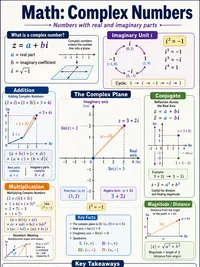
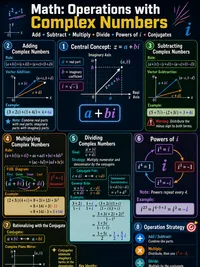
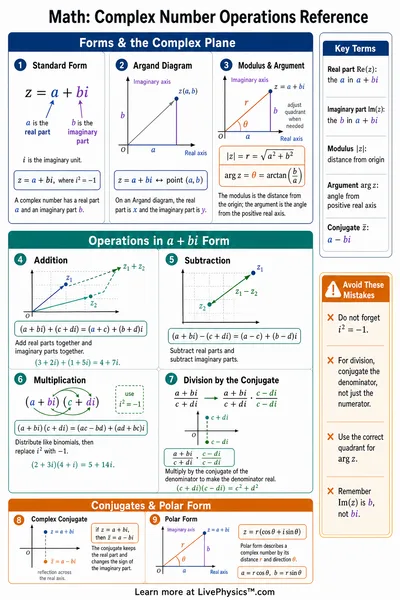
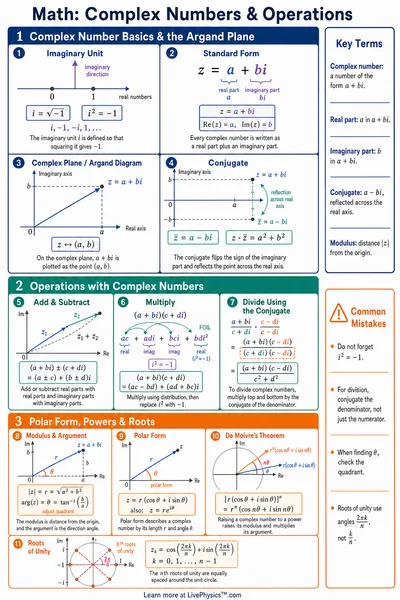
Addition and Subtraction
Add or subtract the real and imaginary parts separately.
Multiplication
Use FOIL and remember that i squared equals -1.
Division
Multiply numerator and denominator by the conjugate of the denominator to eliminate i from the bottom.
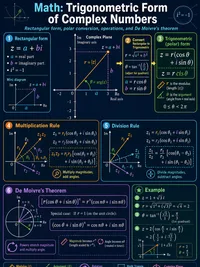
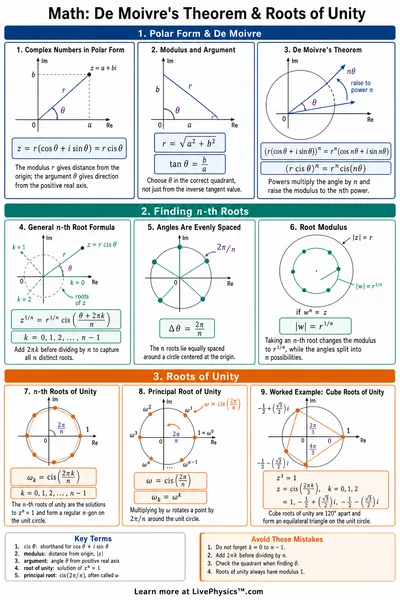
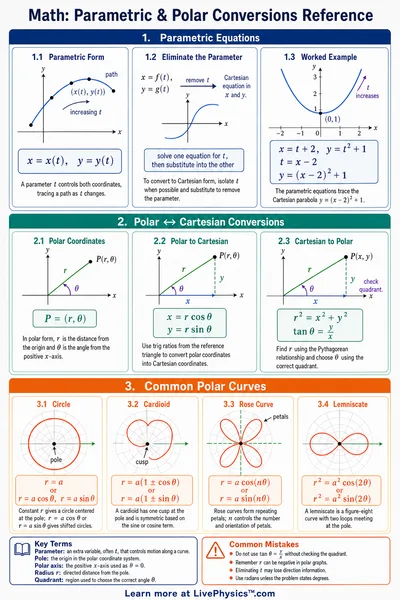
Polar Form
Every complex number can be written in polar form using its modulus and argument.
Related Content
Visual Explainers
Related Tools
MAP Growth Grade 3 Math Practice
Original independent MAP Growth Grade 3 Math skill practice with explanations, adjustable difficulty and first-attempt progress; no official RIT score.
MAP Growth Grade 4 Math Practice
Original independent MAP Growth Grade 4 Math skill practice with explanations, adjustable difficulty and first-attempt progress; no official RIT score.
MAP Growth Grade 5 Math Practice
Original independent MAP Growth Grade 5 Math skill practice with explanations, adjustable difficulty and first-attempt progress; no official RIT score.
MAP Growth Grade 6 Math Practice
Original independent MAP Growth Grade 6 Math skill practice with explanations, adjustable difficulty and first-attempt progress; no official RIT score.
Related Labs
Trigonometric & Polar Functions Lab
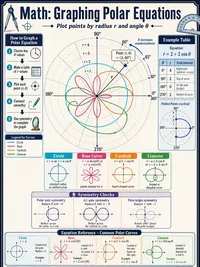
Explore sinusoidal parameters (amplitude, period, phase, shift), inverse trig functions with domain restrictions, and polar curve classification including cardioids, roses, limaçons, and spirals
Matrix, Vector & Transformations Lab
Explore matrix operations, 2D linear transformations, and vector algebra with step-by-step solutions and real-time visualizations. Compute determinants, inverses, eigenvalues, projections, and more
Vector Spaces & Linear Independence Lab
Visualize span and linear independence in 2D. Row-reduce matrices to RREF step by step. Compute null space, column space, rank, and nullity. Verify the rank-nullity theorem
Coordinate Geometry & Conics Lab
Prove quadrilateral properties using coordinates (distance, slope, midpoint). Explore parabolas, ellipses, hyperbolas, and circles. Classify conics from general equations using B²−4AC