
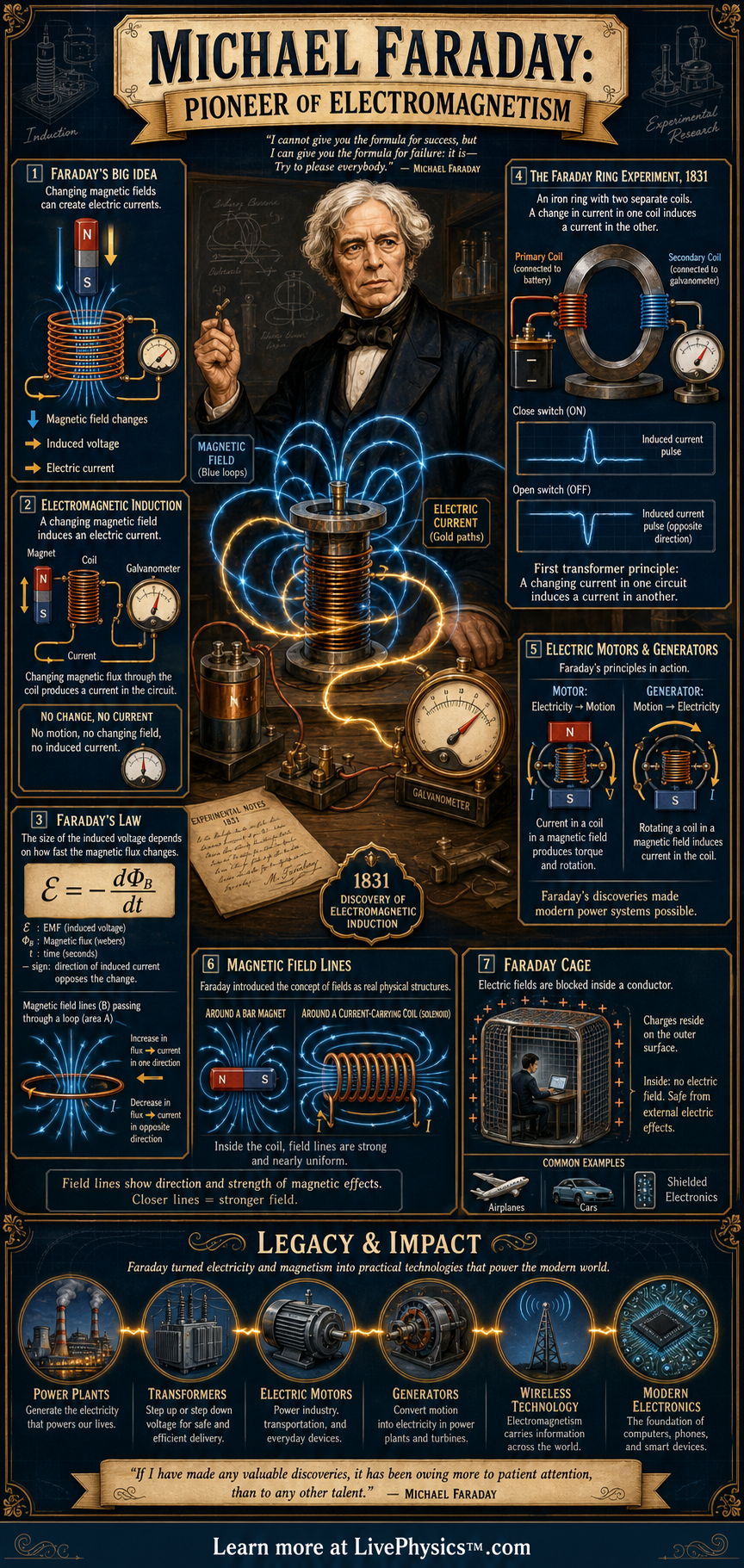
Michael Faraday was one of the most influential experimental physicists in history, even though he had little formal schooling. Born in 1791, he began as a bookbinder's apprentice and educated himself by reading the scientific books he handled. His careful experiments helped transform electricity and magnetism from curiosities into a powerful field of physics.
His 1831 discovery of electromagnetic induction became the basic principle behind generators, transformers, and much of modern electrical technology.
Faraday showed that a changing magnetic field can create an electric current in a nearby conductor. In a classic induction experiment, moving a magnet into or out of a coil changes the magnetic flux through the coil and produces an induced emf. He also built an early electric motor, studied electrolysis, and spent most of his scientific life at the Royal Institution in London.
Faraday's work gave later scientists, including James Clerk Maxwell, the experimental foundation for the theory of electromagnetism.
Understanding Michael Faraday, Discoverer of Electromagnetic Induction
Magnetic flux is a useful way to describe how much magnetic field passes through a loop of wire. It depends on field strength, the loop area, and the loop's orientation. A loop facing the field receives the greatest flux.
Turning it sideways reduces the flux to zero. This explains why motion alone is not the key idea. A magnet can stay still while the coil moves, or the coil can stay still while the magnet moves.
In either case, a current appears only while the flux is changing. The current stops when the change stops.
The direction of the induced current matters as much as its size. Lenz's law says that the current creates a magnetic effect that resists the original change in flux. If a north pole approaches a coil, the coil develops a north pole on its near side and pushes back.
This is not a strange extra rule. It protects conservation of energy. Work is needed to keep moving the magnet against that push.
That mechanical work becomes electrical energy. Without this opposition, a generator could produce energy without any input, which is impossible.
A power station generator uses this principle on a much larger scale. Turbines turned by moving water, steam, wind, or engines rotate coils or magnets. Their rotation continually changes the flux through many turns of wire, producing an alternating voltage.
Transformers work because alternating current in one coil makes a changing magnetic field in an iron core. That changing field induces a voltage in a second coil. More turns in the second coil can give a higher voltage.
Fewer turns can give a lower voltage. This allows electrical energy to travel long distances efficiently before reaching homes, schools, and chargers.
Faraday's electrolysis work showed another link between electricity and matter. In an electrolyte, electric current is carried by charged particles moving through a liquid or molten substance. At electrodes, these particles can gain or lose electrons and form new substances.
The amount made depends on the total charge that passes through the circuit. A larger current for a longer time transfers more charge, so more material can be deposited. This idea is used in electroplating, metal refining, batteries, and the production of chemicals.
When studying these topics, separate voltage, current, charge, and energy carefully. Voltage describes energy transferred per unit charge. Current describes charge flow each second.
Charge is the total amount that has moved. Keeping those meanings separate makes Faraday's experiments much easier to understand.
Key Facts
- Michael Faraday lived from 1791 to 1867 and became a leading scientist through self-education and experimental skill.
- Electromagnetic induction was discovered by Faraday in 1831: a changing magnetic flux through a circuit induces an emf.
- Faraday's law of induction, ε = -N ΔΦ/Δt, where ε is induced emf, N is the number of coil turns, and Φ is magnetic flux.
- Magnetic flux through a flat loop is Φ = BA cos θ, where B is magnetic field, A is area, and θ is the angle between B and the loop's normal.
- The negative sign in ε = -N ΔΦ/Δt represents Lenz's law, the induced current opposes the change in magnetic flux.
- Faraday's laws of electrolysis connect charge and chemical change, including m = (Q M)/(n F), where m is deposited mass and F is Faraday's constant.
Vocabulary
- Electromagnetic induction
- The production of an electric emf or current in a conductor due to a changing magnetic field.
- Magnetic flux
- A measure of how much magnetic field passes through a given area.
- Induced emf
- The voltage created in a circuit when the magnetic flux through it changes.
- Lenz's law
- The rule that an induced current flows in a direction that opposes the change in magnetic flux that produced it.
- Homopolar motor
- A simple electric motor that uses a steady current and magnetic field to create continuous rotation.
Common Mistakes to Avoid
- Thinking a stationary magnet always produces current in a nearby coil. A current is induced only when the magnetic flux through the coil changes.
- Forgetting the number of turns in Faraday's law. A coil with more turns produces a larger induced emf for the same rate of flux change.
- Ignoring the angle in magnetic flux calculations. The flux depends on Φ = BA cos θ, so changing the loop's orientation changes the result.
- Treating the negative sign in Faraday's law as a normal negative value to calculate away. It shows direction through Lenz's law, meaning the induced current opposes the flux change.
Practice Questions
- 1 A coil with 50 turns experiences a magnetic flux change from 0.020 Wb to 0.080 Wb in 0.30 s. What is the magnitude of the induced emf?
- 2 A circular coil of area 0.015 m2 is placed perpendicular to a uniform magnetic field of 0.40 T. What is the magnetic flux through one turn of the coil?
- 3 A bar magnet is pushed north-pole first into a coil connected to a galvanometer. Explain why the galvanometer deflects only while the magnet is moving, and explain what happens to the direction of deflection when the magnet is pulled back out.