Understanding Circuit Calculator
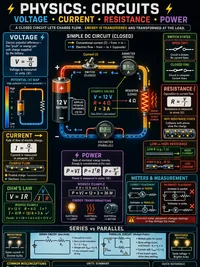
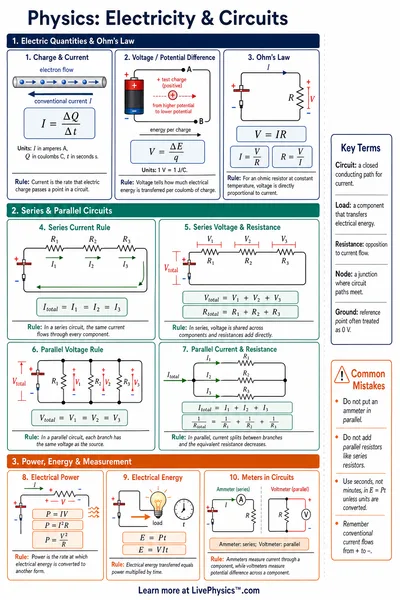
A circuit works because electric charge is pushed through a closed path. Voltage is the energy available to move each unit of charge, while current describes how much charge passes a point each second.
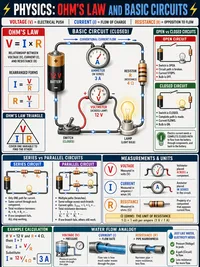
A battery creates a voltage difference between its terminals, but current flows only when conducting parts make a complete loop. Wires have very low resistance, so they guide charge easily, while components such as lamps, heaters, and resistors limit the current or change energy into other forms.
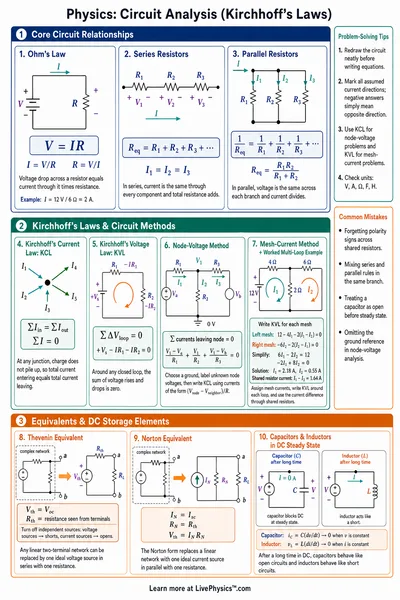
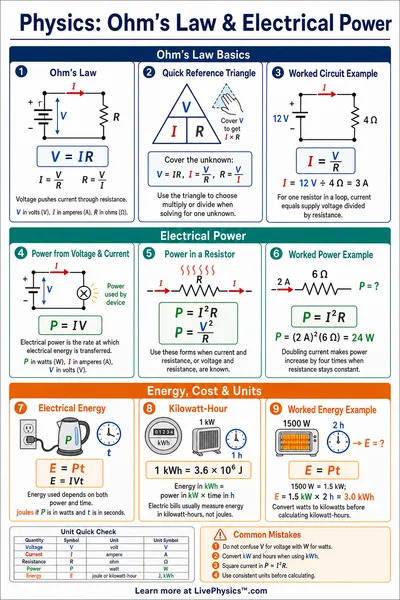
Ohm's law is a useful model for many resistors. It states that voltage equals current times resistance. This means a larger resistance allows less current for the same supply voltage, while a larger voltage produces more current through the same resistance.
Real components do not always follow this rule exactly. Filament lamps heat up as current rises, and their resistance changes with temperature. Diodes, motors, and batteries have more complex behaviour, so results from the law are often a starting estimate rather than a perfect prediction.
Electrical power tells you how quickly electrical energy is transferred. Power equals voltage times current. A high-power appliance transfers energy rapidly, often as heat, light, sound, or motion.
This matters for safety because wires and components can become dangerously hot when too much current flows. A fuse is chosen to break the circuit before the wiring overheats. Power ratings on chargers, lamps, and appliances help you judge whether a component can operate safely in a particular circuit.
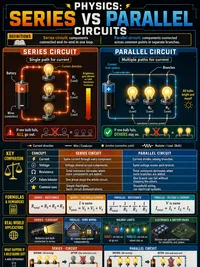
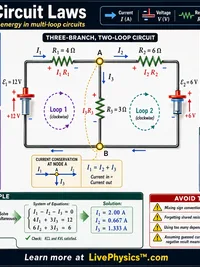
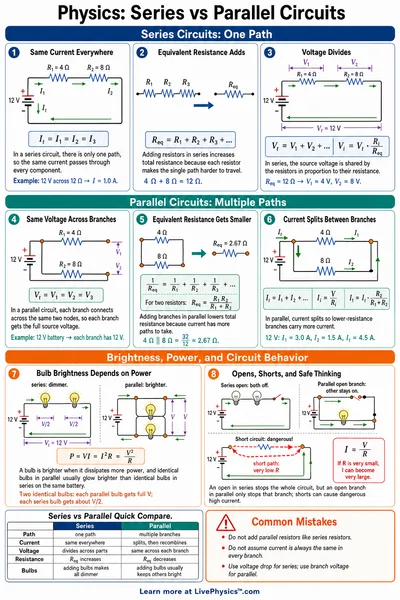
In a series circuit, every component lies on one path, so the same current passes through each one. The total resistance is found by adding the individual resistances, which makes the current smaller than it would be with only one resistor. The supply voltage is shared between the components.
A resistor with a greater resistance has a greater voltage drop because it needs more energy per unit charge to push the same current through it. If one part of a simple series circuit breaks, the complete path is opened and all current stops.
Parallel branches give charge more than one route through a circuit. Each branch has the same voltage across it, but the current divides between branches according to their resistances. Adding another parallel branch lowers the equivalent resistance because it creates an extra route for charge.
This is why household circuits use parallel connections. One lamp can be switched off or fail without stopping other appliances.
When using a circuit calculator, check the units carefully and identify the connection pattern before entering values. Milliamps, kilohms, and watts are common sources of mistakes, especially when prefixes change a value by factors of one thousand.