Bar Model Word Problems Lab
Use bar models to represent and solve word problems. Explore part-part-whole and comparison diagrams, record your results, and discover which model fits each situation.
Guided ExperimentBar Model Investigation
Before you start, predict, when would you use a Comparison bar model instead of a Part-Part-Whole model? Write your prediction.
Write your hypothesis in the Lab Report panel, then click Next.
Controls
Choose a Word Problem
Word Problem
Sam has 15 red marbles and 8 blue marbles. How many marbles does Sam have in all?
Bar Model Diagram
Reference Guide
What Is a Bar Model?
A bar model is a drawing that uses rectangles to represent numbers in a word problem. Each rectangle (or bar) shows a value, and the arrangement of the bars shows the relationship between the values.
Bar models help you see whether to add, subtract, multiply, or divide before you calculate anything.
Part-Part-Whole Model
Use this model when a total is made up of two or more parts. One long bar represents the whole, divided into labeled sections for each part.
If you know the parts, add to find the whole. If you know the whole and one part, subtract to find the missing part.
Key words in all, altogether, total, how many left, how many remain.
Comparison Model
Use this model when comparing two amounts. Two separate bars are drawn side by side. A bracket or arrow shows the difference between them.
Subtract the smaller value from the larger to find the difference. If the difference is known, add or subtract to find the missing bar.
Key words how many more, how many fewer, how much longer, how much shorter.
Choosing the Right Model
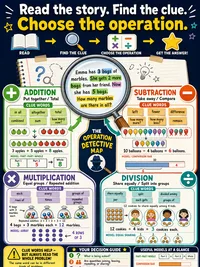
Read the problem carefully. Ask, "Is this about combining or splitting one group, or about comparing two groups?"
- One group with parts combined or separated - Part-Part-Whole
- Two groups being compared to find a difference - Comparison
The unknown can be a part, a whole, or a difference. Label it with a question mark in your diagram.