Trigonometric & Polar Functions Lab
Investigate sinusoidal functions, inverse trig operations, and polar curves through guided experiments. Adjust parameters with sliders, observe real-time graph changes, collect data, and build lab reports.
Guided ExperimentAmplitude and Period Investigation
If you change the amplitude A and frequency parameter B of y = A·sin(Bx), what do you predict will happen to the graph's height and width?
Write your hypothesis in the Lab Report panel, then click Next.
Sinusoidal Function Graph
Controls
Sinusoidal Analysis
Data Table
(0 rows)| # | Trial | Function | Type | Amplitude/a | Period/b | Phase/C | Shift/D | Key Features |
|---|
Reference Guide
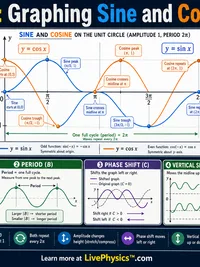
Sinusoidal Parameters
The general sinusoidal function has four key parameters that control its shape.
- A (amplitude) controls the height of the wave. |A| is the distance from the midline to the peak.
- B (frequency) controls how many cycles fit in 2π. The period is 2π/B.
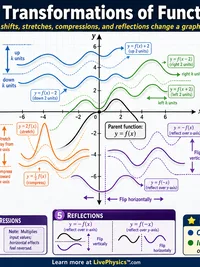
- C (phase shift) translates the graph horizontally. Positive C shifts right.
- D (vertical shift) moves the midline up or down.
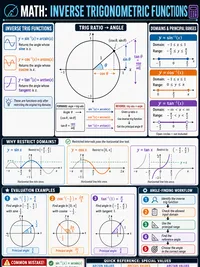
Inverse Trig Functions
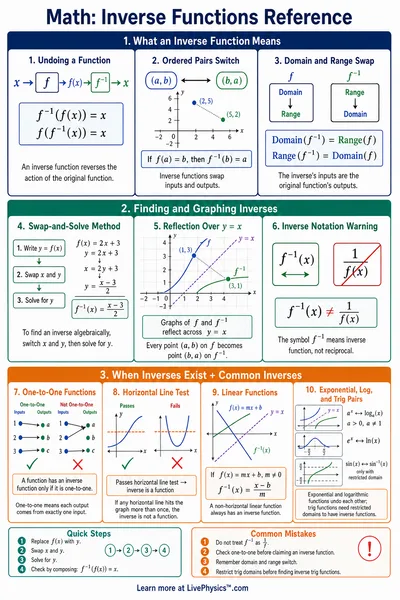
Inverse trig functions reverse the standard trig functions on restricted domains.
The composition f(f⁻¹(x)) = x always holds on the domain, but f⁻¹(f(x)) = x only on the restricted domain.
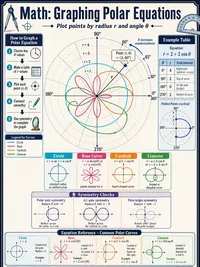
Polar Curve Types
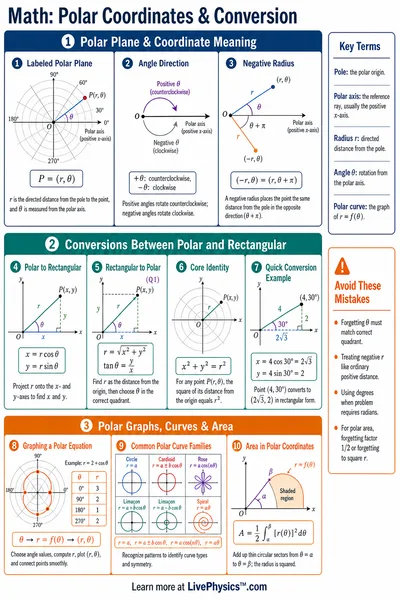
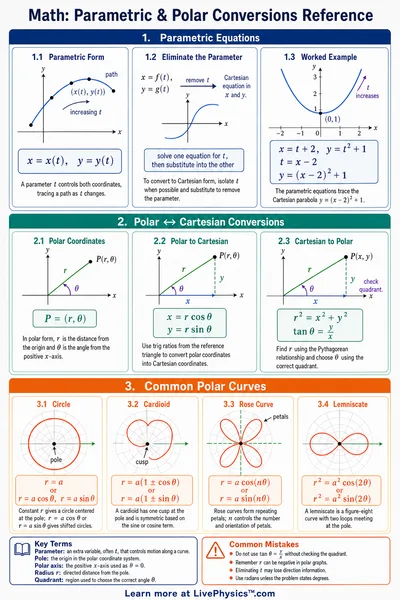
Polar curves are defined by r = f(θ). The shape depends on the equation form.
- Cardioid r = a + a·cos(θ) passes through the origin once
- Limaçon r = a + b·cos(θ) has an inner loop when |a| < |b|
- Rose r = a·cos(nθ) has n petals (odd n) or 2n petals (even n)
- Spiral r = aθ grows outward with each revolution
- Lemniscate r² = a²·cos(2θ) is a figure-eight shape
Polar-Rectangular Conversion
Convert between polar (r, θ) and rectangular (x, y) coordinates.
When converting θ, use atan2(y, x) to get the correct quadrant. The angle θ is measured counterclockwise from the positive x-axis.