Number Bonds and Fact Families Builder
Explore how two parts always add up to a whole. Fill in the missing number, then see all four related addition and subtraction facts. Three difficulty levels for grades K through 3.
Choose a level
Fill in the missing part!
Tip Use the up/down arrows inside the circles, or type a number directly.
Reference Guide
What Are Number Bonds
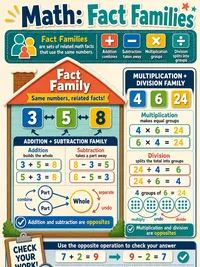
A number bond shows how a whole number is made of two smaller parts. One circle at the top holds the whole. Two circles below hold the parts.
- The whole is the total amount.
- The parts are the two groups that make it.
- The two parts always add up to the whole.
Number bonds help you see addition and subtraction as two sides of the same relationship.
Part-Part-Whole
Every number bond has a part-part-whole structure. For example, with 3, 4, and 7
- Part 3
- Part 4
- Whole 7
If you know the whole and one part, you can always find the missing part by subtracting. If you know both parts, you add to find the whole.
Fact Families
A fact family is a set of four equations that all use the same three numbers. For 3, 4, and 7
- 3 + 4 = 7
- 4 + 3 = 7
- 7 - 3 = 4
- 7 - 4 = 3
Memorizing one fact means you already know three others. This is why addition and subtraction are called inverse operations.
Using Subtraction to Find a Part
When you know the whole and one part, use subtraction to find the other part.
- Whole is 10, one part is 6. The other part is 10 - 6 = 4.
- Whole is 15, one part is 8. The other part is 15 - 8 = 7.
Think of it as "counting up" from the known part to the whole. How many more do you need to reach the whole?