Game Theory Payoff Matrix Explorer
Edit a 2x2 payoff matrix and the tool marks each player's best responses, highlights the pure Nash equilibria, reports any dominant strategy, and solves for the mixed-strategy equilibrium. Load classic games like the prisoner's dilemma, stag hunt, chicken, and matching pennies, then watch repeated strategies such as tit for tat compete in an iterated prisoner's dilemma and a round-robin tournament.
Controls
Classic games
Iterated prisoner's dilemma matchup
New run reseeds the Random strategy. Other strategies are deterministic.
Payoff matrix
| Player 2 | |||
|---|---|---|---|
| Player 1 | , | , | |
, | , | ||
Edit any payoff. An underlined value marks that player's best response in that row or column. A cell where both values are underlined is a pure Nash equilibrium.
Equilibrium analysis
Pure Nash equilibria
- DefectvsDefect(1, 1)
Dominant strategies
- Player 1. Defect dominates
- Player 2. Defect dominates
Mixed-strategy Nash equilibrium
No interior mixed equilibrium. This happens when a player has a strictly dominant strategy.
Iterated prisoner's dilemma
Payoffs use T=5, R=3, P=1, S=0. Player A plays Tit for Tat, player B plays Always Defect for 50 rounds.
Player A
Tit for Tat
49
Player B
Always Defect
54
leads
Per-round moves
Round-robin tournament (each strategy plays every strategy)
Reference Guide
Normal-form games and payoff matrices
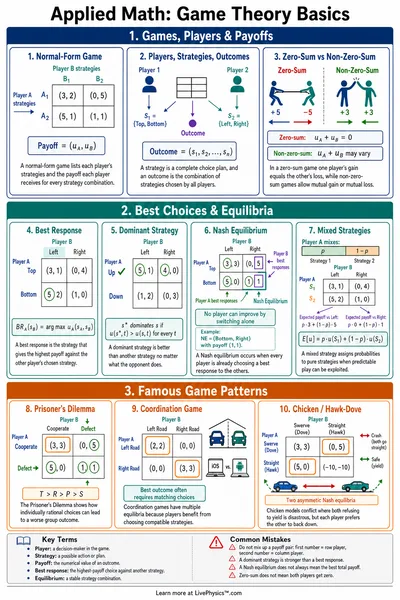
A normal-form game lists the players, the choices each can make, and the payoff each receives for every combination of choices. In a 2x2 game two players each pick one of two strategies.
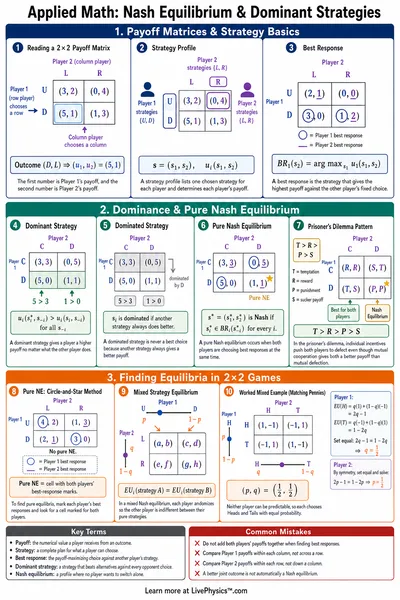
The payoff matrix shows both payoffs in each cell. The first number goes to player 1 who picks the row, the second to player 2 who picks the column.
Best responses and dominant strategies
A best response is the choice that maximizes a player's payoff given what the other player does. The tool underlines each player's best-response payoff so you can read the structure off the matrix.
A strictly dominant strategy is a best response no matter what the opponent picks. When a player has one, rational play is settled before the game even begins.
Pure Nash equilibria
A Nash equilibrium is a choice for every player where no one can do better by switching alone. In a pure equilibrium each player commits to a single strategy.
A cell is a pure Nash equilibrium exactly when both payoffs are best responses, so both values are underlined. A game can have zero, one, or several pure equilibria.
Mixed-strategy equilibria
When no pure equilibrium exists, players randomize. In a mixed equilibrium each player chooses probabilities that keep the opponent indifferent between their two options.
The tool solves the 2x2 closed form. Player 1 plays the first row with probability p, player 2 the first column with probability q, and it reports the expected payoffs.
The prisoner's dilemma
In the prisoner's dilemma defection strictly dominates cooperation for both players, so the only Nash equilibrium is mutual defection.
That outcome pays both players less than mutual cooperation would. The dilemma is that individual rationality leads to a jointly worse result.
Other classic games
- Stag hunt. Two equilibria, one safe and one rewarding, model the tension between trust and caution.
- Chicken. Each player wants the other to yield, with the worst outcome when neither does.
- Matching pennies. A zero-sum game with no pure equilibrium, only a 50-50 mix.
- Battle of the sexes. Two players prefer to coordinate but disagree on which option.
The iterated prisoner's dilemma and tit for tat
When the prisoner's dilemma repeats, cooperation can pay because today's choice shapes the opponent's future moves. The tool runs the chosen strategies for a set number of rounds and shows the move history and cumulative scores.
Tit for tat cooperates first, then copies the opponent's last move. It is simple, never defects first, and punishes defection once before forgiving. Grim trigger is harsher and defects forever after any betrayal. The round-robin tournament pits all five strategies against each other so you can compare totals.